Google Makes Workspace Agent Gateways Generally Available as Approval Moves Into the Access Layer
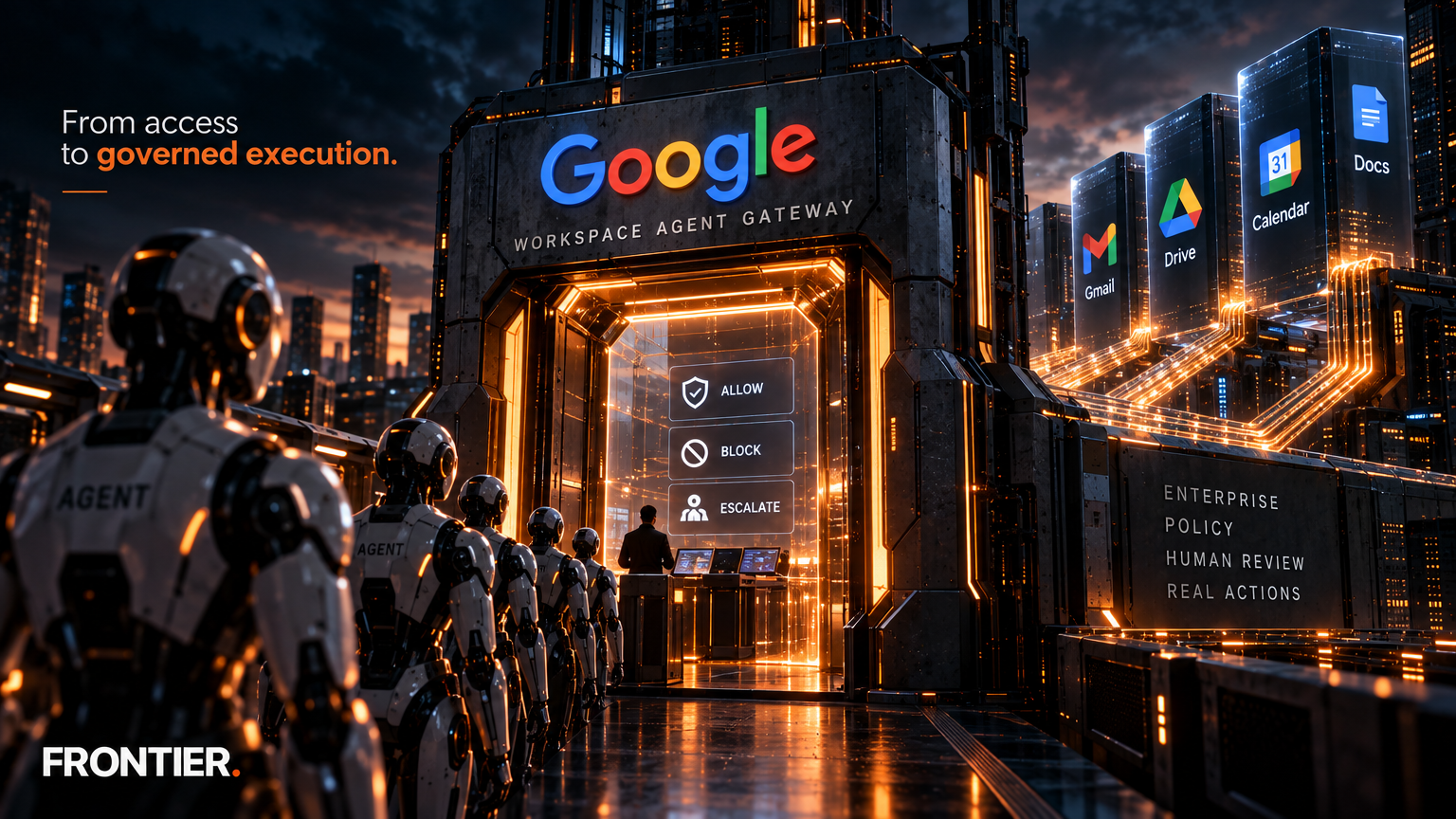
Google has released Workspace MCP servers and a command-line interface that place administrative policy and human review between external AI agents and actions across Gmail, Drive, Calendar and other Workspace applications. The larger shift is from governing what agents can access to governing what they can execute.
Take the argument with you.
Read the publication-ready report. Generated from the canonical News article.
What changed
Google made its Workspace Model Context Protocol servers and Workspace CLI generally available on November 24, 2026, creating standardized paths through which external AI agents can act across Gmail, Drive, Docs, Sheets, Slides, Calendar, Chat and Tasks.1 The release is broader than a pre-send approval feature for Gmail: it introduces an administrator-governed execution layer covering multiple applications and several kinds of consequential action.
Through these paths, administrators can classify categories of external-agent activity as Allow, Require user approval or Block. External collaboration, including sending email to an external recipient, defaults to Require user approval.2 Google's developer documentation says the servers can present a human-review step before an agent sends email, modifies a shared calendar event, shares or trashes a file, or accesses shared data.3 The Next Web highlighted email sending as one of the sensitive actions subject to confirmation under the new controls.4
The approval is not universal. These user-review policies apply to external agents using Workspace MCP tools or the Workspace CLI, while standard application connections do not use the same rules.2 Administrators can also determine how persistent an approval may be. Where policy permits it, a user can choose an Always allow option lasting as long as 90 days; an administrator can instead require confirmation every time.2 That distinction matters because the release does not attach an unconditional prompt to every AI-assisted Gmail message. It gives administrators policy choices for qualifying agent connections.
Google says policy evaluation can incorporate existing Workspace permissions, data-loss-prevention rules and classification labels, and that administrative audit logs can record agent actions and user confirmations.1 Those are vendor claims about the control surface and should be tested against each organization's configuration, licensing and logging requirements rather than assumed from the availability announcement alone.
Google has also said that AI agents must migrate from direct Workspace REST API access to the MCP servers or CLI, with technical enforcement beginning February 1, 2027.5 CyberTech Edition separately reported the same enforcement date and the use of human confirmation for sensitive actions.6 The deadline turns the release from an optional developer convenience into a migration issue for organizations that have built or bought agents using direct API paths.
Why it matters
The immediate CIO choice is not simply whether to enable another AI feature. It is whether an agent that can send, share, modify or delete should reach Workspace through an execution path where central policy can intervene at the moment of action. Model quality and data permissions remain important, but neither answers whether an agent should be allowed to send an external message, alter a shared meeting or discard a file without another decision point.
That creates a practical divide between information access and operational authority. An agent that retrieves a document for summarization presents a different risk from one that shares the document, even if both use the same underlying account permissions. Google's controls let administrators distinguish among action categories and choose whether to permit, interrupt or prohibit them.2 CIOs therefore need an inventory that records not only which systems an agent can read, but which state-changing tools it can invoke, through which connection type and under whose identity.
Human approval is useful only when it is attached to a meaningful boundary. Requiring confirmation for every low-risk action can train users to approve prompts reflexively and undermine the operating benefit of automation. Allowing a reusable approval for up to 90 days, however, can turn a nominally supervised action into extended autonomy.2 The appropriate setting depends on the consequence and reversibility of the action: sending an external email, sharing classified material or trashing a file warrants a different policy from retrieving a user's own calendar entries. The architecture now supports that distinction, but administrators still have to define it.
CIOs must also examine coverage. The new review rules govern external agents using MCP or the CLI, not every application integration connected to Workspace.2 A procurement review that asks only whether a product “integrates with Google Workspace” is therefore insufficient. Buyers need to establish whether the product uses the governed path, a standard application connection or another mechanism, and whether its write operations are visible to the controls and logs on which the organization intends to rely.
The February 1, 2027 enforcement date adds a build-versus-migrate decision. Organizations with custom agents using direct Workspace REST APIs must determine whether to refactor them for MCP, move them to the CLI where appropriate, retire them or constrain their functions before enforcement begins.5 Purchased agents require a parallel vendor conversation: customers need migration dates, supported action categories and evidence that approval and audit behavior work as represented. Waiting until enforcement approaches could combine technical migration with policy design and user testing in one compressed program.
The tradeoff is bounded autonomy rather than autonomy versus no autonomy. A centrally controlled gateway can permit routine actions while reserving sensitive ones for approval or blocking them outright. That makes it possible to fund agent deployments whose authority expands in stages, provided the execution path exposes policy controls. Conversely, an agent with impressive capabilities but an opaque or uncovered action path may deserve deferral until its operational authority can be governed.
Frontier take
Google's release marks a shift in where enterprise agent control is implemented: the decisive policy boundary is moving into the access and execution layer between an agent and the application it can change. That layer matters more than an approval dialog by itself because it can apply one administrative policy to external agents attempting several kinds of action across multiple Workspace applications.1
The strong conclusion is that governed execution paths should become a prerequisite for consequential enterprise agents. Application permissions establish what an identity may do, but an agent acting through that identity can operate with a speed, persistence and scope different from an occasional human action. An intermediary capable of evaluating the attempted operation can narrow that authority without eliminating the useful parts of automation. In Google's implementation, administrators can allow, require approval or block categories of activity, while the server can request human review for actions such as sending email or sharing and trashing files.23
This does not prove that every action will be safe or that a human confirmation will be well judged. It also does not eliminate the need to secure agent credentials, limit application permissions or test agent behavior. The more defensible inference is narrower: organizations now have a concrete architectural option for applying policy when an external agent attempts to act, and Google plans to require its standardized paths instead of allowing direct REST API access for these agents after February 1, 2027.5
The design also reveals where governance can become superficial. If users can persist an Always allow choice for 90 days, an organization may retain the appearance of human oversight while removing review from most subsequent actions.2 If an integration uses a connection outside the rules' scope, administrators may assume controls exist where they do not. And if audit records lack the context needed to reconstruct the agent's action and the user's decision, logging alone will not provide useful accountability. These are implementation questions CIOs should test, not reasons to reject the gateway model.
The strategic value lies in separating agent capability from agent authority. Teams can adopt a capable model without granting every supported action on day one. They can allow retrieval, require approval for external communication and block destructive operations, then expand authority after observing real behavior. Google's claim that the checks can use Workspace permissions, DLP rules and classification labels suggests a path for connecting agent controls to existing information-governance policy, although customers should validate that behavior in their own environments.1
This pattern should shape purchases beyond Google Workspace as an architectural requirement, not as proof that all MCP implementations provide equivalent safeguards. CIOs should ask whether an enterprise system exposes a policy-controlled action layer, which operations it covers, how exceptions work and what evidence it records. The relevant unit of evaluation is no longer only the model or agent product. It is the complete execution path from an agent's request to the application action.
Three moves for CIOs
-
— Map execution paths before migrating agent code Create an inventory of every agent that can act on Workspace data, recording the applications touched, read and write operations, connection type, acting identity and current owner. For direct REST API implementations, choose explicitly among migration to Workspace MCP, use of the CLI where appropriate, removal of write authority or retirement.
- Decision trigger: Begin remediation when an agent can send email, share or trash files, modify shared calendar events, or otherwise change Workspace state through a direct API or an unidentified connection path.
- Why now: Google says direct Workspace REST API access for AI agents will face technical enforcement beginning February 1, 2027.5 An early inventory separates straightforward protocol work from agents whose authority, ownership or business value needs to be reconsidered.
-
— Set approval duration by consequence, not convenience Define an action matrix that assigns Allow, Require user approval or Block according to recipient boundary, data classification, reversibility and shared-resource impact. Disable persistent Always allow decisions for high-risk categories and require confirmation each time where a mistaken action would cross an external or destructive boundary.
- Decision trigger: Apply the stricter policy when an action sends content externally, changes a shared calendar, exposes shared data, or shares or trashes a file; relax it only after evidence shows that the action is bounded and readily reversible.
- Why now: Workspace permits administrators to govern action categories, but users may be allowed to save an approval for as long as 90 days.2 Policy choices made during rollout will determine whether human review remains an actual control or becomes a one-time consent.
-
— Make governed-path evidence a procurement gate Require agent vendors and internal teams to demonstrate the exact Workspace connection used, the actions covered by approval policy, the treatment of blocked actions and the resulting administrative records. Test representative external, shared and destructive operations in a controlled environment rather than accepting a general claim of Workspace integration.
- Decision trigger: Withhold production write access whenever a supplier cannot show that consequential actions travel through Workspace MCP or the CLI, or when the proposed standard application connection falls outside the user-review rules.
- Why now: Google's review policies do not apply to every kind of application connection.2 Establishing proof at procurement and release gates prevents organizations from buying apparent governance that does not cover the agent's actual execution path.
Sources
- Google Workspace Blog — Built for trust and control: New AI agent protections and developer tools in Google Workspace 1
- Google Workspace Updates — Simplifying agent access while keeping organizations in control 5
- Google Workspace Admin Help — Manage AI agent access and user review 2
- Google for Developers — Configure the Google Workspace MCP servers 3
- The Next Web — Google will make AI agents use new gateways to reach Gmail and Drive 4
- CyberTech Edition — Google Will Require AI Agents to Use Workspace MCP Servers or CLI From Feb. 1, 2027 6
[^google-workspace-blog][^google-admin-help][^google-mcp-configuration][^google-workspace-updates]