Air Force Cloud One breach is a warning for national cyber resilience
A breach of the Air Force’s defense cloud raises questions far beyond one platform. As AI accelerates vulnerability discovery and institutions confront overlapping incidents, CIOs and CISOs must prove they can preserve essential services and restore trusted control—even when their normal security and administration systems are under containment.
Take the argument with you.
Read the publication-ready report. Generated from the canonical News article.
What changed
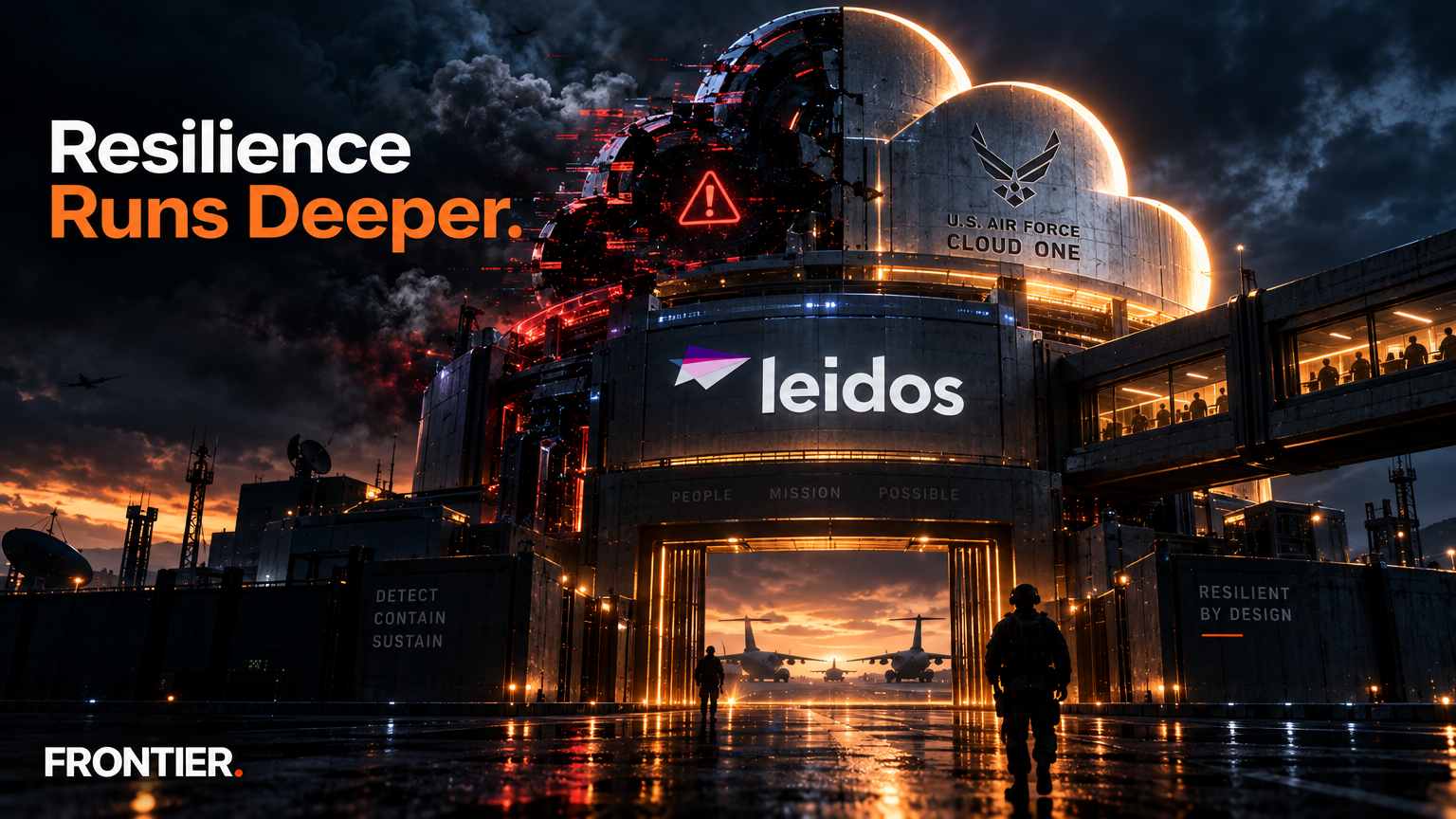
Hackers have penetrated the U.S. Air Force’s Cloud One platform, bringing the widening cyber crisis into a defense cloud built to demanding military security requirements. The immediate damage remains uncertain. The strategic warning is clearer: a highly protected environment can face a breach that constrains the very administrative capabilities needed to keep it secure. For CIOs and CISOs, that raises a question with national implications: can essential institutions keep operating when the systems that authorize, update and restore their technology become suspect?
Reuters reported on November 27 that discovery during upgrades had prompted migration pauses, blocked application updates and withdrawal of some administrator privileges. One source described access to the control plane through an unidentified software vulnerability. Reuters could not establish the attackers, full scope or data theft.1
The Associated Press reported on November 28, citing an unnamed person familiar with the incident, that the intrusion occurred early in 2026, had been mitigated, and had affected neither mission-critical nor classified systems. AP also reported involvement by the White House’s National Security Council and Homeland Security Council. That limited-impact account belongs at the center of the assessment, alongside the reported administrative disruption.2 The Air Force declined to discuss specific systems; the Pentagon said mission-critical operations would continue.3
The precise intrusion and discovery timeline, dwell time and affected security boundaries remain unresolved. Nor does it establish an AI role in this breach or a compromise of any cloud provider’s underlying infrastructure.
Cloud One’s security ambitions explain why this matters beyond another incident headline. In 2024, the Air Force described a platform designed for defense security requirements and zero trust, with standardized controls and support for workloads up to Secret. In a 2023 commentary, Cloud One leadership claimed a perfect defensive record against roughly 10 million annual penetration attempts. That was a historical program claim, not an independent audit, but it captures the confidence invested in this architecture.45
Cloud One was engineered for unusually demanding defense responsibilities. Its safeguards, mission responsibilities and influence on other government cloud programs give this breach unusual weight, even if the reported containment successfully protected critical missions.
Leidos announced a $454.9 million modernization contract in March 2026 spanning AWS, Microsoft Azure, Google Cloud and Oracle Cloud Infrastructure, with goals of stronger security, more automation and simpler operations.6 The public evidence does not assign fault to Leidos or a particular provider. It does establish the standard that modernization now needs to meet: demonstrate how trusted control survives an intrusion, not merely how efficiently applications migrate.
Why it matters
The first stake is military readiness. Cloud One leadership has described its role supporting the Theater Integrated Combat Munitions System across 210 locations.5 That does not mean this application was compromised. It explains why the platform deserves scrutiny: the quality, availability and integrity of administrative services can matter to the institutions responsible for moving people, equipment and supplies.
In a future incident, a sustained inability to update software, validate records or restore trusted access could become a readiness constraint without an immediate application outage. Loss of confidence in data could force operators to slow decisions or reconcile information manually. These are plausible consequences to prepare for, not established outcomes of the Cloud One breach. Security leaders need to distinguish confidentiality, integrity, service availability and the ability to make trusted changes; each can fail differently.
The second stake is the economics of shared assurance. Cloud One’s appeal includes inheritable security controls: the Air Force described customers inheriting 30–40% of a cybersecurity package, potentially rising to 70–80% under Operation Swift Shield.4 Centralization can reduce duplicated work and improve protection. But the security services that many organizations inherit can also become dependencies that many must recover together.
This is where conventional multicloud thinking falls short. Placing workloads with different providers does not create independent recovery if they share the same identity authority, deployment pipeline, policy engine or administrator. Geographic redundancy protects against some failures; it cannot by itself resolve doubt about who is authorized to control every replica. Diversification must be evaluated at the level of authority and recovery dependencies, as well as compute capacity.
The third stake is the speed mismatch exposed by the wider cyber crisis. Frontier’s Black October analysis argued that recovery requires restoring trust in code, keys, identities and operating environments. A patch closes a vulnerability; it does not automatically invalidate stolen credentials, remove persistence or prove that a release pipeline is clean.7 Cloud One brings that argument into defense modernization. A system can remain available while its operators are constrained in how safely they can change it.
AI makes that mismatch harder to ignore. Anthropic reports that its Project Glasswing partners uncovered at least 129,000 verified software vulnerabilities from April through July 2026. The figures come from partial partner reporting with differing triage practices; they are not a count of breaches or distinct CVEs.8 More revealing than the headline total is Anthropic’s disclosure dashboard, which explicitly identifies human review and triage capacity as a bottleneck between discovery and reporting.9
Google and Wiz’s October PHP research supplies a separate example: Google said AI contributed to vulnerability discovery, exploit development, detection and patch validation.10 Those are defensive advances. They also demonstrate that capabilities across the vulnerability lifecycle are improving together. In November 2025, Anthropic separately reported an espionage campaign using AI for much of its tactical work, while humans retained critical decisions and model errors persisted.11 None of this attributes Cloud One to AI. It changes the environment in which the next incident must be managed.
The strategic bottleneck is therefore moving toward the organization’s capacity to act safely on what it learns. Discovery can scale faster than application ownership, regression testing, credential replacement and coordinated recovery. More findings are valuable only if the resulting exposure can be reduced. If the administrative environment is itself under containment, remediation demand can rise just as the capacity to deliver fixes falls.
The timing matters: AP also places Cloud One alongside separate intrusions involving an unclassified CIA system and the FBI’s national law-enforcement database. Those reports do not establish a common actor or cause.2
That is the pathway from an enterprise security problem toward a potential national security emergency. The danger is not simply a higher breach count. It is concurrent loss of trusted services across institutions, compounded by exhausted response teams, shared suppliers and interrupted recovery channels. Electricity, telecommunications, transport, finance and government operations need not fail completely for delays and uncertainty to reinforce one another.
Deliberate disruption of critical infrastructure is an established threat model; the broader cascade described here is a preparedness scenario, not a claim that it is unfolding. In 2024, CISA, NSA and partners assessed that Volt Typhoon had compromised U.S. critical infrastructure, in some cases retaining access for years to prepare for disruption during a crisis or conflict.12 That advisory provides no attribution for Cloud One. It explains why governments and enterprises must plan for coordinated disruption rather than assume every incident will arrive alone.
Cloud One illustrates a condition that could magnify such a crisis: losing trusted administrative freedom precisely when rapid repair is most necessary.
Frontier take
Frontier’s assessment is that this incident should become a turning point in how enterprises evaluate cloud resilience. Its eventual historical importance will depend on facts still unavailable. Its immediate value is the test it poses to a widespread assumption: that strong preventive controls and continued application uptime together constitute adequate assurance.
Containment can be evidence that defenses worked. If the limited-impact account holds, protecting critical and classified systems would be an important result. The right response is to learn which boundaries held and whether recovery remained effective, rather than treat every restriction as a security failure. Conversely, an application that still responds is not sufficient proof that the organization can investigate, repair or safely administer it.
The new acceptance criterion should be straightforward: can the organization re-establish trustworthy authority over essential services while its normal management environment is unavailable or under investigation? NIST’s cyber-resiliency guidance already frames the problem around withstanding compromise, sustaining essential functions and recovering trustworthy resources.13 Cloud One gives boards and procurement teams a concrete reason to demand evidence of those outcomes.
That should change spending. Incremental detection coverage remains useful, but recovery engineering needs an explicit budget: independent emergency administration, protected evidence, verified software provenance, segmented privileges and rehearsed service restoration. Otherwise, the organization risks becoming better at discovering conditions it still cannot safely resolve.
It should also change the managed-services market. An uptime commitment does not establish that a provider can support emergency changes during containment. Buyers should ask how evidence is obtained, how customers regain clean administrative access, which controls share dependencies, and how scarce recovery staff are allocated when many clients need them simultaneously. Contractual promises should be backed by exercises involving the actual provider and customer teams.
Leidos’ modernization program is a prominent test of that principle. Centralized security and automation can improve defense; their success should include demonstrated limits on the reach of a compromise and reliable routes back to trusted operation.6 The same expectation belongs in enterprise platform programs. It is more useful than attributing an incident to a contractor before the technical facts are known.
AI-assisted defense should be measured against that recovery burden. Use it to accelerate asset discovery, dependency analysis, evidence triage and patch testing. Bound its production permissions and independently validate its outputs. Granting a defensive agent unrestricted authority over the same identity, deployment and recovery systems would create another concentrated dependency. Speed without controlled authority can amplify an error as efficiently as it removes exposure.
For national preparedness, the change is equally practical. Private operators and public agencies need exercises in which several incidents compete for the same people, communications channels and suppliers. Sector coordination must include restoration priorities and resource constraints, not only exchange of threat indicators. An adversary need not breach every institution if disruption of a few shared dependencies prevents many others from recovering.
The warning from Cloud One is not that defense-grade cloud has become futile. It is that assurance must survive contact with compromise. The institutions best prepared for the next phase of the cyber crisis will be those that can prove what remains trustworthy, preserve essential functions and restore control under pressure.
Three moves for CIOs and CISOs
-
Prove that critical services can be recovered without the normal management plane.
CIO: Within 30 days, select the organization’s five most important business or mission services and run a controlled exercise with their usual identity or deployment service unavailable. Agree with business owners which functions must continue, which may pause, and the maximum tolerable interruption.
CISO: Demonstrate separately controlled emergency credentials, clean administrative devices, protected logs and a verified path for delivering an urgent fix. Preserve tightly scoped permissions, dual approval and auditability; emergency access must not become a permanent backdoor.
Decision trigger: If disabling one shared authority removes every approved route to investigation, patching or restoration, treat that dependency as a funded architecture defect. Require evidence that the chosen continuity target was met, not a completed tabletop checklist.
Why now: The reported update and privilege restrictions make management capability a necessary part of the resilience test.1 The 30-day timetable is Frontier’s recommendation.
-
Make supplier renewal and modernization funding depend on demonstrated recovery.
CIO: At the next major platform milestone or renewal, require a joint recovery exercise and explicit commitments for emergency change capacity, evidence delivery, restoration support and concurrent-customer incidents. Map shared dependencies across providers before paying for additional multicloud redundancy.
CISO: Require proof that routine administration, security investigation and recovery do not all depend on the same compromised credentials or trust service. Test restoration from verified configurations and credentials, including the ability to exclude suspect artifacts and revoke old sessions.
Decision trigger: Where a provider cannot demonstrate an independent recovery path within the business’s tolerance, require a remediation plan, an alternative operating mode or explicit executive acceptance of the exposure before expanding dependency.
Why now: Modernization spending can otherwise deepen concentration while improving only normal operating efficiency. Recovery evidence makes security and continuity promises testable.
-
Prepare for simultaneous incidents as an executive continuity problem.
CIO: Bring operations, finance, critical suppliers and continuity leaders into a scenario where a cloud-management incident coincides with a communications or software-supply-chain disruption. Establish service priorities, fallback capacity, staffing and authenticated communications outside the affected environment.
CISO: Pre-agree escalation with the relevant national authorities and sector information-sharing bodies. Track essential services operating in degraded mode, time to restore trusted administration, and urgent remediation blocked by containment. Use AI to reduce analysis and testing delays within bounded permissions.
Decision trigger: Escalate when essential-service recovery is projected to exceed approved tolerances, multiple critical dependencies are affected, or the team cannot establish trustworthy control. Coordinate decisions before technical queues consume the remaining response capacity.
Why now: A cluster of individually manageable incidents can become a systemic emergency when organizations exhaust their ability to restore service. Planning for that condition is warranted without claiming that Cloud One proves it has already arrived.
Sources
- Reuters, via Military Times — Cloud One breach and reported administrative disruption, November 27, 2026 1
- Associated Press — Limited-impact account and investigation; also available via ABC News, November 28, 2026 2
- CBS News — Air Force and Pentagon statements, November 27, 2026 3
- U.S. Air Force — Cloud One security architecture and inherited controls, September 12, 2024 4
- Cloud One Leadership, FedScoop — Mission applications and historical security claims, February 8, 2023 5
- Leidos — $454.9 million Cloud One modernization announcement, March 11, 2026 6
- Frontier Research — Black October: The Enterprise Survival Manual, October 22, 2026 7
- Anthropic — Cyber Verification Program and partner-reported vulnerability findings, October 6, updated November 18, 2026 8
- Anthropic — Coordinated vulnerability disclosure dashboard, November 2, 2026 snapshot 9
- Google Cloud — AI-assisted PHP vulnerability research and remediation, October 21, updated October 23, 2026 10
- Anthropic — Reported AI-orchestrated espionage campaign, November 13, 2025 11
- NSA, CISA and partners — Volt Typhoon and critical-infrastructure disruption risk, February 7, 2024 12
- NIST SP 800-160 Vol. 2 Rev. 1 — Developing Cyber-Resilient Systems, December 2021 13
[^reuters-via-military-times][^associated-press][^aflcmc-cloud-one][^cloud-one-leadership][^leidos-announcement][^frontier-black-october][^anthropic-cvp][^anthropic-cvd][^google-php][^anthropic-espionage][^nsa-volt-typhoon][^nist-resilience]