Black October: The Enterprise Survival Manual
A 0–72-hour trust-restoration and 365-day assured cyber-resilience playbook for CIOs, CISOs, SecOps and business continuity leaders confronting PHP2Shell, eMudhra, Railway, LiteLLM and Zeabur.
Take the argument with you.
Read the publication-ready report or watch the rapid-fire Frontier briefing. Both are generated from the canonical Research Object.
FRONTIER RESEARCH | FLAGSHIP FIELD MANUAL | FR-030 (provisional identifier) | 22 October 2026 | Evidence cutoff: 22 October 2026, 12:00 UTC
For CIOs, CISOs, security operations, SRE/platform engineering, enterprise architecture, legal, corporate communications, business continuity, and boards.
Status: Initial industry analysis; not an incident-specific legal opinion or substitute for vendor incident advisories.
THE FRONTIER THESIS. The patch is not the recovery. The recovery is the provable restoration of authority: trusted code, trusted keys, trusted identities, known-clean runtimes, verifiable telemetry, and a business that can keep operating while those foundations are being rebuilt. Black October exposes an enterprise operating model in which a single compromised provider, build pipeline, certificate issuer, or administrator can outrun an organization's capacity to revoke trust.
The five-minute executive decision sheet
Declare a cross-functional cyber stability event now if material exposure exists. This need not mean declaring a breach: distinguish affected, exploited, compromised, and unknown. Assign a single incident commander and individual leads for containment, forensics, identity/secrets, software supply chain, platform recovery, business continuity, and communications. Use an out-of-band command channel, authenticated against a different trust boundary than the potentially compromised corporate identity platform.12
Within the first hour: (1) identify business-critical internet-exposed PHP and other affected services; (2) choose patch, isolation, or approved shutdown for each; (3) freeze unverified emergency software pulls; (4) block compromised artifact versions and untrusted registries; (5) identify and revoke high-risk exposed secrets, tokens and signing privileges from clean administrator workstations; (6) preserve evidence before destroying potentially compromised hosts; (7) activate a written business and stakeholder communications cadence. If an affected PHP service cannot be made safe promptly, the NSA explicitly recommends taking it offline until mitigation is complete; it does not instruct every organization to switch off its entire website estate.34
Within six hours: prove patched runtime instances, not merely installed package versions; locate all deployments and immutable images that could have pulled poisoned LiteLLM artifacts; inspect host, CI and cloud logs covering their actual exposure windows; validate certificate-chain trust on browsers and nonbrowser clients; and map every inherited secret behind Railway/Zeabur deployments. Publish a single timestamped exposure and action ledger, including confirmed unknowns.5678
Do not reopen by intuition. Require four signed-off gates: technical remediation on every serving replica; evidence-led compromise assessment and persistence hunt; containment of compromised credentials and software supply chain; and functional service/dependency recovery with heightened detection. Escalate exceptions explicitly, with business impact and expiration. Do not conflate a green vulnerability scanner with a trustworthy system.
1. Why this is different: concurrent failure of five kinds of trust
The phrase “Black October” describes a surge of serious disclosures, not an attribution that all events share an adversary, a campaign, or a single root cause. The five well-evidenced events below have different mechanisms. That is precisely why the situation defeats a conventional vulnerability queue: each threatens a different administrative control plane. All dates are 2026 unless stated otherwise; the facts are provisional where investigation continues.
| Event | What the evidence supports | Immediate enterprise exposure | Decision consequence |
|---|---|---|---|
| PHP2Shell | The PHP project patched unauthenticated code-execution flaws CVE-2026-109618 and CVE-2026-109619 on October 21; CVSS v4.0 9.2 each. | Affected PHP web runtimes, including third-party packaged products and old unsupported branches. | Patch supported branches immediately; isolate an exposed system if this cannot be accomplished. |
| eMudhra CA keys | Eight intermediate CA private keys were generated with critically weak entropy; browser/root-store operators applied blocks after the October 17 report. | Forged HTTPS identity on clients not receiving effective trust-store or revocation controls; some legitimate certificates may need migration. | Validate affected trust chains and client coverage, not only server certificate expiry. |
| Railway | On October 21, Railway said an unauthorized party may have accessed encrypted environment variables and some decrypted content; it recommended rolling all stored environment variables and private registry credentials. | Credential replay against cloud, databases, AI providers and registries; deployment capability was paused during investigation. | Rotate each secret at its upstream authority; record scope and service dependency before redeploy. |
| LiteLLM | Its October 21 version 1.107.0 packages/images were maliciously published through compromised developer/release credentials. The vendor said earlier releases and its private enterprise registry were not affected. | Build- and runtime-executed credential-stealing malware; secondary persistence; AI-provider, cloud and database keys. | Quarantine affected artifacts, investigate execution, rebuild from a verified clean base, rotate reachable secrets. |
| Zeabur | A preliminary October 19 forensic report describes October 14–15 intrusions; 321,810 account records and 3,218,965 environment-variable records accessed in its platform database. Zeabur separately announced a shutdown by December 31. | Credentials, databases, root access, platform dependency and forced supplier migration. | Treat secrets and affected hosts as exposed; perform cloud-account hunts and a time-bound provider-exit plan. |
The NSA issued unusual, specific PHP isolation language on October 21. ENISA, CERT-EU, the UK NCSC, Canada’s Cyber Centre and national defenders likewise called for urgent remediation. The PHP project lists fixed upstream releases 8.5.12, 8.4.27, 8.3.36 and 8.2.35. Linux distributions and product vendors may ship backported fixes under their own package versions: require their official security advisory/build identifiers rather than naïvely judging all nonmatching package strings as vulnerable.3491011
The danger of headline compression is illustrated by eMudhra. Google and Mozilla confirmed eight affected intermediates and rapidly blocked them in standard browsers; Google said no certificates issued by six of those intermediates were CT-logged before intervention and that CT enforcement reduced risk in those clients. eMudhra says no affected intermediate issued end-entity certificates. These statements do not establish that all nonbrowser clients, frozen appliances, private trust stores, Java runtimes, or non-CT-enforcing applications were protected. Nor do they justify saying that normal mainstream ECC has been mathematically broken: this was a disastrous key-generation entropy failure.71213
LiteLLM illustrates a different deception. Its official October 21 post says PyPI wheels litellm==1.107.0 were malicious during roughly 11:39–13:23 UTC, and container tags v1.107.0, latest, main-latest, main-stable pointed to compromised indexes during roughly 11:46–14:20 UTC on Docker Hub. Registry tags subsequently changed; compare deployed immutable digests and installation evidence, not today's tag contents. The published legitimate GitHub source tag did not contain the malicious files: an apparently normal release name or source tree cannot attest to what was actually packaged. Independent Datadog analysis corroborates credential stealing and remote-access components; do not assume its earlier LiteLLM compromise shares an actor with this incident.514
Zeabur offers perhaps the most instructive strategic failure. Its own report says credentials outside the earlier remediation scope stayed active, exposed administrative endpoints and excessive privileges amplified access, and compromised backups captured newly rotated credentials. The preliminary account identifies 101 GCP dedicated servers accessed as root and reports gaps in historical logs. The counts above describe data read from the platform database, not proof that every value was subsequently abused. Zeabur's shutdown is a real continuity event, but the exact affected service/exit dates should be checked against its active notices before any migration plan is finalized.815
What remains unproven: that a single actor orchestrated the five events; that every PHP website is already compromised; that the eMudhra failure constitutes general ECC cryptanalysis; that AI independently caused all incidents; that every Railway customer had decrypted secrets taken; or that a patch alone evicts existing intruders. The report's advice remains urgent without these exaggerations.
2. We warned about the collision: what “When the Keys Fail” actually predicted
Frontier Research's October 9 flagship, “When the Keys Fail: Surviving the Enterprise Security Gauntlet,” described three diverging clocks: AI-driven exploitation and vulnerability discovery accelerating; long-lived data facing future cryptographic exposure; and years-long infrastructure/identity modernization. It warned that a cipher can remain mathematically sound while the institution around it becomes indefensible. Its “AI exploit acceleration shock” scenario contemplated vulnerability discovery and exploit construction moving faster than the organization's change-control and recovery machinery.16
October's incidents are consistent with that operational warning. On October 21, Google Cloud and Wiz explicitly described using AI tools, including Gemini 4 Argon, to help discover, develop, detect and validate the PHP flaws. That supports the claim that AI has changed defensive vulnerability research throughput. It does not prove an AI-led offensive campaign, nor a new ability to defeat modern cryptographic mathematics. eMudhra is a key-entropy implementation collapse; LiteLLM is a release-identity breach; Railway/Zeabur are secret-custody and operator-control incidents. We anticipated the class of compound trust failure, not these companies, vulnerabilities, precise dates or adversary motives.161718
The revised Frontier thesis: When time-to-exploit falls below time-to-validate-and-redeploy, security becomes an operating-model problem before it becomes a tooling problem. The unit of recovery is no longer a patched server; it is an independently attestable chain of trusted identities, builds, secrets, services and people.
3. Figure 1 — Cyber stabilization and trust restoration: the incident command system
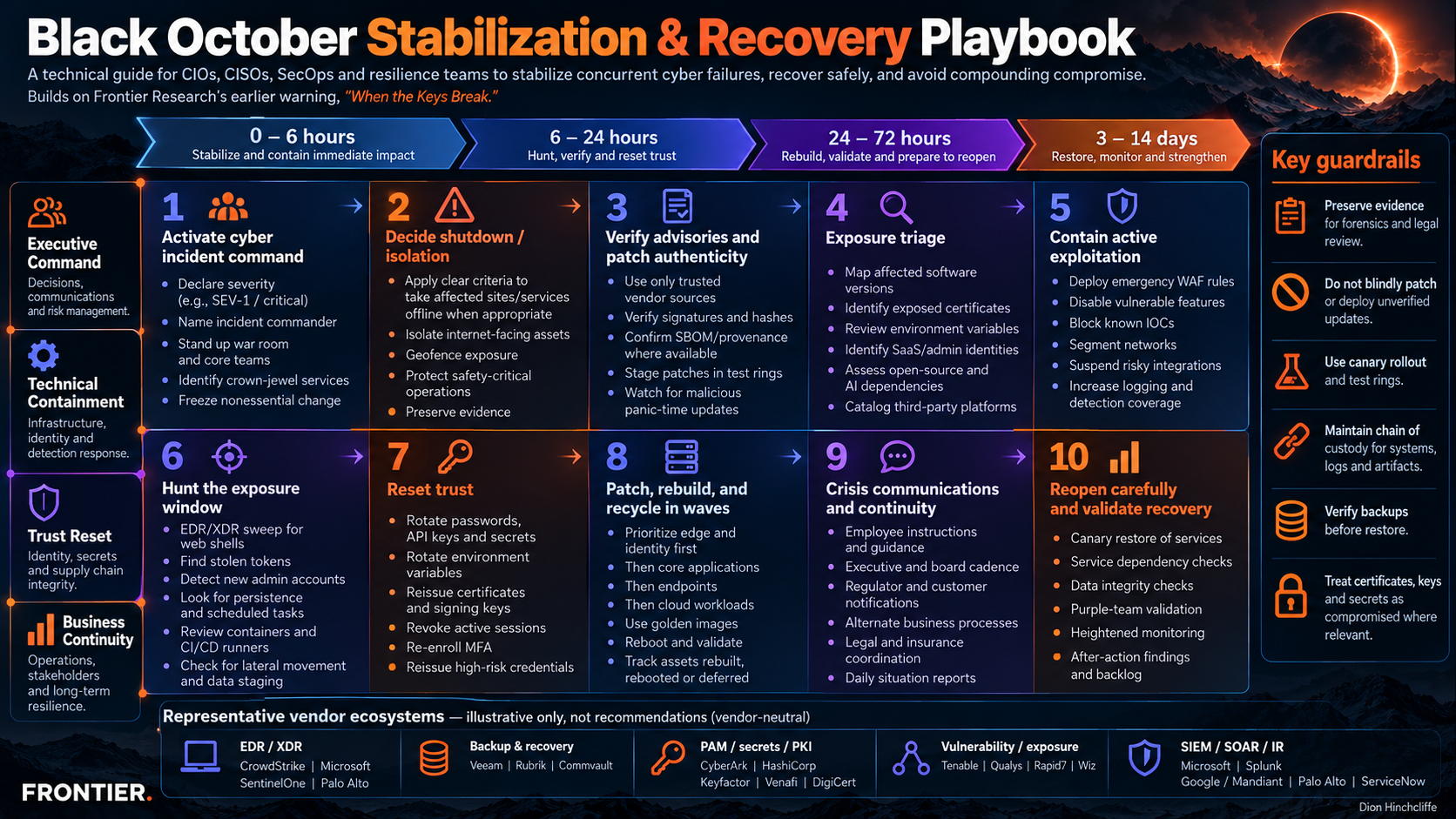
Operating assumption: simultaneous incidents may consume the same teams. The figure's 0–6, 6–24, 24–72 hour and 3–14 day bands are response targets, not forecasts or safe-harbor deadlines. Shorten them for proven active compromise and safety-critical or regulated systems. Preserve an evidence clock separate from the service-restoration clock. NIST SP 800-61r3 integrates response across the risk-management lifecycle; NIST SP 800-184 emphasizes business-priority sequencing and realistic recovery tests.12
3.1 Incident command, ownership and authority — first 30 minutes
| Role | Single accountable decision | Required live output |
|---|---|---|
| Executive incident commander (usually delegated by CEO/CIO) | Declare severity, authorize exceptional changes and downtime, resolve conflicts | Incident number, severity, scope, timestamped decisions |
| CISO / security incident lead | Threat model, containment boundaries, trust status | Exposure ledger, hunt hypotheses, IOC/behavioral rules |
| CIO / technical recovery lead | Change freeze, capacity, sequencing, rollback, business service restoration | Dependency graph, patch/rebuild waves, integrity evidence |
| Digital forensics and incident response (DFIR) | Evidence collection and clean/compromised classification | Chain-of-custody log, time-normalized timeline |
| Identity / key custody lead | Revocation, root-of-trust recovery and re-enrollment | Credential-rotation dependency graph, invalidation record |
| Software supply-chain lead | Genuine advisory/artifact validation and release controls | Approved hashes, signing identities, build attestations |
| Business continuity lead | Fallback processes, customer commitments, continuity thresholds | Critical-service tiers, RTO/RPO and manual-workaround status |
| Legal/privacy/regulatory lead | Materiality, notification clocks, preservation and privilege | Deadline register with jurisdiction and counsel decisions |
| Communications lead | Consistent staff, customer, partner and board messaging | Approved SITREP, evidence-grade statements, next update |
Operate on a 30–60 minute internal situation-report cadence in the first six hours, then adjust to severity; incident commander approves broader communication. Maintain one authoritative incident register accessible through a clean out-of-band path. Every ticket must include object/service ID, owner, last-known-good, exposure period, decision, work performed, verification evidence, time, and residual risk.
Freeze discretionary deployments and privilege changes unless approved through the incident bridge. Restrict the freeze to impacted scopes; indiscriminate companywide freezes can obstruct the very emergency fixes that must land. Ensure two-person approval for irreversible shutdown, root-key rotation or destruction of evidence. If command identity is suspect, use clean devices, alternate MFA, non-federated break-glass identities, and independent call-backs for senior-level instructions.
3.2 Shutdown, isolate or operate with compensating controls — decision matrix
| Observed state | Preferred immediate action | Rationale and authority |
|---|---|---|
| Internet-facing PHP instance affected; fix unavailable within approved risk window; potential RCE | Remove public routes, WAF/edge isolate or take affected service offline; preserve logs and snapshots; document customer fallback | Explicit NSA/UK NCSC recommendation; full remediation still requires patched runtime |
| Known malicious LiteLLM version executed, or host evidence suggests credential theft | Quarantine host/build worker, block egress and artifact promotion; preserve image/logs; rebuild from clean trusted provenance | Treat execution as compromise, not a simple vulnerable package |
| Provider reports secret access (Railway/Zeabur) but no observed local host compromise | Revoke/rotate affected upstream credentials using clean controls; audit dependent identities and workloads; prioritize high-blast-radius secrets | Provider-side incident creates downstream credential risk even if local services run |
| Affected CA chain or relying client lacks trusted revocation distribution | Block affected intermediates/root as directed by trust-store authority; replace dependent certificates; update application/client trust bundles | TLS identity can fail even if servers and keys otherwise operate |
| Suspected compromise of tier-zero identity/signing authority | Isolate the identity plane, revoke active sessions/keys, protect backup access, activate independent administration | Every subsequent patch, communication and recovery depends on trusted authority |
| Safety-critical OT/medical/control system where abrupt shutdown is hazardous | Escalate to engineering/safety authority; segment paths, control remote maintenance, follow validated safe-state procedures | Cyber containment must not cause physical harm |
Decision rule: An outage is an acceptable containment when the probable compromise consequence exceeds the documented business cost of that outage, and a safer isolated mode is unavailable. Keep an exception expiry and owner. WAF rules, network ACLs, or enhanced EDR may temporarily narrow exposure, but are not a claim that vulnerable PHP runtime behavior has been corrected.310
4. Stabilize in ten controlled steps
Step 1 — Establish an authoritative exposure graph, not a list of CVEs (0–2 hours)
Collect five evidence classes: (a) reachable public entry points, CDNs and firewalls; (b) runtime inventories—actual PHP/Python, modules and package digests, including appliances and embedded distributions; (c) identities/secrets reachable from each runtime; (d) software delivery routes and registries; (e) business services dependent on each instance. Join CMDB, SBOM, CSPM, EDR, container, SSO, DNS, endpoint-management, vulnerability-scanner, cloud IAM and deployment data. Mark unknown, do not infer clean from missing inventory.
Priority score should combine reachability × exploitability × authority/blast radius × business criticality × evidence gap. A publicly reachable unauthenticated RCE on a host with production database and cloud role access outranks an isolated vulnerable library that never handles untrusted input; a malicious executed package with access to organization-wide CI secrets may outrank them both. Keep scoring explainable and operator overridable.
Minimum output: Top 20 highest-risk service instances with owner, environment, fixed/affected runtime, application entry point, dependent secret stores, restore class, isolation authority and next decision time. Reconcile ephemeral workloads from orchestrator state and deployment history, not only current scan results.
Step 2 — Establish patch and advisory authenticity before emergency rollout (0–3 hours)
Black October makes the emergency patch channel a target. LiteLLM demonstrates a second-order failure: a named official package version and familiar registry path can still conceal attacker-controlled build output. Treat every unsolicited “urgent fix,” forum link, chat attachment and search-ad result as hostile until verified.519
A production-grade trusted update gate requires all of the following:
- Origin: Reach official vendor advisory and release channel from a known-good bookmark, signed advisories/known maintainer channels, or pre-established vendor contact. Confirm CVE and exact affected product/SKU; use a separate out-of-band source to corroborate surprising emergency instructions. Never click an emailed patch binary merely because the sender resembles the vendor.
- Authority: Verify the vendor's known code-signing identity and validity chain with a trusted verifier or internal trust policy; confirm signing keys were not revoked or newly replaced without authenticated notice. A cryptographically valid signature from an attacker-controlled release key is not proof of clean source.
- Integrity: Compare local SHA-256 with a digest obtained from a separately authenticated vendor release notice or trusted private package mirror; reject mismatches and unexplained checksum changes. Hashes copied from the same compromised download page establish only consistency with that page.
- Provenance: Validate signed SLSA/in-toto/Sigstore attestations where available: artifact digest, canonical source repository, builder identity, workflow/ref, expected external parameters, approval and timestamp. Reject unexpected forks, ephemeral builders or disabled protections. An absent provenance mechanism is an explicit risk acceptance, not an invitation to invent one.
- Binary vs source delta: Compare SBOM and transitive dependencies, install hooks, embedded files, startup scripts, package maintainer scripts, container entrypoint, runtime egress, permissions and requested secrets against the last known-clean release. Where practical run independent clean-room rebuild or binary-diff analysis before fleet-wide rollout.
- Clean-room acquisition: Download and stage through a known-clean administrator workstation or quarantined build runner; avoid invoking package managers from already suspect Python virtual environments. For the LiteLLM incident specifically, vendor guidance warns that starting Python could rerun malicious
.pthandsitecustomize.pyhooks.5 - Rehearsal: Patch an isolated test and representative canary ring; test schema migrations, application transactions, authentication, API rate limits, TLS interoperability, host/process restart and rollback. Do not blindly roll a security patch over a compromised host and declare it clean.
- Authorization: Two-person release approval with version, digest, source, signer/build identity, health criteria, exception ticket, rollback path, and on-call response named.
- Promotion: Pin immutable container digests; distribute through an internal verified registry; prevent mutable
latesttags from bypassing policy; sign the internal approved artifact as an internal statement of acceptance, not a claim of vendor provenance. - Post-deploy attestation: Verify running binary/package checksum and loaded process/container digest on every serving replica. Record what rebooted, what rebuilt, what failed, and what was intentionally isolated.
Operator-safe checks (illustrative—not a claim that a checksum alone authenticates a package):
# Run only on a trusted inspection host with a separately authenticated expected digest.
sha256sum ./vendor-patch.tar.gz
# Compare the output to the expected digest from the pre-established signed source.
# For a downloaded certificate chain, inspect issuer/subject/fingerprint:
openssl x509 -in ./candidate.pem -noout -issuer -subject -fingerprint -sha256
Sigstore and SLSA workflows vary by ecosystem; do not copy-paste a universal signing command or mistake signature validation for proof that the signer or builder was uncompromised. The Enduring Security Framework calls for integrity checks, verified build processes and protected signing operations.1920
Step 3 — Contain the active path before circulating new secrets (0–6 hours)
Close externally reachable affected runtime paths; revoke stolen CI OAuth grants, registry publish credentials, cloud service-account tokens and high-risk user sessions; isolate suspect image registries and runners. Quarantine affected nodes at the network and orchestrator layer—preserving volatile evidence where feasible—rather than terminating entire clusters without planning. For PHP, the point of isolation is to remove untrusted web input until a fixed runtime is actually serving. For LiteLLM, cease executing tainted Python in the suspect environment, preserve an image, and rebuild from a known-clean pinned version. For Railway and Zeabur, revoke at each downstream issuer, not merely edit the environment-variable text.3568
Controls are not interchangeable: a WAF may buy time against a known web exploit but cannot negate a stolen GitHub OAuth token; EDR may catch a process but cannot revoke a CA private key; password rotation cannot remove a web shell; rebuilding a server does not invalidate cloned session credentials.
Step 4 — Hunt everything that could have been planted during the open window (0–24 hours, then repeat)
Mandatory rule: the exposure window is a threat-hunting boundary. Define the earliest credible unauthorized access or malicious release before the public advisory, extend backward where evidence is incomplete, then review through the last confirmed remediation plus a monitoring buffer. Do not adopt an arbitrary 24-hour lookback when vendor reports show older access or missing logs. For Zeabur, potential server access predates October 14; its own findings include activity in early September, uncertain attribution.8
Hunt hypotheses and evidence sources:
| Plane | Look for | Evidence / verification |
|---|---|---|
| Web/PHP | Unexpected PHP files, uploads in executable paths, web shells, altered .user.ini/.htaccess, outbound sockets, child shells of web workers, new files in document roots, anomalous POST bodies/HTTP 500 spikes | Web/access/error logs, filesystem diffs vs signed baseline, EDR process ancestry, memory/netflow, WAF request context |
| Linux/Windows persistence | Cron/systemd timers and units, scheduled tasks, startup directories, service/registry changes, kernel/module loads, SSH keys, local admin creation, altered PAM/SSH configs | EDR, OS config snapshots, auditd/Sysmon, image diffs, signed binaries, network flows |
| Containers/Kubernetes | New privileged pods, jobs, DaemonSets, admission hooks, altered RBAC, secret reads, image tag drift, container escape indicators, unexpected registry pulls | K8s audit, OCI immutable digest, CI/KMS access, cluster events, cloud control-plane logs |
| CI/CD & artifacts | Changed GitHub workflows, reused privileged tokens, bypassed branch protections, suspicious approvals, new deploy keys/webhooks, unrecognized workflows/artifact uploads | VCS org audit, OAuth grants, workflow run evidence, attestation/provenance, registry push logs |
| Cloud/IAM | New access keys, policy bindings, service principals, sessions from new ASNs, GetCallerIdentity/STS anomalies, secret retrieval bursts, new snapshots, metadata-service access | CloudTrail / Azure / GCP audit, identity logs, KMS/HSM logs, resource snapshots, billing anomalies |
| SaaS / business apps | New API tokens, consent grants, mail forwarding/delegation, changed SSO rules, OAuth app installations, bulk exports | IdP and SaaS audit, DLP, API gateways, CASB, business application journals |
| Data/AI | Database role/trigger/extension changes, n8n credential exports, AI-provider key use, unusual model calls, prompt/log exfiltration, object-storage list/download spikes | DB audit, AI gateway/provider billing, object access logs, DLP and egress telemetry |
| PKI / trust | Newly trusted local CAs, certificate chain to affected intermediates/root, software signing anomalies, missing revocation freshness | Trust-store inventories, CT monitoring, OCSP/CRL evidence, TLS clients and PKI issuance logs |
Known persistence families include scheduled jobs and account manipulation documented in MITRE ATT&CK. A negative indicator-of-compromise search does not prove absence of compromise: attackers erase logs, use valid identities, live in memory, and change artifacts. For materially suspect systems prefer reimage/rebuild from a separately attested baseline plus restored clean data and revoked identities, after collecting legally appropriate forensic evidence. File cleanup alone is not an adequate assurance level for a known credential-stealing package.21225
Require DFIR to publish a conclusion by tier: confirmed compromised / likely compromised / exposure only / no evidence found with stated visibility limits. Do not let “no alerts” become “clean.” Review every privileged security-system compromise separately; an untrustworthy EDR or logging authority cannot attest to itself.
Step 5 — Reset identity, secrets, certificates and sessions in dependency order (0–48 hours)
Build a secret blast-radius graph: compromised service → reachable process environment → in-memory and mounted secrets → associated IAM role → downstream accounts and delegated permissions → key signing/rotation services → backups. Classify exposed credentials into deploy, cloud root, IAM, CI, source code, database, AI provider, payment, signing, TLS/PKI, session/JWT and customer integration tiers.
Sequence under a clean authority: (1) establish out-of-band break-glass accounts and protected logging; (2) revoke known attacker footholds, active sessions and OAuth/CI grants; (3) create fresh credentials outside the compromised source (new HSM/KMS partitions or hardened vault as needed); (4) deploy new secrets only to rebuilt/isolated consumers; (5) validate normal transactions; (6) revoke old credentials in the upstream service and prove no surviving authentication path; (7) examine all backups, mirrors and caches that can reintroduce the secrets; (8) reissue and re-enroll clients where signing/session roots changed; (9) monitor for reuse attempts and anomalous cost spikes.
The exact order of revoke vs issue is service-specific: stolen credentials should be invalidated as promptly as safe, while safety-critical systems may require a break-glass cutover. Never place fresh credentials into a host that may still run the stealer. Rotation of an environment variable in a dashboard is not proof that a database user password, cloud API key or virtual token was invalidated. Zeabur's backup recapture of fresh credentials is a concrete reason to test every rotation path.86
For eMudhra, apply root-store vendor mitigations and inventory actual affected client chains. Mozilla and Chrome distributed blocks to typical users without full browser restart; other libraries and custom bundles require separate treatment. Google's announced removal of the signing root from Chrome Root Store is scheduled for October 27 and can disrupt legitimate dependent sites. Replace affected server certificates from an unaffected trusted hierarchy with staged TLS/client compatibility tests; don't disable certificate verification or revocation checks to restore service.712
Step 6 — Rebuild and patch in rings; recycle runtime instances, not the business (6–72 hours)
Treat software installation and software execution as separate states. A patched binary on disk does not remediate a long-lived PHP-FPM worker, an old container image on a node, a warmed autoscaling template, a Lambda layer, a detached agent or a CI runner waiting to execute a poisoned cache. An incident bridge should never receive the report “patched 98%” without a denominator.
Wave 0: authority and recovery dependencies. Restore trustworthy identity, DNS, NTP/time synchronization, secrets, KMS/HSM, CI signer, registry, backup and telemetry infrastructure; isolate them before they touch other systems.
Wave 1: highest-risk public edge. Fix CDN/origin ingress, public PHP, remote management and externally reachable reverse proxies; safely drain traffic, stop/restart workers or replace container pods, validate load balancer state and keep WAF compensating controls until the fixed serving process is verified.
Wave 2: core applications and data. Coordinate rolling database and app updates with transaction boundaries, schema-compatibility and replicas; test authentication and APIs, queue processing, data replication and rollback safety.
Wave 3: cloud/AI/developer factory. Replace contaminated CI workers and mutable images, rotate registries/provider tokens, verify AI gateway keys, rebuild agent runtimes and every service that may have received poisoned dependencies.
Wave 4: endpoints, long-tail SaaS, appliances and offline estates. Apply vendor updates and root-store corrections, schedule reboots with user notice, catch disconnected devices, vendor appliances and shadow deployments. Where an EOL product has no credible patch, retire, isolate or replace it under a recorded business deadline.
For every ring: signed artifact/digest → offline/static verification → canary → service smoke/transaction checks → rolling drain/replace → per-instance version and running-process attestation → elevated detection → business owner signoff. Roll back service functionality if health fails, but do not roll back to known vulnerable or malicious code; prefer isolate/fail closed and recovery alternatives. Capture a count of instances replaced, restarted, still exposed, unreachable or exempted.
Step 7 — Keep business services alive while core systems are intentionally dark
Continuity leads own minimum viable service by tier: payment intake, payroll, healthcare/industrial safety, customer support, identity, logistics, essential regulated services. Define RTO/RPO, alternate suppliers, manual order processing, staged queueing, read-only mode, temporary feature suspension and local emergency access. A partial read-only site can be safer than an unpatched transactional origin. Preserve customer data through immutable/versioned backups that are protected by separate credentials and have been scanned and restored into an isolated recovery enclave. Recovery capacity must not share exactly the credentials, build system and signing roots suspected in the incident.2
Step 8 — Communications, legal and human coordination run in parallel, not afterward
Activate internal staff, executive/board, customers, regulators, insurers, critical suppliers and national CERT/CSIRT contacts through preapproved templates. Each message states: what is known, what is unknown, what people should do, what services are affected, and when the next update will occur. Use exact timestamps and regional time zones. Never say “no data was exposed” because no evidence has yet been found; never publish indicators that would compromise active containment or identifiable personal information.
Legal counsel should keep a jurisdiction-specific notification clock. For organizations within scope, the NIS2 reporting framework anticipates a 24-hour early warning, 72-hour notification, and final report within a month, subject to national implementation and significance thresholds. GDPR personal-data breach notification to the supervisory authority generally has a 72-hour awareness rule when risk threshold is met. US SEC domestic registrants generally disclose a material cyber incident within four business days of the materiality determination, which must not be unreasonably delayed. These are not interchangeable clocks or a universal duty triggered by every vulnerability.232425
Communicate business alternatives before downtime; update affected employees with phishing warnings and authenticated channels. An emergency patch alert is an ideal pretext for attacker-run credential harvesting. Staff should be told never to install third-party “recovery agents,” upload logs containing secrets, or provide MFA codes on unsolicited requests. Provide the internal patch update page and the callback number by a known established communication route.
Step 9 — Reopen by explicit gates and maintain an aftercare watch (24 hours to 14 days)
Technical green gate: every serving instance patched or isolated, immutable image matched, reboot/worker replacement verified, dependency smoke tests passed, and known EOL exposures bounded.
Security green gate: malware/persistence hunt documented with evidence limits; all exposed secrets revoked; privileges regranted least-privilege; original root cause or residual exposure path mitigated; no unexplained active attacker session; independent logging and monitoring online.
Business green gate: transaction integrity verified (not just website HTTP 200), RTO/RPO documented, downstream dependencies tested, safe rollback/fail-closed route rehearsed, customer-service and fraud-monitoring plans active.
Governance green gate: incident commander, CIO, CISO and affected business owner record risk acceptance, outstanding exceptions, press/regulatory commitments and next assessment. If one gate fails, remain isolated or allow a time-limited restricted mode under written exception.
Continue 24x7 high-confidence threat hunting for at least the agreed recovery watch period, with incident-driven time horizon rather than an arbitrary universal number. Watch for reuse of revoked secrets, new code deployment, suspicious consumer certificates, unauthorized cloud spend, changes in backup keys, late-arriving IoCs, and interrupted services due to certificate revocation or vendor shutdown. Maintain a separate long-tail migration board for supplier exits and EOL software.
Step 10 — Transfer from crisis command to accountable reliability engineering (3–14 days)
A crisis closes only when a named permanent control owner takes over every unresolved path. Publish an evidence-led timeline, blast-radius estimate, decision log, downtime and lost data, repeat exposures, residual risks, vendors involved, exceptions with expiry, compensation/contract claims, and engineering backlog. Require an independent review of the emergency patch source/provenance process and the completeness of rekeying, then exercise a second failure scenario while lessons remain fresh. A postmortem that produces only awareness training has failed.
5. Incident-specific runbooks: actions that must not get lost in a generic checklist
5.1 PHP2Shell: protect the serving interpreter, not just the CMS interface
Affected: HTTP-serving PHP, including PHP-FPM, Apache mod_php, php-cgi, LiteSpeed, FrankenPHP and products bundling PHP. Match current official and distributor advisories; the fixed upstream branches are 8.5.12 / 8.4.27 / 8.3.36 / 8.2.35. Supported distribution backports require vendor confirmation. Unsupported 8.1 and older generally need modernization or contract-backed support. Avoid the inaccurate interpretation that every version of every PHP application is exploitable regardless of runtime build or exposure.410
Action order: enumerate all runtimes (including containers, appliances, test/preproduction sites, stale domains and cron-only PHP); prioritize internet-facing; take affected unpatchable public services offline or isolate; preserve evidence; verify patch origin; stage canary; replace/restart actual workers, container layers and autoscaling templates; hunt files/processes/auth changes and database access during exposure; verify every public origin; keep enhanced logging; remove exceptions. WAF virtual patching is a short-term filter, not an official full cure. Do not reinstall a compromised PHP service over untrusted host state.
Evidence: SBOM/runtime list; application/service-owner map; officially linked package advisory; per-instance php -v or distribution-equivalent build evidence from a safe console; image digest; web access/error and EDR logs; captured suspicious artifacts; change ticket; smoke tests. Use PHP response-time telemetry and backend behavior, not just HTTP health checks. Per NSA, offline is appropriate when immediate mitigation is infeasible.39
5.2 eMudhra: cryptographic trust-chain failure, not universal ECC failure
Action order: identify enterprise relying parties and services chaining to affected intermediate/root certificates; verify Chrome, Firefox, Android and other OS trust update state; inventory embedded apps, Java truststores, network appliances, proxy TLS inspection, machine-to-machine services and pinning behavior; ingest root-program trust updates from trusted channels; replace impacted service certificates under unaffected hierarchies; use staged compatibility tests and CT observations; log any lingering use of banned chains. Do not turn off TLS certificate verification to keep old services running.71213
Evidence: certificate chain and fingerprints; client trust-store version; service dependencies; observed validation failure/success on representative clients; change board approval. If an organization itself used affected eMudhra-issued end-entity certificates, the actual renewal requirement depends on the chain and current trust-store handling—confirm before mass revocation.
5.3 Railway: all environment variables are a potential bridge to other companies
Action order: export inventory of names and owners, not secret values into an incident ticket; enumerate every secret at each downstream issuer (AWS/GCP/Azure, AI providers, databases, registries, SaaS APIs); revoke and rotate by privilege tier, using an unaffected control plane; update applications in a safe ring once provider deployments are available; invalidate sessions and tokens linked to compromised signing keys; hunt cloud/API usage since the earliest credible exposure, including unexplained infrastructure or model charges; coordinate business continuity while Railway's build pipeline is paused. Railway itself advised all users to rotate as precaution, while its initial impact assessment remained limited/uncertain.6
Evidence: provider notice, inventory and rotation receipts, revocation status, deployment checks, cloud audit and provider billing, secrets never pasted into shared spreadsheets or tickets.
5.4 LiteLLM: contaminated package means contaminated execution environment
Action order: freeze 1.107.0 and affected mutable image tag pulls; enumerate installed wheels, container histories, CI cache, lockfiles, virtual environments and executed digests during the exact vendor-disclosed windows. If the compromised Python package was executed, isolate before running more Python tools, preserve forensic evidence, and rebuild clean virtual environments/containers from pinned clean artifacts. The official report identifies cook.pth, sitecustomize.py and remote-loader persistence clues; these are hunt indicators, not a reason to assume that deleting three files proves safety. Rotate every reachable cloud, database, provider and LiteLLM key, including implicit roles, from clean stations and then hunt for replay. Compare release provenance against trusted builder and source: LiteLLM reports that malicious binaries came from attacker-controlled source despite a clean official source tag.514
Evidence: SBOM/digest/time records, registry and GitHub audit, Python runtime indicators, clean rebuild provenance, secret rotation checklist, cloud access anomalies and observed egress.
5.5 Zeabur: supplier breach plus forced exit is a two-front recovery program
Action order: classify platform-database secrets as exposed where they remained stored by Zeabur; rotate and revoke at source, including n8n encryption keys/third-party credentials and AI gateways. Check database internal users, snapshots, functions/triggers/extensions, cloud access, GitHub App grants, SSH authorized_keys and unexpected cloud resources. For affected GCP servers with confirmed root access, treat reimage from trusted backup as the default assurance path after evidence preservation, rather than merely resetting a root password. Keep copied snapshots and cloud audit under DFIR custody. Zeabur's preliminary report disclosed 101 root-accessed GCP servers and 3,218,965 environment-variable records accessed; other server/provider access confidence varied and must be called out separately.8
Continuity: create a supplier-exit workstream with service inventory, target platform choices, data export/import integrity, credential rotation after cutover, DNS/TLS move, read/write freeze windows, contract and payment continuity, test restores, parallel operation and rollback. The announced December 31 platform shutdown is a business deadline, not a reason to shortcut security isolation now.15
6. Figure 2 — Assured cyber resilience: from static controls to adaptive, provable survivability
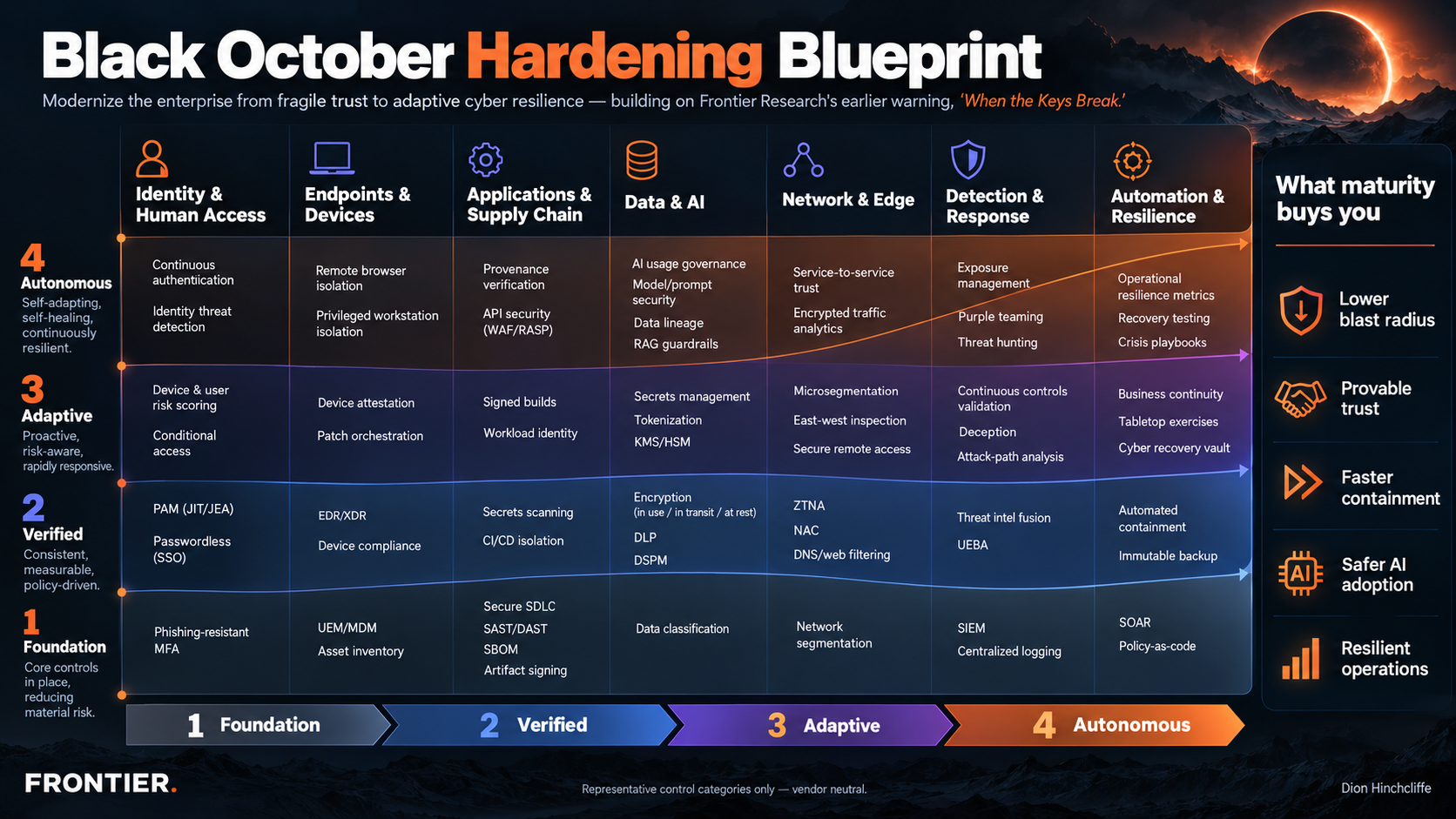
This Frontier diagram deliberately reinterprets the user's Cyber Maturity Model for 2023 with current terminology and a test-driven scope. Its seven working domains are (1) identity and human access, (2) endpoints and device trust, (3) application/workload and software supply chain, (4) data/AI/cryptographic authority, (5) network and edge, (6) detection and adversary hunting, (7) automation and operational resilience. Four Frontier maturity bands—Foundation, Verified, Adaptive, Autonomous—are our analytical model, not official CISA labels or certifications. Autonomous means well-governed, reversible security automation with human authority for high-impact actions, not self-authorizing destructive software.262728
Why the older model evolves: foundational MFA, network segregation, CI/CD security and observability remain necessary, but do not solve modern cloud workload identity, poisoned build provenance, compromised signing authority, pervasive SaaS secrets, ephemeral AI agents or supply-chain-linked business continuity. Blockchain/distributed ledgers are not a generic security maturity prerequisite. Likewise, placing every device in a virtual desktop is not a universal goal. Promote these technologies only for specific assurance and evidence use cases, with explicit alternatives.
6.1 Map to standards without misrepresenting them
| Frontier resilience domain | CISA Zero Trust Maturity Model pillar/crosscut | NIST operational anchor | Evidence of higher maturity |
|---|---|---|---|
| Identity & human access | Identity; Governance | SP 800-207; CSF Protect | Phishing-resistant MFA, PAM/JIT/JEA, continuous authorization, break-glass testing, provable session revocation |
| Device & endpoint trust | Devices | CSF Identify/Protect/Detect | Attested device posture, managed local privileges, EDR coverage, repair/reimage time and device integrity telemetry |
| Apps, workloads, software factory | Applications and Workloads | SP 800-207A; Secure SDLC/SSDF | Workload identity, SBOM and verified provenance, CI separation, signed artifacts, admission policy, application/API least privilege |
| Data, AI & keys | Data | NIST CSF Protect; crypto agility | Data lineage, encrypted and minimized sensitive flows, HSM custody, AI provider/gateway control, revocable secrets and prompt/tool logging |
| Network and edge | Networks | SP 800-207 | ZTNA, identity-aware access, fine microsegmentation, controlled egress, east-west visibility |
| Detection, threat hunting & deception | Visibility and Analytics | CSF Detect/Respond; MITRE ATT&CK | Cross-plane correlation, tested detections, adversary simulations, logging that survives compromised administrators |
| Automated response and business resilience | Automation and Orchestration; Governance | CSF Govern/Recover; SP 800-184 | Guarded isolation, tested restores, isolated recovery enclave, decision logs, crisis drills, measurable RTO/RPO |
CISA's official Zero Trust Maturity Model v2.0 defines Traditional, Initial, Advanced, Optimal stages across its own pillars and crosscutting capabilities; Frontier's bands above are an explanatory adaptation and must not be sold as a CISA accreditation. NIST CSF 2.0 adds the Govern function to Identify, Protect, Detect, Respond and Recover; governance and recovery are nonoptional if a cyber program is to survive a multi-incident week.2728
7. Engineering the assured-resilience architecture: minimum viable controls and verification
7.1 Zero trust as an architectural default, not an SSO product
Design access around resource, subject, device, workload identity, context, data classification and time-bound authorization. Build continuous authorization with a policy decision point, distributed policy enforcement, short-lived tokens, device attestation, MFA resistant to phishing, just-in-time privilege and session recording. Require machine-to-machine identity (mTLS/service identity such as SPIFFE-compatible systems where fit) and context-based policy for service mesh, APIs and AI agents. Network presence does not confer trust; cloud account root permissions are not operating convenience.2629
Immediate proof: attempt access from a noncompliant device, replay a stolen workload token after revocation, add a new service principal, use an expired elevation and connect east-west between sensitive zones. The first expected success criteria are deny, detect, alert and restore a legitimate path. Measure percentage of crown-jewel resources enforcing contextual authorization, median privilege lifetime and revocation latency.
7.2 Identity and secret custody must become revocable by construction
Replace static deploy keys and broad API tokens with short-lived workload federation when supported. Enforce secret vaulting, rotation automation, distinct production/nonproduction authorities, protected signing keys, separation of approval duties and immutable logs in a different trust account. Rotate keys through dependency-aware procedures, not recurring mass e-mail requests. Certificate authorities and machine trust should have a tested alternate chain; all applications consuming their trust stores must be discoverable. Build an enterprise cryptographic bill of materials (CBOM) covering algorithms, issuer, hardware key custody, certificate chains, signing protocols, data lifetime, update mechanisms and rollback/failover.
Standards-directed post-quantum migration remains important for long-lived confidentiality and signature planning. It is separate from the October eMudhra weak-entropy implementation error. A post-quantum handshake does not invalidate a stolen cloud token or remove an attacker-controlled Python hook. The October 9 Frontier report explains this distinction at length.16
7.3 Software provenance is now a production admission control
Require SBOM and trusted build provenance, not just a vulnerability scan. For every critical release: canonical source, reviewed changes, isolated nonpersistent builder, protected approval policy, expected external parameters, signed attestations and immutable published digest. Enforce provenance verification at registry admission and runtime deployment, including AI frameworks and model runtime images. Disable unpinned mutable tags in production; keep rebuildable clean-room copies and tested artifact rollback, including source and binary audit evidence.
LiteLLM is a case study in how an apparently ordinary published package can be built through an attacker-controlled path. Provenance checking should compare source and builder against preconfigured known-good identities; relying only on a registry-uploaded signature is insufficient when privileged producer credentials are stolen. SLSA explicitly requires verifying artifact digest, builder and expected source/build parameters, with extra caution around compromised build platforms.51920
7.4 Continuous exposure management must beat the exploit clock
Shift from quarterly scans and monthly patch committees to internet-first, identity-aware continuous threat exposure management (CTEM-like practice): discover externally reachable instances continuously; reconcile application and SBOM/dependency manifests; enrich with active-exploitation evidence and privilege reachability; validate real attack paths safely; prioritize remediation by risk; track deadlines by business service; automatically isolate unpatchable assets under preapproved guards. Vulnerability totals are weak executive metrics. Count material attack paths still open and reachable instead.
Set explicit emergency service level objectives as internal targets to be tested and tuned, for example: suspected active internet RCE triage within 30 minutes; decision on containment within two hours; full serving-runtime verification within 24 hours where supported fixes and operations permit; any exception requires named authority and alternative barrier. No SLA grants safety to wait until expiry when active exploitation is observed. Record maintenance-restricted OT and unsupported systems as exceptions with compensating controls and retirement plans.
7.5 EDR/XDR, CNAPP and detection engineering must be independent of the attacker’s permissions
Instrument web process lineage, cloud control-plane APIs, CI changes, artifact signing, KMS, email and SaaS admin actions, data exports, AI provider usage, DNS and egress. Send security-critical telemetry to an isolated account and immutable storage using read/write-segregated credentials, with time synchronization and retention spanning plausible intrusion history. Build behavior-based hunts keyed to MITRE ATT&CK, not vendor IoCs alone. Detect new SSH keys, external OAuth grants, K8s role changes, mass environment-variable reads, large database queries, new scheduled tasks, anomalous cost and certificates outside expected trust anchors.2122
Run purple-team emulations of common persistence and credential replay using approved test conditions and safe synthetic identities, not live stolen secrets. Measure: detection reliability, mean time from evidence to triage, mean time to revoke, logging gaps, false-positive burden and demonstrated containment without harm. Deception/honeypots may add signal but cannot replace basic identity and telemetry controls.
7.6 Software-defined segmentation and controlled egress contain blast radius
Segment by asset criticality, workload identity and data boundary: user-to-app, service-to-service, admin-to-production, CI-to-release, cloud account-to-backup, OT safety boundary. Default-deny unnecessary east-west flows; manage allowed connectivity as code with monitoring and expiration; require verified outbound paths from build workers and high-value server processes. Restrict metadata-service and secret-manager reachability by workload role. Test that a web service compromised at the edge cannot reach backup control planes or mint high-privilege cloud tokens by default.29
7.7 Recovery is an independently runnable product
Maintain two or more meaningfully independent recovery authorities: immutable/offline backups, distinct keys and administrators, clean-room build images, read-only recovery documentation, alternate communications, precontracted incident-responder access, and rehearsed supplier exit. Recovery tests must include compromising the production identity provider, poisoning the signed package source, losing an internet-facing runtime and invalidating a CA hierarchy. Test data integrity and application transactions, not just file restoration. NIST SP 800-184 explicitly links priority, realistic scenario testing and business restoration.2
7.8 AI agents and developer assistants extend your identity plane
Treat every AI agent as a workload principal with inventory, owner, bounded tools, delegated least privilege, expiring credentials, data access labels, approval for sensitive writes, independent trace logging and kill switch. AI gateways need egress controls, key isolation and usage anomaly detection. Disallow unmanaged local agents from reading production secrets, SSH keys or cloud credentials. A poisoned AI dependency can steal not just inference API keys but every reachable enterprise authority. An automated remediation agent must be deterministic within explicit policy boundaries and escalate blast-radius-affecting actions to an accountable human.529
8. The 365-day transformation program — priorities, outputs, owners
| Horizon | Deliverables | Acceptance test |
|---|---|---|
| Days 0–3 | Crisis command; confirmed exposure list; isolation/patch decisions; verified artifact lane; initial hunt; revoke highest-risk secrets; business workarounds | Every tier-zero path and internet-exposed instance has an owner, status, evidence and next action; clean/unknown never confused |
| Days 4–14 | Full trust reset; clean builds and session invalidation; all rings restarted/rebuilt; affected-chain update; customer/regulatory reporting; first recovery drills | No serving exposed instance without documented exception; secrets rotation evidenced at issuer; canary + integrity recovery passed |
| Days 15–30 | Continuous exposure map; critical dependency/CBOM; logging gaps closed; vendor exit priority; board after-action review | Demonstrate identity and artifact provenance graph for top 20 crown-jewel services |
| Days 31–90 | Zero-trust reference architecture; production provenance/admission gates; 24x7 hunt coverage; isolated recovery enclave; alternative incident comms | Purple-team five representative attacks, show measured containment/revocation and clean restore |
| Months 4–6 | Least-privilege workload federation, microsegmentation across highest-risk estates, anti-replay and dynamic access, automated risk-driven patch rings | Audit paths from edge to critical secrets; prove no implicit default admin reachability |
| Months 7–12 | Supplier isolation/exit rehearsals, legacy and OT modernization, crypto agility and trusted-chain renewal, continuous adversary emulation | Executive exercise: one CA failure + one supplier breach + one core RCE while processing essential transactions |
Decision rights: CIO funds reliable change and recovery factories; CISO defines assurance tests and exception boundaries; CTO/app owners make services rebuildable; business units declare minimum viable outcomes and service priorities; CFO oversees quantified downtime and capital allocation; legal owns applicable notification determinations; board oversees risk appetite and independently verified claims. Product purchase cannot substitute for this operating discipline.
9. Board and war-room scorecards: measure survivability, not activity
| Metric | How to compute it correctly | Why it changes a decision |
|---|---|---|
| Critical exposure at risk | Reachable vulnerable service instances × privileged dependency, segmented by business criticality | Drives isolation and staff allocation |
| Time to containment decision | Advisory/validated detection time → approved isolate/patch/defer decision | Exposes governance delay |
| Verified running-runtime remediation | Fixed and running instances ÷ known affected instances, separately tracking unknown inventory | Prevents “patch installed” false positives |
| Compromised credential revocation | Revoked high-risk downstream issuer credentials ÷ identified exposed credentials | Measures real trust reset, not dashboard edits |
| Persistence hunt coverage | Evidence sources reviewed against defined exposure interval ÷ relevant sources, with gaps | Makes confidence limitations explicit |
| Clean build/provenance coverage | Critical deployments with matching trusted source+builder+digest attestation ÷ critical deployments | Detects supply-chain integrity debt |
| Independently recoverable services | Critical services that passed clean-room restore and business transaction test ÷ critical services | Measures realistic business recovery |
| Identity revocation latency | Median/p95 time to invalidate sessions, workload tokens and privileged grants | Exposes token life-cycle risk |
| Recovery blast radius | Number of independent trust domains required to restore one critical service | Identifies hidden shared dependencies |
| Communications integrity | Timeliness, audience reach and correction rate of approved fact updates | Supports regulators, board and workforce |
| Unknown dependencies | Critical services with undocumented runtime, key/CA or supplier links | Quantifies blind spots instead of hiding them |
| Supplier exit rehearsal | Time, data fidelity and cost of moving one critical workload to an independent provider | Tests bargaining power and continuity |
For mature estates, trend these weekly; during the crisis, update the first five at each incident-command SITREP. Avoid compiling composite green scores that hide one catastrophic uncontained trust root.
10. Vendor ecosystem map — illustrative examples, emphatically not recommendations
Frontier Research is vendor-neutral. The names below identify product/ecosystem categories that organizations may investigate; appearance is not an endorsement, ranking, statement of fitness, certification, proof of incident coverage or confirmation of product availability in every edition/region. Capabilities, integrations, licenses, data residency and security claims must be independently tested against specific control objectives. Open-source and internal builds can also satisfy some needs.
| Work package | Illustrative ecosystem participants | Procurement test to run |
|---|---|---|
| Vulnerability/attack surface | Tenable, Qualys, Rapid7, Wiz, Palo Alto Networks, Microsoft Defender, Google Security Command Center | Find internet-facing embedded PHP and map owner, exploit paths and runtime proof |
| EDR/XDR, forensics and hunting | CrowdStrike, Microsoft Defender, SentinelOne, Palo Alto Cortex, Sophos, Elastic, Velociraptor | Detect process ancestry, persistence, tampered runtimes and clean rebuilding across OS/cloud |
| Network containment/WAF/ZTNA | Cloudflare, Akamai, Fastly, F5, Zscaler, Netskope, Palo Alto Networks, Cisco | Isolate affected origin without severing safe business operations; verify egress limits |
| Identity, PAM and machine trust | Microsoft Entra, Okta, CyberArk, BeyondTrust, Delinea, HashiCorp Vault, Venafi/CyberArk, DigiCert | Revoke privileged sessions and workload credentials, rotate CA/key paths, prove cutover |
| Cloud posture/Kubernetes workload | Wiz, Orca Security, Prisma Cloud, Lacework/Fortinet, Aqua Security, Sysdig, Snyk | Detect malicious image/role changes and secret reachability across cloud accounts |
| Artifact/CI provenance & software composition | GitHub, GitLab, JFrog, Sonatype, Snyk, Chainguard, Sigstore, SLSA/in-toto ecosystems | Reject maliciously sourced valid-looking package, validate immutable digest and trusted builder |
| SIEM/SOAR/IR casework | Splunk, Microsoft Sentinel, Google SecOps/Mandiant, Elastic, IBM QRadar, ServiceNow SecOps, Cortex XSOAR | Cross-correlate web, IdP, CI, cloud, database and business events in one timeline |
| Backup, recovery and continuity | Veeam, Rubrik, Commvault, Cohesity, Druva, AWS/Azure/GCP native services | Restore independently of compromised tenant and root credential; verify data/business integrity |
| Crisis communications/continuity | Everbridge, OnSolve, PagerDuty, ServiceNow, Atlassian Statuspage, business continuity platforms | Notify when enterprise SSO/email unavailable; preserve approval trail and update cadence |
| Independent DFIR / incident advisory | Mandiant, Unit 42, CrowdStrike Services, Microsoft DART, NCC Group, Kroll, sector-specific specialists | Validate privileged response authority, evidence custody, time to mobilize and conflict-of-interest controls |
Contract tests: data export, evidence access, independently retrievable logs, exit rights, supply-chain attestations, revocation SLAs, breach disclosure times and offline operation under provider outage. Avoid buying ten overlapping dashboards without identifying the authority that integrates them.
11. Copy-ready crisis communications and decision artifacts
11.1 Internal executive situation report — every 60 minutes initially
Incident: [ID] • Classification: [affected/exposed/compromised/under investigation] • UTC as of: [timestamp]
Known: [specific affected services, confirmed evidence with source and confidence]
Unknown: [scope, lateral movement, customers, timing]
Immediate business effect: [what is offline, fallback and RTO]
Containment: [isolation, patched running versions, trust-store status, revoked secrets]
Persistence/forensics: [what searched, earliest event, evidence gaps, clean rebuild plan]
Decision needed: [owner, exact choice, risk of action/inaction, deadline]
Next update: [UTC].
11.2 Employee communication
“We are actively containing an elevated software and identity-security risk. Some services may be temporarily unavailable while we validate updates and restore safe operation. Do not install patches from emails, chat links, advertising, or unexpected support messages. Use [established company update channel] and report suspicious instructions to [verified number]. We will provide our next update at [time, zone]. We are investigating possible exposure; we will not speculate before evidence is confirmed.”
11.3 Customer/partner holding statement
“We identified [defined issue] affecting [known services] starting [time]. We have [contained/isolated/restored] [specific controls], and [what customers should do] is our current guidance. The investigation is ongoing; we have [confirmed/not yet determined] [defined type of information or service impact]. We will update this notice by [time]. We will separately contact customers whose required actions differ.”
11.4 Reopen signoff record
| Required evidence | Signer | Decision |
|---|---|---|
| All serving instances fixed/isolated and runtime attested | CIO / platform lead | GO / restricted / NO-GO |
| DFIR exposure window hunted; unresolved gaps accepted explicitly | CISO / DFIR | GO / restricted / NO-GO |
| High-risk credentials revoked at issuer; clean authority restored | Identity lead | GO / restricted / NO-GO |
| Critical transaction, identity, data and backup integrity tests passed | Business process owner | GO / restricted / NO-GO |
| Legal, customer, staff and regulator notifications assessed | Counsel / communications | GO / restricted / NO-GO |
| Watch controls and rollback/fail-closed path active | Incident commander | GO / restricted / NO-GO |
Reopen policy: unanimous GO or formally signed restricted-mode exception with a time limit and business sponsor. Never change the status from unknown to clean merely because a scanner or monitoring console shows no open alerts.
12. Methods, confidence and practical limitations
Evidence window: primary-source material published through October 22, 2026, reconciled where possible against independent research, public standards and regulatory publications. Sources distinguish vendor-confirmed facts, authority guidance, independent corroboration and Frontier decision synthesis. Vendor incident scope and attack attribution are mutable and should be rechecked against the most recent disclosures before action. No primary secrets, live exploits, proprietary telemetry or private victim investigation data were accessed. We conducted no live testing of production environments.
Claim grades: A = direct primary source plus independent corroboration or government guidance; B = one primary source with detailed evidence, investigation still open; C = informed architectural inference or proposed operational standard; D = uncorroborated/unknown, not used as fact. PHP fixed releases A; eMudhra compromise and mainstream browser protections A; LiteLLM affected artifact windows A/B; Railway possible decrypted variables B and actual victim extent unknown; Zeabur internal logged accesses B and some downstream usage uncertain; scenario vindication C (mechanism direction validated, no claim of shared attacker or universal AI cause).
Metrics and timelines: response windows and internal SLAs are Frontier-authored suggested operating targets, not government requirements or guarantees of containment. Corporate legal and safety teams must adapt recommendations to their jurisdiction and system criticality. Shutting down safety-critical systems can be dangerous and requires operational engineering approval. Malware hunting is evidentiary; absence of known indicators alone does not establish clean state. Vendor-neutral examples are not recommendations or vendor assurance. Research figure bands and maturity labels are Frontier-developed, informed by—not copies of—NIST/CISA classifications.
Existing Frontier intellectual lineage: Our FR-028, When the Keys Fail, remains the deeper treatment of AI vulnerability economics, post-quantum cryptography, ECC, crypto agility and the multiyear identity/device modernization challenge. This FR-030 is its action-oriented incident command and adaptive-resilience companion. The more immediate evidence validates that patching cannot be the only plan; it does not imply a demonstrated classical break of cryptography.16
Sources and authoritative reference register
- Frontier Research, When the Keys Fail: Surviving the Enterprise Security Gauntlet, 9 October 2026
- U.S. National Security Agency, NSA Advisory: Critical Patches Recommended for PHP Vulnerabilities, 21 October 2026
- PHP Project, Security advisory: Critical remote code execution vulnerabilities, update now, 21 October 2026
- NHS England Digital, Critical Vulnerabilities in PHP (PHP2Shell), 21 October 2026
- Canadian Centre for Cyber Security, AL26-026: Critical vulnerabilities impacting PHP, 21 October 2026
- ENISA and European agencies, Joint statement on critical PHP vulnerabilities, 21 October 2026
- Google Cloud, Responding to core PHP vulnerabilities, 21 October 2026
- Wiz Research, PHP2Shell: AI uncovers critical RCE vulnerabilities, 21 October 2026
- Google Chrome and Android Security Teams, Protecting users from compromised eMudhra intermediate CA certificates, 20 October 2026
- Mozilla Security Team, Protecting Firefox users following the compromise of eMudhra intermediate certificates, 20 October 2026
- eMudhra, Statement on Recent Certificate Security Incident, 20 October 2026 updates
- Railway, Security Disclosure: Wednesday October 21st, 21 October 2026
- LiteLLM, Contained: Oct 21, 2026 release v1.107.0 compromised, 21 October 2026
- Datadog Security Labs, LiteLLM supply chain compromise: What you need to know, 21 October 2026
- Zeabur, Zeabur October 2026 security incident (preliminary report), 19 October 2026
- Zeabur, Zeabur is shutting down: what happens next, 17 October 2026
- NIST, SP 800-61 Rev. 3, Incident Response Recommendations and Considerations for Cybersecurity Risk Management, April 2025
- NIST, SP 800-184, Guide for Cybersecurity Event Recovery
- NIST, Cybersecurity Framework 2.0, February 2024
- NIST, SP 800-207, Zero Trust Architecture
- NIST, SP 800-207A, Zero Trust Architecture Model for Cloud-Native Applications
- CISA, Zero Trust Maturity Model 2.0, April 2023
- SLSA Framework, Build: Verifying artifacts, version 1.2 (current specification)
- NSA/CISA Enduring Security Framework, Securing the Software Supply Chain: Recommended Practices for Suppliers
- MITRE ATT&CK, Persistence tactic TA0003 and scheduled tasks technique T1053
- MITRE ATT&CK, Account Manipulation technique T1098
- European Commission, NIS2 Directive FAQs, incident reporting
- European Data Protection Board, Data breaches, requirements and examples
- U.S. Securities and Exchange Commission, Cybersecurity Risk Management, Strategy, Governance, and Incident Disclosure, 2023 rule guidance
[^nist-recovery][^nsa-php][^php-release][^litellm-official][^railway-official][^google-emudhra][^zeabur-incident][^canada-php][^enisa-php][^mozilla-emudhra][^emudhra-official][^datadog-litellm][^zeabur-shutdown][^fr-028][^slsa-verification][^cisa-supply][^mitre-persistence][^mitre-account][^gdpr-commission][^nist-zta][^cisa-ztmm][^nist-csf][^nist-zta-cloud]Push this further.
Bring us the question. We’ll take it further together.