The Looming Labor Cliff: AI Is Accelerating Faster Than Society Can Rebuild Work
AI is now demonstrating high-maturity labor capabilities such as completing entire remote-work projects unassisted while also suddenly accelerating AI research itself. Our new global labor model explores the global cognitive-work shock, the later humanoid wave, the jobs that might return, and the urgent decisions executives and governments must make.
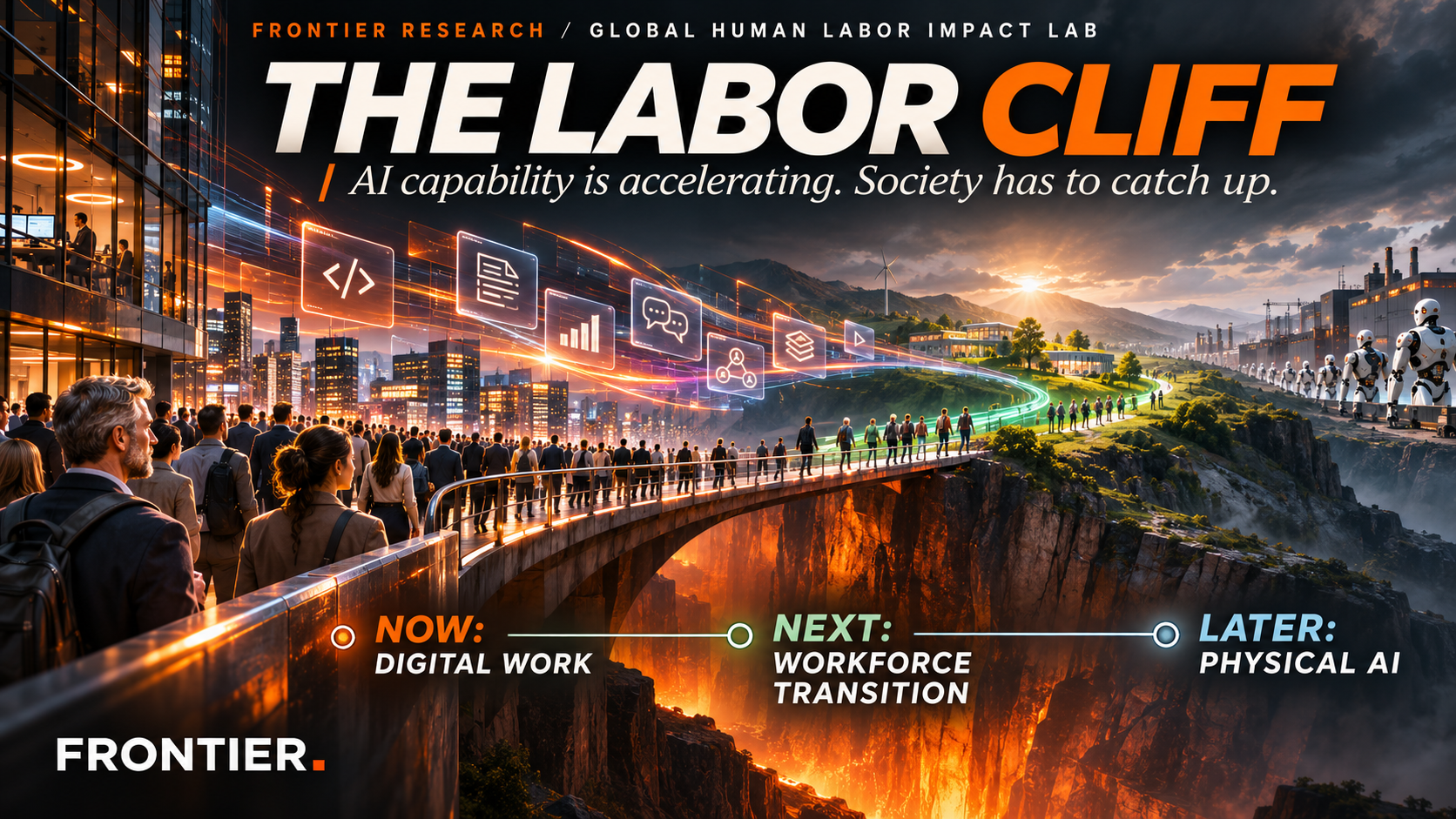
For years, I've told CIOs that artificial intelligence would remake the enterprise. I now believe that may have actually been the least significant way to describe what is coming.
The more fundamental question is what happens when the global economy's ability to automate cognitive work improves much faster than its ability to create, finance, and train people for new work? We have built our institutions around the expectation that workers, organizations, skills, and careers change on human timescales. Frontier AI appears increasingly capable of changing the underlying task economics on machine timescales.
We now appear to be approaching the first technological revolution in which the machinery becomes dramatically better before society has finished deciding what happened to the last generation of workers. It will almost certainly be bigger in scope and faster in pace than the industrial or digital revolutions that preceded it. That is a serious scenario. Our analysis today the the global posture appears to be nowhere near where it needs to be to address the impacts.
To be clear, I don't think resignation, triumphalism, or theatrical panic is an adequate response. I think it is time to do the hardest, least glamorous thing: measure the approaching labor transition, expose the uncertainties, and start building the institutions that can absorb it before the displacement is visible in the rearview mirror. That is why we developed Frontier's brand new Global Human Labor Impact Lab.
November 2026: the evidence is arriving faster than the conversation
Consider what happened in just the past few days.
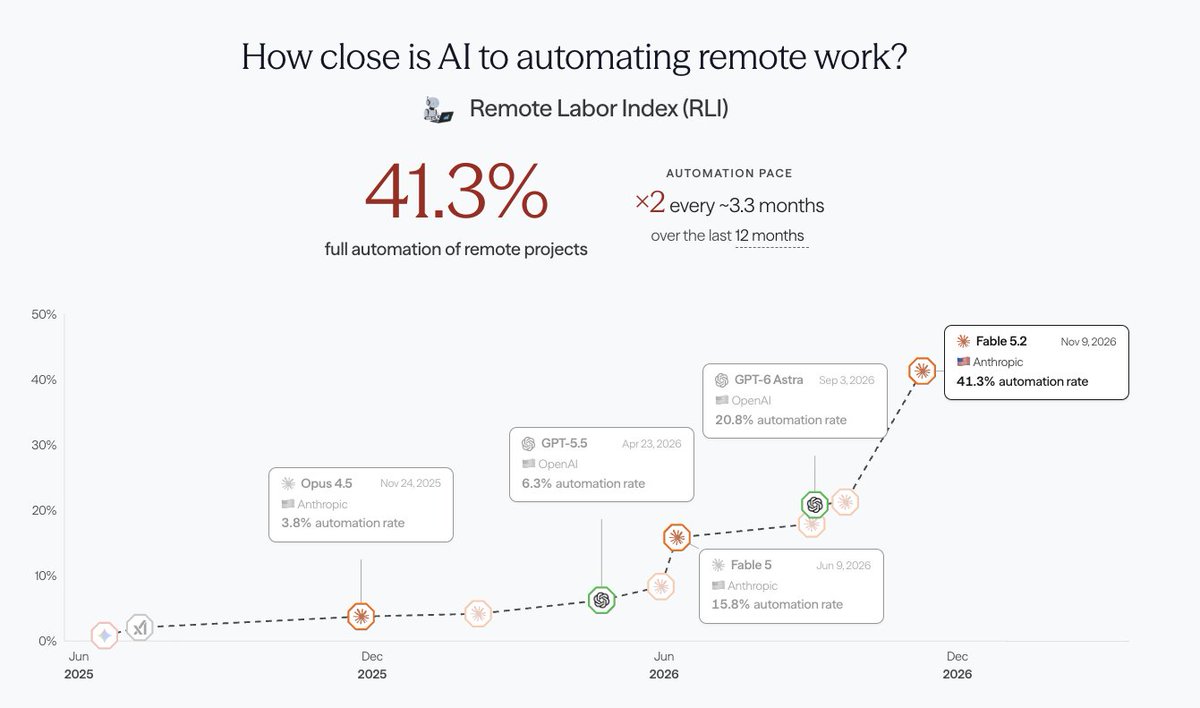
On November 9, Anthropic introduced Claude Fable 5.2 and Mythos 5.2. The same underlying frontier model, deployed with different restrictions, is advancing agentic coding, technical reasoning, computer use, science, and complex knowledge work. In Anthropic's published comparisons, Fable 5.2 scored 41.3% on the Remote Labor Index, against roughly 21.3% for Opus 5.5 and 20.8% for OpenAI's GPT-6 Astra. Anthropic also reported Fable 5.2 solved two theoretical-physics problems and that a roughly 1,000-agent system formalized Fermat's Last Theorem in 30 hours. Those achievements deserve technical scrutiny, especially the difference between generating new mathematical discoveries and formalizing a known proof. But this now far, far more than a story about chatbots writing adequate first drafts.12
The Remote Labor Index was originally designed around selected real freelance projects and whether an agent could autonomously deliver work a paying client would accept. Its project mix spans design, development, analysis, and other remote outputs. It is not an experiment showing that 41.3% of the world's jobs will be removed. It has a restricted task sample, particular tooling and evaluation conditions, and does not cover the full human, institutional, legal, and social dimensions of employment. Yet the trend is strategically striking: the benchmark's leading score was only a few percent about a year ago. Its roughly three-month historical doubling pace is a retrospective property of a bounded score and may not be an exponential we can safely project to 2030.23 But it’s more than adequate, however, to extrapolate some major insights.
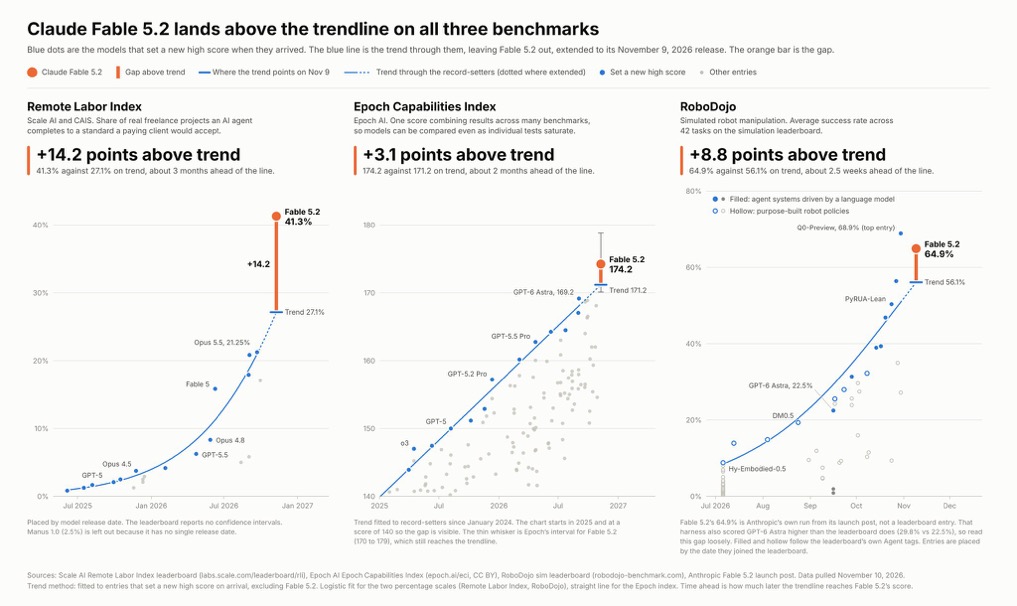
The pattern appears across different recent evaluations. Epoch's Capabilities Index places Fable 5.2 at about 174, compared with approximately 169 for GPT-6 Astra, with overlapping uncertainty intervals. In RoboDojo Sim, Anthropic reports 64.9% for Fable 5.2 versus 29.8% for GPT-6 Astra under its internal testing configuration. A general language model controlling simulated two-arm manipulation tasks is key evidence about the transfer of model capabilities into physical control—but simulation proficiency is not a humanoid robot fleet. Note: The benchmark numbers and the illustrated trendline must not be mistaken for a real-world robotic productivity audit.41
But it isn't simply Anthropic's week. OpenAI's GPT-6 Astra advanced computer use and professional task execution this year, while November's GPT-6 Cyber focused on vulnerability research within bounded scopes. Google made Gemini 4 Carbon broadly available on November 10 for long-horizon research, engineering, and coordinated agent work. Meta launched Muse Ember on November 9 for cheap, repeatable tool calls, routing, coding subtasks, and document operations inside larger agent systems. And Google's new TPU 8tx and 8i Max systems target confidential inference and the memory intensity of large-context agents. The frontier is moving at both ends: more capable reasoning at the top, cheaper and more accessible execution beneath it.56789
That combination is more important to the labor market than any single model ranking. A breakthrough model does not have to perform every small task cheaply. It can plan, delegate to many inexpensive specialists, verify the results, and operate inside existing enterprise software. The price of finished work, not simply the price of a model token, becomes the decisive variable.
The recursive loop has gone from theory to measurable evidence
I have been particularly focused lately on the progress of the much-vaunted technique of recursive self-improvement (RSI): AI helping to create better AI, which then improves AI development further. There is good reason to distinguish AI-assisted R&D acceleration from fully autonomous and indefinitely self-improving systems. We have solid evidence for the first. We do not have a demonstrated, unconstrained loop for the second, but it is clear that it’s coming soon.
Anthropic disclosed that, by August, Claude was leading about 26% of measured AI R&D work, compared with less than 1% just in February, and collaborating on more than 90%. But the company reported that no measured category was yet operating fully autonomously. That is an extraordinary change in research workflow, not quite proof yet that the researchers have become unnecessary.10
More significantly, the respected AI benchmarking organization, METR, just spent eleven weeks independently examining Anthropic's internal research pipeline. On November 5, it reported that benchmark capability progress was running at approximately 1.9 times its previous rate—a 95% confidence interval of 1.5–2.8 times under one specification. METR judged a majority of the acceleration was probably attributable to AI use, but stressed uncertainty, unavailable public evidence due to redactions, and the absence of proof that AI had fully automated the most strategically important research decisions. METR did not find a clear near-term bottleneck that would force the acceleration to stop.11
This is a credible warning and one that has made many observers sit up: Research productivity, synthetic experimentation, code migration, automated evaluation, and laboratory infrastructure can form a reinforcing loop well before we reach the science-fiction version of RSI. Yet it also remains entirely possible that bottlenecks, evaluation artifacts, energy, economics, safety restrictions, or diminishing returns interrupt it. Given all this, I believe our task is now to prepare for accelerated progress without pretending the acceleration is guaranteed.
Yesterday, the authors of the AI 2027 scenario revised their timelines in response to this evidence. The six authors now put their median expectation for a superhuman AI researcher somewhere in 2027 under a continued-progress assumption. Daniel Kokotajlo's median moved to May 2027. These are unusually aggressive, explicitly conditional forecasts by a particular forecasting group—not an independent consensus about when human work disappears. Still, when a serious forecast moves by more than a year because of evidence from a notable research laboratory, every executive planning cycle should notice.12
The first great disruption is cognitive
Humanity has roughly one billion or more knowledge and information workers, depending on whether we count only managers, professionals, technicians, and clerical roles or include frontline employees who regularly work with information. There is no universally agreed, current global census of "knowledge workers": ILO occupational classifications supply a more defensible boundary than any one round headline. The order of magnitude is sufficient to frame the stakes.1314
What if one in five of an approximately 1.0–1.1 billion knowledge-worker population had to change roles or employers over a decade because AI changed the economics of their tasks? That is roughly 200–220 million people. What if the disruption affected two in five? It would involve 400–440 million. Those are now the approximate global workforce stresses we are likely to face, depending on the configuration of the forecast model used model.
The exposed job roles are already recognizable: software maintenance and testing, back-office administration, claims processing, routine finance and legal preparation, marketing operations, content production, research support, customer service, documentation, and the information-handling portions of healthcare and education. The order matters, but the critical unit is not the job title. It is the set of tasks, the workflow around them, and whether the organization converts time saved into fewer people, more production, higher quality, or new demand.
The International Labour Organization's occupational analysis finds one in four workers worldwide employed in roles with some generative-AI exposure, but just 3.3% in its highest exposure band. Its conclusion is that transformation, rather than wholesale replacement, is the most likely near-term effect. An IMF assessment places the broader share of global employment affected by AI at about 40%, and around 60% in advanced economies; that includes complementarity and augmentation, not 40% unemployment.1516 But this is unfortunately, not the whole story.
What’s interesting is that the labor-market evidence we have right now is contrary to this: Anthropic's March analysis found no systematic increase in unemployment among the most exposed US workers, though it saw suggestive evidence of reduced hiring for younger entrants. An ILO review in June likewise found large-scale displacement still limited and productivity gains unevenly realized. That is the situation today, and why there is complacency in many quarters. But I now believe this situation is poised to chance.1718
My strategic planning assessment is that the next twenty-four months are the window to prepare for a likely serious global cognitive-work shock—and is not yet a verified countdown to mass layoffs by November 2028. In our high-impact scenario, dislocation pressure becomes quite large in this interval. In lower-impact scenarios it develops more slowly. What I am arguing is that our main institutions must now treat a two-year transition window as a risk-management horizon rather than wait for national employment statistics to confirm the damage.
The world is not an overnight robot factory
The physical economy follows a slower curve. Fable 5.2's RoboDojo results show that the intelligence required for general robot manipulation may be improving much more rapidly than expected. That is strategically important for manufacturing, logistics, construction, agriculture, hospitality, and care. It does not mean robots can be deployed at software scale.1
The International Federation of Robotics counted about five million installed industrial robots in operation worldwide in 2025, versus only about 7,000 full-size humanoids sold that year. Many early humanoids remain pilots or data-collection platforms. Reliable hands, power systems, installation engineering, safety certification, maintenance, site integration, unit economics, and labor relations create real-world bottlenecks that a better language model does not abolish.1920
This is why I suspect the 2034–2036 period—roughly eight to ten years out—is a more plausible planning window for globally material humanoid-driven labor effects than the next two years, absent a very unusual deployment acceleration. This is my professional judgment, not an observed forecast. Industrial robotics will keep automating specialized work sooner; the extraordinary uncertainty concerns when generalist humanoids will be sufficiently inexpensive, durable, and useful to become ubiquitous.
Our medium model at eight years produces only about 2.4 million robotics-related role equivalents against a global baseline of 3.73 billion employed people. At ten years it produces about 6.4 million. The high-impact assumptions generate far more physical transition pressure—approximately 87 million robotics-related role equivalents at year ten. That enormous spread is why I insist that the hardware assumptions stay editable. It would be irresponsible to bury that uncertainty under a confident date, but humanoid robots will play a role in this eventually, just not soon.
The Global Human Labor Impact Lab: turn the argument into a model
To help with strategic planning for global leadership, we just created the Global Human Labor Impact Lab here at Frontier Research because we urgently need something better than alternating between "AI changes everything" and "don't worry, jobs always come back."
It is a ten-sector, month-by-month, global scenario model. It starts with a roughly 3.73-billion-person employed workforce baseline and exposes the variables linking capability to deployment and the workforce. It includes low, medium, and high impact paths, a default five-year horizon that can be switched to ten and adjusted out to twenty, digital-work conversion, attrition, reemployment, complementary job categories, industrial robotics, and humanoids. The inputs are sourced where observed and plainly identified as Frontier assumptions where speculative.2122
The chart deliberately separates gross position reductions, potential forced worker transitions, and the unreabsorbed transition gap after modeled reemployment. No number is claimed to be a measured layoff or unemployment rate, nor are the three paths statistical confidence intervals.
With the canonical ten-year defaults as of November 11, 2026, the medium scenario models 278 million forced worker-transition equivalents across all sectors, with approximately 154 million reabsorbed by the end of the decade, leaving an illustrative 124 million transition gap. The high-impact path models 538 million forced transitions and about 234 million reabsorbed, leaving 305 million. The low-impact net gap is approximately 48 million. Those are sweeping numbers, but they are conditional on the visible assumptions, not empirical forecasts. In particular, one cannot divide them by one billion knowledge workers, because the simulated population is the entire global workforce.21
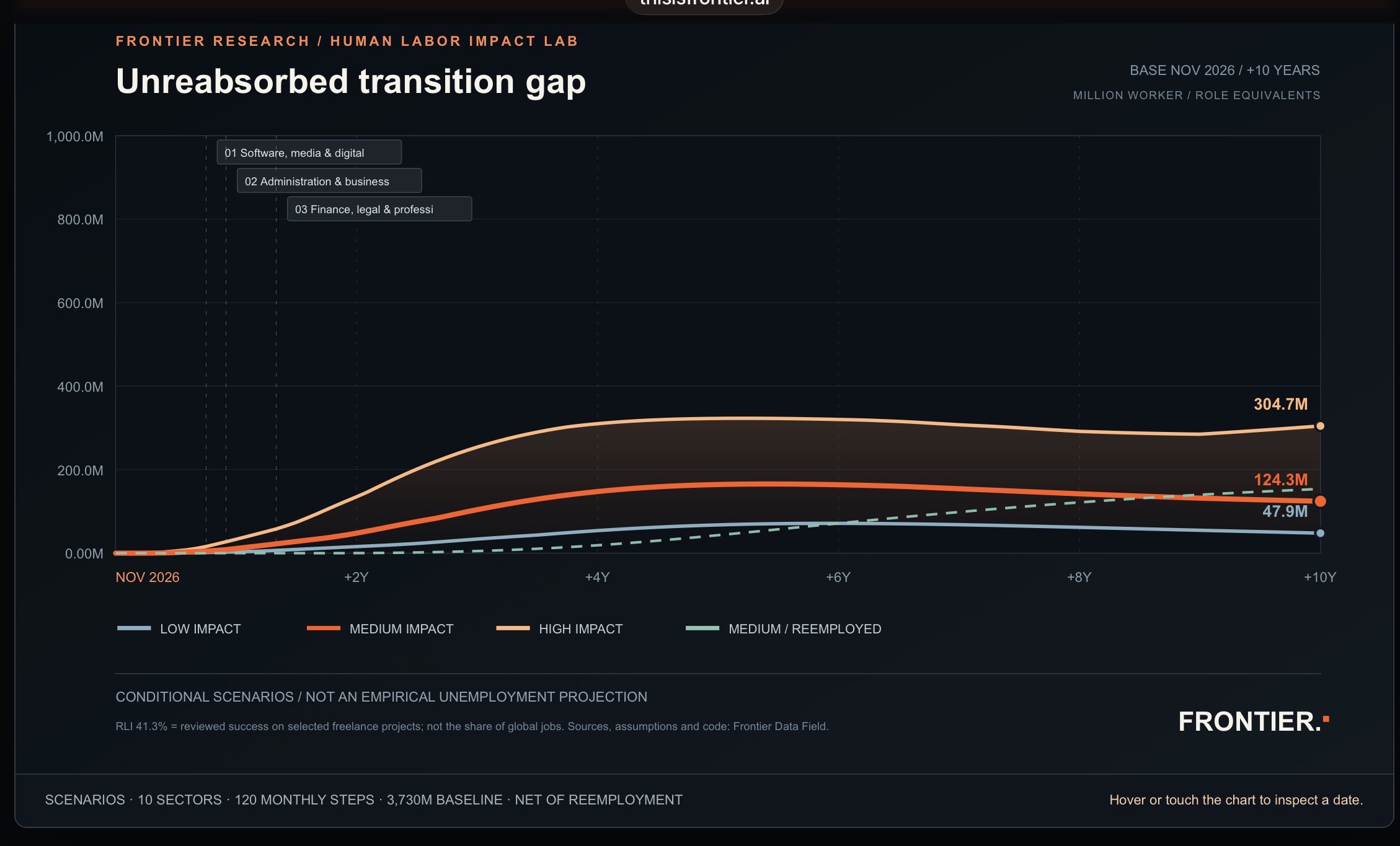
The source of the danger to jobs right now is just as important as the final number. Software and digital work crosses the model's illustrative early-transition threshold first, followed by administration, and then finance and professional services. Robot-heavy sectors follow later. Reemployment takes time: cohorts must first leave or change work, then acquire skills, then find a viable opening. The default medium path already has some reentry before year six, but the accumulated return curve becomes markedly more substantial over the following years. It is wrong to imagine an instantaneous rescue, and equally wrong to assume no worker can make a successful transition.
The model does not presently include wages, geography, demographics, fiscal responses, changes to consumer demand, general-equilibrium effects, redistribution, or government interventions. That last omission is decisive. If rapid labor dislocation emerges, I think meaningful public intervention is likely—whether through wage support, retraining, tax changes, expanded benefits, procurement, AI deployment restrictions, or entirely new social arrangements. But the timing, design and success of those interventions are genuinely unknown. The graph is what certain technology and adoption assumptions produce without modeling the political and social response, not what must inevitably happen.
FIELD GUIDE | HOW TO USE THE GLOBAL HUMAN LABOR IMPACT LAB
1. Open the live experiment. Go to the interactive model. Start with Compare all; the three lines are alternative assumptions, not probabilities. The default is five years. Check 10-year view to see the more profound transition, or use the horizon slider under the graph for a custom interval.
2. Change one driver at a time. Under the chart are adjustable controls for AI capability growth, a hypothetical recursive-feedback coefficient, enterprise adoption speed, role conversion from saved tasks, attrition, reskilling delay, eventual reentry, the creation of complementary roles, and humanoid and industrial robot deployments. A slider is a question to test—not a prediction you are expected to believe.
3. Put return to work into the equation. Check Return to work · net impact. The low/medium/high worker-transition curves decrease by each scenario's already modeled reemployment, once, with the same vertical axis so you can see the difference. The dashed medium reemployment curve shows the lag. Uncheck it to recover gross transition pressure. Use the sector and reentry panels below to understand where the assumptions place the first disruption and the eventual work.
4. Compare what can be measured. Switch the view to gross role reductions, forced transitions, robotics-related reductions, reemployed workers, or complementary role demand. The last category is separate from people returning to work: do not add it to reemployment and double count jobs. Try slower organizational adoption, faster reskilling, or much lower productive humanoid utilization to see the sensitivity.
5. Use it for a planning workshop—not an unemployment headline. Export a branded 1600-pixel, 3200-pixel, 4K or 8K PNG, an SVG, and a current-input CSV or full model JSON. Share the settings link with your CEO, CFO, CHRO, CIO and public-policy colleagues. The canonical evidence and assumptions dataset is public. Change the inputs, document why, and write down the decision that changes as a result.
The most revealing experiment may be to leave the AI capability curve fast, but slow organizational adoption or increase the reintegration share. The labor shock can change dramatically. We do not have to assume that technological capability alone determines social outcomes.
The argument over stopping AI cannot be treated as a culture war
Rob Bensinger of the Machine Intelligence Research Institute recently argued that we may have far less time than governments assume to manage a dangerous loss of control. His proposal is concrete: negotiate international restrictions on the largest frontier training runs, supported by compute monitoring, supply-chain verification, and inspections. He is explicit that extinction risk, irreversible loss of control, and the last politically practical moment to intervene are different thresholds. His essay is a warning and a policy proposal, not proof of a near-term extinction deadline.23
There is more than rhetoric behind concern. The 2026 publication of a 2024 survey of 1,580 researchers found wide disagreement, but elicited material subjective concern about catastrophic outcomes. This does not establish the objective probability of human extinction or the month when control would be lost. It establishes that uncertainty is severe enough that a serious risk program is reasonable.24
At the opposite pole is the argument that deliberately slowing powerful AI could sacrifice cures, scientific discoveries, poverty reduction, new energy systems, accessibility and ultimately lives. I take that objection seriously. Anthropic's work on difficult physics and Google and OpenAI's advances in research agents are reminders that the technologies posing labor and safety challenges may also help solve problems that have defeated generations of human expertise.175
The choice is not necessarily unrestricted acceleration versus permanent prohibition. We can distinguish safety-critical training and deployment safeguards from ordinary experimentation; demand pre-deployment evaluations and transparency proportional to capability; impose independent oversight on high-risk autonomy; test escalation thresholds; and invest in beneficial science while building emergency authority for cases where control fails. A cross-border framework may ultimately be needed, but it must be verifiable, internationally workable and sensitive to the opportunity costs of both action and inaction.
And the labor emergency needs its own institutions, regardless of where anyone lands on existential risk. A country may have an AI safety strategy and still leave millions of workers without transition income. A company may have excellent model security and still hollow out the entry-level career ladder its future senior leaders depend upon.
CIOs, CFOs, CHROs: the strategic cliff is an operating decision
I would urge every executive team to take the following steps now, not after the next macroeconomic report.
First: create an accountable map of work. Over the next 90 days, inventory the business services and actual task families where agents could reliably deliver accepted outcomes, not merely where licenses are deployed. Identify the owners, affected workers, dependencies, information rights and failure recovery. Use the model to stress-test demand at 24, 60 and 120 months. Publish the assumptions internally.
Second: make every automation business case a workforce transition case. A proposal to remove 20% of processing effort should state whether capacity will become faster service, lower prices, more demand, fewer jobs, or new internal positions. Put retraining and transition costs in the same investment committee package as token fees and ROI. Finance should require fully loaded cost per verified business outcome and distinguish a modeled productivity dividend from realized cash savings.
Third: rebuild the internal talent market before eliminating its feeder roles. If entry-level analysts, junior coders, coordinators, writers, researchers and operations staff lose their on-the-job learning pathways, where will tomorrow's senior architects and business leaders come from? Start paid internal apprenticeships in agent evaluation, process design, model operations, data stewardship, human-AI oversight, risk, cybersecurity, robotics fleet operations and customer-facing judgment. Give people protected learning time before a restructuring announcement.
Fourth: establish an executive labor-transition council with external accountability. CIO, CHRO, CFO, COO, CISO and business leaders should jointly monitor roles being transformed, positions eliminated through vacancies, separations, workers moved into paid new roles, wage and career progression, new hires, and third-party labor impacts. Measure adverse outcomes, not just productivity wins. Involve employee representatives and regional educators where relevant. Maintain a standing plan for accelerating transitions or slowing deployments when labor or safety indicators cross explicit thresholds.
Fifth: prepare a public-policy partnership. Governments should improve real-time job-transition statistics, finance portable retraining, modernize wage insurance and income support where needed, and avoid tax incentives that subsidize displacement without financing adaptation. The United States already has legislative proposals for tracking and supporting workers displaced by automation, though a proposal is not enacted law. This must expand beyond the countries and highly educated workers who get the first advantages from AI.2518
The strategic choice is not whether to use AI. It is whether the productivity dividend accrues to a few balance sheets while entire regional labor markets absorb the transition costs, or whether companies and societies use that dividend to create the next economy.
The decade ahead, seen from the edge
Picture 2027: the first board committees realize that software agents are completing entire audited workflows, not merely helping people type faster. Apprenticeship programs are suddenly an operating priority because the entry-level work used to train experts is changing.
Picture 2028 or 2029: some firms announce headcount reductions while others hire aggressively for AI supervision, domain engineering, cybersecurity, customer trust and new products. Governments argue about transition funds, wage protection and the acceptable rate of deployment. The public debate becomes much louder because the affected people have names, mortgages, and communities.
Picture the early 2030s: an extraordinary amount of digital work has been redesigned. Some societies have used the productivity dividend for shorter workweeks, richer services, retraining and enterprise creation. Others have allowed a long gap between displacement and opportunity to harden into political anger and institutional distrust.
Picture 2034–2036: the physical frontier begins to matter more materially if generalist humanoids finally clear the reliability, safety and cost thresholds. Warehouses, field service, factories, food systems and assisted care may reorganize around machines that can do many things—if hardware supply and the economics cooperate.
These are illustrative scenes, not asserted events. Our model deliberately cannot forecast the elections, social contracts, wage settlements, training institutions or public decisions that will fill in the actual history. Those are choices still available to us.
That is what gives me both urgency and hope. If our only strategy is to admire the exponential, the labor cliff becomes something that happens to people. If we begin building the bridge now, AI can become the greatest enlargement of human opportunity in history instead.
We should be planning for a transformation potentially larger than any modern labor shift, while refusing false certainty about the path. We have extraordinary tools, a public model we can challenge, and a narrow but real opportunity to make the transition deliberate.
The technology is accelerating. It's time for our institutions to do the same.
[^openai-astra][^openai-cyber][^google-carbon][^meta-ember][^google-tpu][^anthropic-rd][^metr-rd][^aifutures][^ilo-occupations][^knowledge-occupation][^ilo][^anthropic-labor][^ifr-industrial][^ifr-humanoid][^frontier-lab][^model-data][^bensinger]