The Labor Transition: A Global AI, Human Work & Robotics Forecast
How fast could AI dislocate human work? Explore three adjustable global scenarios, ten sectors, reemployment paths and the humanoid robotics wave—without mistaking a task benchmark for job-loss data.
Work is changing. Explore the rate.
Model three possible global paths. Adjust the five-year horizon, AI progress, adoption, job conversion, reskilling and humanoid robotics. Every curve is reproducible; none is presented as an observed job-loss count.
Model 1.0.0 · Source commit 8e5fc7b · Not a probabilistic unemployment forecastAI's ability to complete entire remote-work projects has advanced remarkably quickly. The Remote Labor Index reports a 41.3% success rate on a selected set of paid freelance tasks, while the rate of improvement in its recent benchmark series appears to be accelerating. That is a profound signal about machine capability—not a measurement of 41.3% of human jobs disappearing.1
The central challenge is what happens next: how rapidly capability becomes affordable, reliable and organizationally deployable; which tasks convert into eliminated positions; how people are displaced or reemployed; and when robots expand the impact beyond the digital economy.
Frontier's new Global AI Labor Impact Forecast is an open, adjustable science experiment designed to interrogate those questions rather than hide them inside a single speculative curve. It models 10 sectors, three alternative scenarios, job-equivalent reductions, potentially displaced workers, reemployment after reskilling, complementary new-role demand and separate industrial/humanoid robot deployment. The default horizon is five years, and readers can change it from two to twenty.
The signal versus the forecast
The observed anchors matter. The International Labour Organization estimates roughly one-quarter of global employment is in occupations with some generative AI exposure, while only 3.3% falls within its highest exposure category. Exposure is not displacement, but the figures show that AI reaches across occupational boundaries long before the majority of jobs can be fully automated.2
Physical AI is starting from a radically different base. The International Federation of Robotics reports roughly 5 million operating industrial robots and more than 600,000 new industrial installations in 2025. A separate IFR service-robot release records only about 7,000 full-size humanoids sold that year, often into restricted applications. The model therefore constrains humanoid impact by unit supply, productive utilization, installation friction and job-equivalent contribution rather than treating a robot demonstration as an immediately replaced worker.34
An estimated 3.73 billion employed people worldwide sets the initial scale, while the ten sector shares, adoption lags, conversion rates and reemployment rates are explicitly illustrative Frontier inputs. They are not a validated occupational transition matrix and must not be reported as observed labor-market statistics.5
Three conditional paths—not three forecasts of unemployment
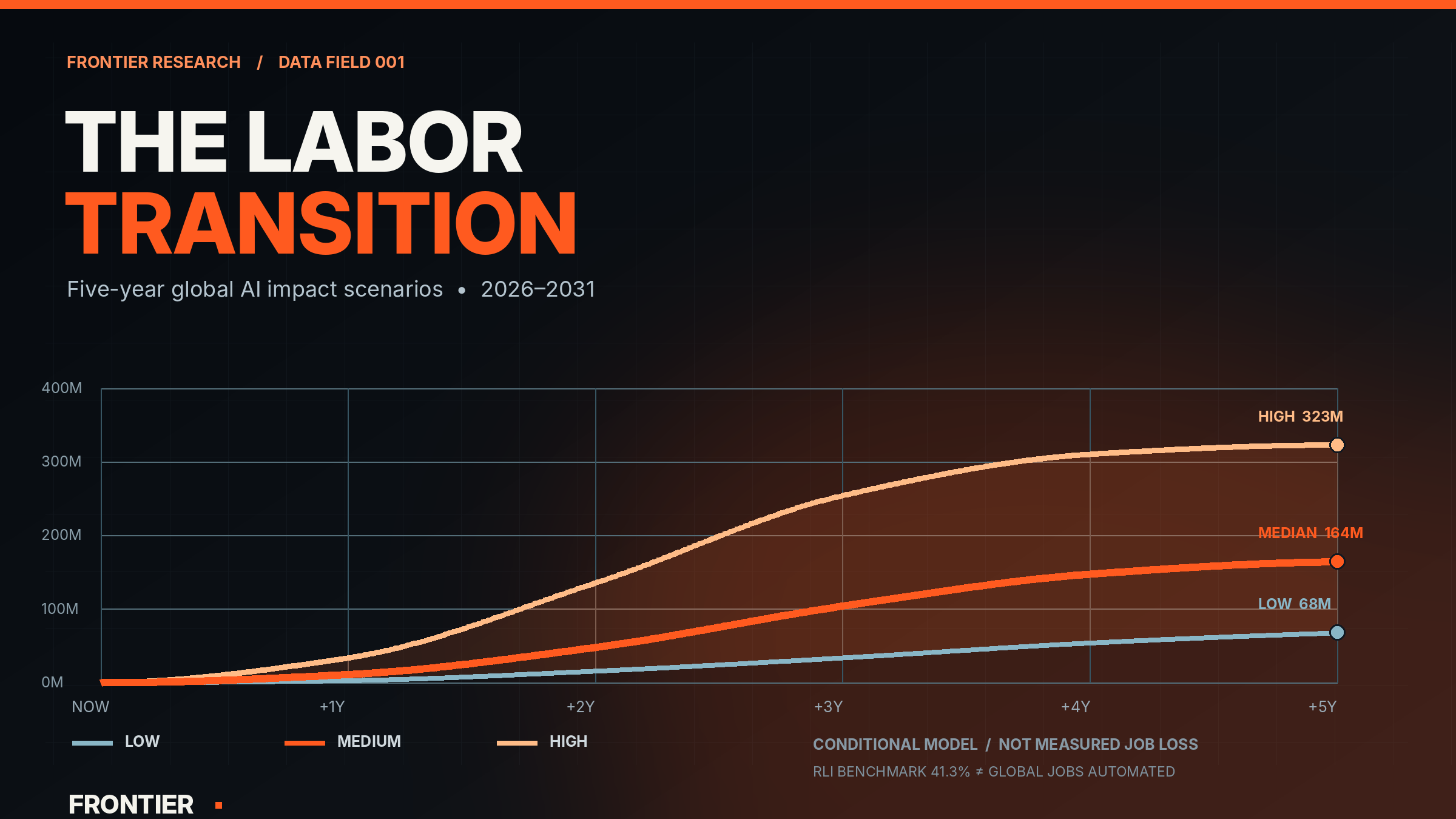
With the displayed default assumptions, the five-year unreabsorbed labor-transition gap is approximately 68 million in the low-impact scenario, 164 million in the medium-impact scenario and 323 million in the high-impact scenario. These are modeled worker/job-equivalent transition pressures after the assumed partial reemployment of displaced cohorts. They are not measured job losses, unemployment forecasts, estimates with statistical confidence bounds or a claim that the outcomes will occur.
In the medium scenario, software and digital work reaches the model's 1.5%-of-sector forced-transition threshold first, followed by administration and business services, then finance, legal and professional services. Physical sectors follow on different adoption curves as robotics becomes more capable and available. These modeled threshold crossings depend directly on the assumptions visible in the explorer—not on an empirical finding that any sector has already crossed them.
The reemployment model matters just as much as displacement. We distinguish roles removed from workers forcibly transitioning, then apply an explicit reskilling lag and separate reentry curve. Potential return pathways include AI operations and assurance, redesigned professional and customer services, care and education, physical robotics support, infrastructure and new ventures. Complementary job demand is tracked separately so readers cannot double-count it as recovered employment.
Make the assumptions argue with one another
The interactive Data Field lets readers change the improvement rate of AI capability, a hypothetical recursive improvement feedback parameter, enterprise adoption, the fraction of automatable tasks that result in eliminated roles, vacancy/attrition absorption, time to reemployment, the fraction of people eventually reabsorbed, and humanoid/industrial robot supply and productivity. The recent RLI benchmark doubling rate is not mechanically applied as an employment-displacement rate. METR's independent task-horizon work also underscores why capability measurement is not equivalent to economy-wide labor substitution.16
No honest model can yet forecast the future distribution of wages, political response, macroeconomic demand rebound, demographic change and retraining capacity with precision. The World Economic Forum's widely cited 2030 figures for all-category job creation and displacement are contextual labor-churn estimates across many forces; they are not treated here as AI-only calibration targets.7
The point of this experiment is not to proclaim an inevitable jobless future. It is to show which variables could create an unusually fast dislocation, which ones provide society time to absorb the shock, and how much of the transition turns on deliberate human choices.
Explore the live, adjustable labor transition model. Download the underlying JSON-LD with every observed source and assumed input, the default monthly CSV, and current-view branded PNG/SVG exports at up to 8K resolution. The modeling code and version history live in Frontier's GitHub repository.
[^ifr-industrial][^ifr-humanoid][^employment]