Zoho Turns Analytics Into an Agent Context Layer—Moving Enterprise AI Control Beyond the Model
Zoho has expanded Zoho Analytics with semantic, ontology, agent-orchestration and governance capabilities, reflecting a larger shift from human-facing business intelligence toward governed context infrastructure through which AI agents can interpret enterprise data and act.
Take the argument with you.
Read the publication-ready report. Generated from the canonical News article.
What changed
On October 28, 2026, Zoho announced an evolution of Zoho Analytics into what it calls an Agentic Analytics platform.1 The release centers on native semantic and ontology layers designed to give AI systems organization-specific definitions, metrics, entities and relationships rather than leaving each agent to infer business meaning from raw schemas or isolated prompts.1 Independent reporting corroborated the launch and the principal additions, including semantic and ontology capabilities, a multi-agent Ask Zia architecture, custom agents, Model Context Protocol connectivity, embedded or headless BI, and administrative monitoring.2
Zoho describes Ask Zia as a super-agent that coordinates six specialized agents for analysis, visualization, data preparation, formulas or modeling, data-science coding and SQL work.3 This is a vendor description rather than independently demonstrated performance, but it clarifies the architectural direction: a user or application submits an analytical objective, while an orchestration layer assigns parts of the task to specialized agents operating against shared business context. Zoho also introduced or highlighted custom-agent creation, a data catalog, AI observability, sandbox and governance controls, MCP-based connections to external systems, and headless access intended to make analytics available inside other applications.4
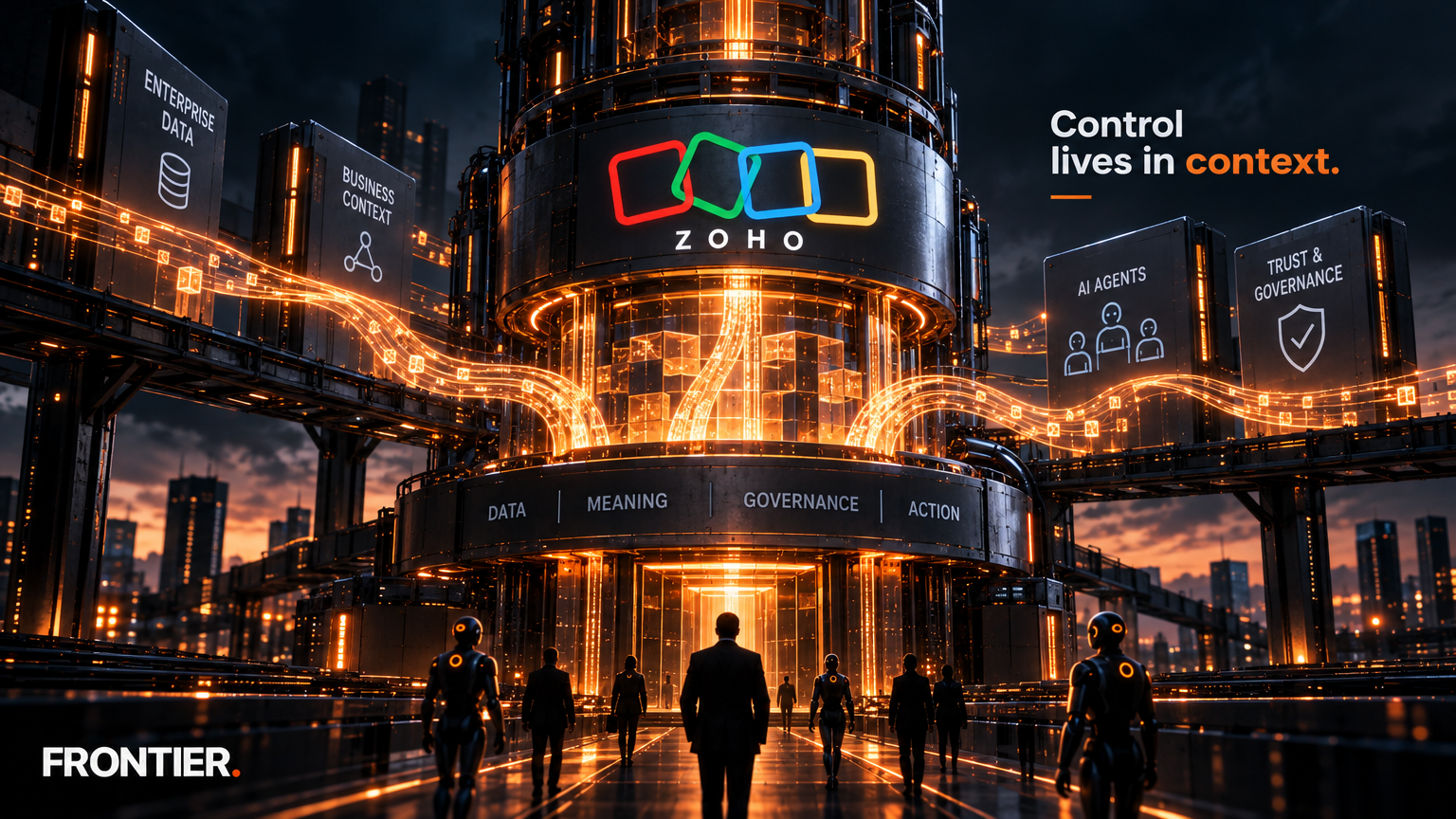
The significant event is therefore not simply the addition of another natural-language assistant. Zoho is packaging data access, semantic meaning, ontology, analytical tools, agent orchestration and governance within one platform boundary. Constellation Research identified this integrated packaging as the main point of differentiation while noting that many of the individual capabilities already exist elsewhere.5 That distinction matters: the news is an architectural consolidation, not evidence that Zoho has invented every component or established a uniquely capable agent system.
Availability also remains staged. Zoho said cloud functions were being opened gradually by region and account, with preview versions of the ontology, semantic model and pixel-perfect reporting scheduled for global rollout over four to eight weeks; it planned on-premises updates for the first quarter of 2027.3 Zoho also said pricing was unchanged and that plans would include Zoho LLM credits and a one-time Zoho Key System credit allocation, although availability and consumption conditions vary by plan and data center.6 Those are vendor-stated commercial terms, not a demonstrated total-cost profile for production agent workloads.
Why it matters
The CIO decision model for analytics platforms now has to extend beyond reporting features, dashboard adoption and analyst productivity. If agents use an analytics platform to interpret business metrics and initiate downstream work, that platform can become part of the enterprise’s operational control plane. Its definitions of revenue, customer, inventory, risk or performance may shape not only what employees see but what software decides to do. The evaluation question consequently changes from “Can this tool answer a question?” to “Can this context layer produce consistent interpretations, preserve authorization boundaries and support accountable action across agents and applications?”
Zoho’s design illustrates why semantic governance is moving closer to the center of enterprise AI architecture. Raw access to a warehouse or application database does not by itself provide an agent with agreed business meaning. A semantic layer can map technical fields to governed measures, while an ontology can represent entities and relationships relevant to the organization. Zoho says its new layers are intended to provide precisely this terminology and context.1 The analytical inference is that enterprises able to make those definitions machine-consumable can reduce the need to recreate business logic separately inside every prompt, agent or application. Whether Zoho’s implementation delivers that outcome in production remains to be tested.
This shifts platform selection in three ways. First, accuracy must be assessed at the level of business interpretation, not merely query execution. An agent can generate syntactically valid SQL and still apply the wrong metric definition, time period or entity relationship. Second, authorization fidelity becomes an end-to-end concern. CIOs need evidence that the permissions governing source data, semantic objects, agent tools and resulting actions remain aligned across the entire request path. Third, reliability now includes graceful failure: the platform must expose uncertainty, preserve traceability and prevent an analytical error from becoming an unauthorized operational action.
The available disclosures do not independently establish production accuracy, authorization fidelity, implementation effort or reliability. SoftwareReviews’ analysis similarly treats those outcomes as matters requiring customer validation rather than acceptance of the “trusted intelligence” positioning.7 CIOs should therefore treat the announcement as evidence of strategic direction and product scope—not as proof that the resulting agent system is ready for high-consequence autonomy.
The sourcing model changes as well. A conventional BI purchase can be evaluated as a bounded user tool. A machine-consumable context layer creates broader dependency because multiple agents and applications may rely on its metrics, relationships, metadata and policies. Switching costs may then reside less in dashboards than in encoded business meaning, integration contracts and governance workflows. CIOs should compare platforms according to the portability, versioning and auditability of those assets, not only the quality of the user interface or bundled model.
Frontier take
The governed business-context layer—not the foundation model—is becoming the durable control point for enterprise AI. Models can be replaced or routed among providers, but an enterprise still needs a stable mechanism that defines what its data means, which relationships are valid, who may access which information and what actions may follow. Zoho’s announcement is strategically important because it places that mechanism inside the analytics platform and exposes it to both people and agents.1
This does not mean every CIO should make a BI vendor the enterprise-wide agent control plane. It means analytics architecture must now be evaluated as a candidate source of machine-readable institutional meaning. Zoho’s combination of semantic modeling, ontology, agent orchestration, headless BI and governance shows one way that category boundary can expand.2 Independent analysis indicates that the package, rather than any single feature, is the notable proposition.5 The implication is that competition will increasingly concern which platform governs the chain from data to meaning to analysis to action.
That chain should not be accepted as a single trust domain by default. Semantic correctness, identity enforcement, tool permissions and action approval are distinct controls, even when one vendor packages them together. A platform may correctly define a metric but retrieve data under the wrong entitlement; it may produce an accurate analysis but allow an agent to take an excessive action. “Trusted” must therefore be decomposed into testable properties rather than treated as a product attribute.
CIOs should organize adoption around governed context reuse. The objective is not to maximize the number of autonomous agents. It is to establish whether multiple agents and applications can consume the same versioned business definitions while preserving policy, provenance and accountability. Headless access and MCP connectivity make that question more urgent because they can extend the analytics layer beyond its native interface.4 Wider reuse can improve consistency, but it can also propagate a flawed definition or permission rule more broadly.
The correct near-term posture is controlled architectural validation. Enterprises should identify a limited decision domain, encode its metrics and relationships, test multiple agent paths against authoritative answers, and separate analytical output from operational authority. Production expansion should occur only when the context layer demonstrates measurable accuracy, authorization fidelity, traceability and recovery behavior. Zoho has presented the components of that architecture; customers still have to prove that those components function as a trustworthy system.
Three moves for CIOs
-
— Benchmark the context layer, not the chatbot Build a versioned test suite for one bounded business domain using approved metrics, entity relationships, edge cases and role-based access scenarios. Run the same questions through Ask Zia, custom agents and any headless or MCP-connected path under consideration. Score semantic correctness, source traceability, entitlement enforcement and repeatability separately. Require reviewers to distinguish an incorrect calculation from a correct calculation using the wrong business definition, because those failures require different remediation.
- Decision trigger: Start this benchmark before approving any deployment in which an AI-generated analysis informs a financial, customer, workforce, supply-chain or compliance decision. Block production expansion if the platform cannot reproduce approved answers across user roles or cannot identify which semantic definition, source and agent path produced a result.
- Why now: Zoho is exposing shared semantic and ontology capabilities to a multi-agent architecture and external connections, increasing the potential reach of both correct and incorrect business context.3 The staged rollout creates an opportunity to establish acceptance criteria before preview capabilities become embedded in operational workflows. Vendor descriptions and independent launch reporting establish the feature set, but they do not establish production accuracy or authorization fidelity.7
-
— Make semantic portability a sourcing requirement Inventory the business definitions, ontology relationships, formulas, permissions and agent instructions that would reside in Zoho Analytics. During procurement or renewal, require documented export, versioning and change-control mechanisms for those assets, then test whether a representative domain can be reconstructed or consumed outside the native interface. Assign ownership of each critical definition to a business authority rather than allowing the platform team or an agent to become its de facto owner.
- Decision trigger: Invoke this requirement when two or more agents, applications or business units are expected to consume the same Zoho-managed context, or when replacing the platform would require rebuilding material semantic logic. Escalate to architecture review if definitions can be exported only as documentation rather than as sufficiently structured, testable artifacts.
- Why now: The architectural dependency is moving from dashboards toward machine-consumable meaning. Zoho’s headless BI, custom-agent and MCP capabilities are intended to extend analytics into other systems, so semantic assets may become shared infrastructure rather than local report configuration.4 Evaluating portability before broad reuse gives CIOs leverage while platform boundaries and operating practices are still being set.
-
— Separate analytical confidence from authority to act Create an action-tier policy that maps analytical outputs to permitted consequences. Allow low-impact outputs to remain advisory, require human approval for consequential recommendations, and prohibit autonomous execution until the relevant context and authorization controls have passed predefined tests. Log the initiating identity, semantic-model version, data sources, participating agents, generated analysis, approval and resulting action as one auditable transaction.
- Decision trigger: Apply the policy whenever an agent can move from answering a question to calling an external tool, updating a system, sending a customer-facing communication or changing a governed record. Require a new review when an MCP connection, custom agent, ontology revision or permission change expands the actions or data available to that workflow.
- Why now: Zoho’s platform direction connects analysis with custom agents, external connectivity and administrative controls, which narrows the distance between insight and action.2 That integration is strategically valuable but does not prove that every layer shares equivalent reliability. Establishing action tiers now prevents the marketing category of “agentic analytics” from collapsing distinct analytical, authorization and operational risks into a single approval.
Sources
- Zoho US press release, October 28, 2026 1
- Zoho product launch blog 3
- Zoho Analytics 2026 product and availability documentation 6
- TechTarget launch reporting and analyst commentary 4
- Moneycontrol technology report 2
- Constellation Research launch analysis 5
- SoftwareReviews/Info-Tech technology note 7
[^zoho-us-release][^moneycontrol-report][^zoho-product-blog][^techtarget-report][^constellation-report][^zoho-whats-new][^softwarereviews-analysis]