Workday Agrees to Acquire C1.ai, Moving Identity Governance Toward a Human-and-Agent Control Plane
Workday has signed a definitive agreement to acquire C1.ai, a pending transaction that signals a larger shift from simply registering AI agents to governing what people and machine actors can access across enterprise applications and infrastructure.
Take the argument with you.
Read the publication-ready report. Generated from the canonical News article.
What changed
Workday announced on October 13, 2026 that it had signed a definitive agreement to acquire C1.ai, and C1.ai separately confirmed the agreement.12 The transaction remains pending rather than completed. Workday expects it to close in its fiscal 2027 fourth quarter, ending January 31, 2027, subject to customary closing conditions.1 Independent identity-technology reporting corroborated both the agreement and the expected closing period.3
Financial terms were not disclosed, according to independent reporting.4 Another independent report described C1.ai as the company formerly known as ConductorOne and confirmed that it had agreed to be acquired by Workday.5 The absence of a disclosed price limits any external assessment of the transaction's economics, while the pending status means CIOs should distinguish between the strategic direction represented by the agreement and capabilities available in production today.
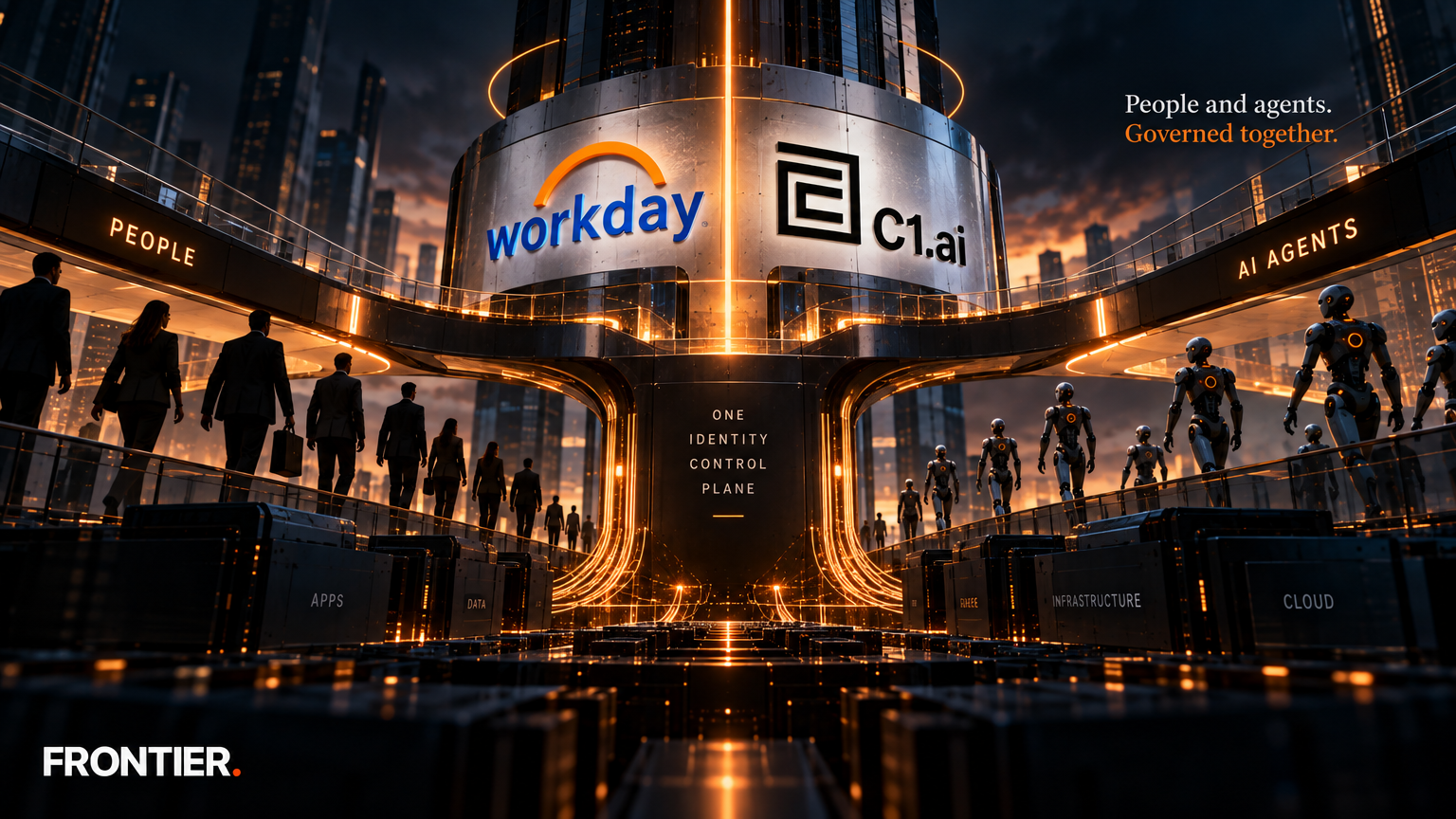
Workday says C1.ai connects with email, CRM, code repositories, finance systems and cloud infrastructure to grant and remove access for people and AI agents.1 That description is a vendor claim, not evidence that a combined Workday-C1.ai offering has already been integrated or deployed. Workday also says the acquisition would extend its Agent System of Record from registering AI agents to governing what those agents may access across Workday and other enterprise systems.1 C1.ai's own announcement confirms the transaction, but the promised combined capabilities remain forward-looking while the deal awaits closing.2
The event is therefore more consequential than a conventional feature addition, but less complete than an acquisition headline can imply. Workday has declared an intent to move from maintaining records about agents toward participating in the enforcement of agent access. The strategic signal is clear: identity governance is being repositioned as part of the operating architecture for enterprise AI. The implementation, packaging and realized scope are not yet established.
Why it matters
The CIO decision model for AI agents has often treated identity as a registration problem: establish that an agent exists, associate it with an owner and place it in an inventory. Workday's stated rationale points toward a more demanding model. If agents interact with email, CRM, source-code repositories, finance platforms and cloud infrastructure, the decisive question is not merely whether an enterprise can identify them. It is whether the enterprise can determine, approve, constrain and revoke what each agent may access across those systems.1
That changes the sequence of enterprise AI decisions. Identity and access governance can no longer be treated as a control added after an agent proves its usefulness. It becomes a prerequisite for deployment wherever an agent crosses application or infrastructure boundaries. This is an analytical implication of the access scope Workday describes, not proof that its proposed combination has already solved the problem. CIOs should evaluate an agent initiative by its control path as well as its business case: what systems the agent can reach, who authorizes that reach, how access is removed and whether governance spans both human and machine actors.
The boundary between enterprise applications and cybersecurity also becomes less useful for procurement and architecture decisions. Workday's announcement positions a business-application vendor to extend into security-adjacent identity governance.1 That does not establish that Workday will replace existing identity controls. It does mean CIOs will need to assess whether agent governance should reside primarily in an application platform, an enterprise-wide identity layer or an architecture in which responsibilities are divided between them. The correct choice cannot be inferred from the acquisition announcement because integration details and commercial packaging have not yet been demonstrated.
The pending transaction introduces an additional decision constraint. CIOs should not equate strategic alignment with product readiness. Workday expects the transaction to close in the quarter ending January 31, 2027, subject to customary conditions.1 Until closing occurs and combined products ship, commitments that depend on integrated capabilities remain roadmap bets. Independent reporting confirms that this is an agreement to acquire C1.ai, not a completed purchase.35
The practical change is a move from vendor selection based chiefly on agent functionality toward architecture selection based on governability. A capable agent that lacks a reliable access-control and revocation model can create an unresolved dependency across every system it touches. Conversely, an identity product that can catalogue agents but cannot govern their effective access leaves the central operational question unanswered. CIOs therefore need evidence at the level of permissions and enforcement, rather than relying on a vendor's agent count, product taxonomy or acquisition narrative.
This also alters how technology value should be assessed. Because the purchase price was not disclosed, the transaction does not provide a public valuation benchmark for agentic identity technology.4 CIOs should avoid reading market economics into the deal. Its stronger signal is architectural: Workday believes registering agents is insufficient without a mechanism for controlling their access across enterprise systems.1 Whether Workday and C1.ai can deliver that mechanism as a cohesive product remains to be proven.
Frontier take
Agent deployments without enforceable, cross-system access governance should now be classified as architecture debt, not merely incomplete security work. That is the strongest defensible conclusion from Workday's proposed acquisition. The company is explicitly connecting its agent system-of-record strategy with governance over what agents and people can access.1 The transaction does not prove that Workday has delivered a unified control plane, but it does clarify the standard against which enterprise agent platforms should be judged.
A record of an agent answers administrative questions: whether the agent is known, who is associated with it and where information about it resides. A control plane must answer operational questions: which resources the agent can reach, who approved that access and how the organization removes it. Workday's description of C1.ai emphasizes granting and removing access across email, CRM, code repositories, finance systems and cloud infrastructure.1 The analytical significance lies in the breadth of that target. Agent governance is not confined to one application category; it must follow the machine actor across application and infrastructure boundaries.
CIOs should consequently resist organizing agent governance as a collection of isolated product features. If each business platform registers its own agents while access decisions remain fragmented, the enterprise may gain multiple inventories without gaining a coherent governance model. The alternative is not necessarily a single vendor. It is a single architectural policy: every agent must have accountable ownership, explicitly authorized access and a tested path to revocation, regardless of which platform created it.
Workday's move also puts a sharper burden of proof on vendors. Claims about an agent system of record should be separated from evidence of effective access governance. Claims about future integration should be separated from currently shipping controls. Because the Workday-C1.ai transaction is pending, CIOs should request product evidence tied to the post-close offering before changing architecture or commercial commitments. The announced closing schedule is a milestone, not evidence of delivered integration.1
The durable strategic shift extends beyond Workday. Enterprise identity architecture is expanding from governing employees to governing employees and machine actors under a shared control model. This is an inference from the functions Workday says it is acquiring and the systems C1.ai is intended to govern, rather than an independently established market outcome.1 It nevertheless provides a practical decision rule: no agent should advance from experiment to enterprise operation unless its access can be approved, observed and withdrawn with the same seriousness applied to human access.
That rule should govern near-term architecture even if the acquisition closes on schedule. CIOs do not need to predict whether Workday will become the dominant platform for agentic identity. They need to prevent their current agent portfolio from outrunning their ability to control it. The acquisition is strategically important because it exposes the gap between knowing that an agent exists and governing what it can do. Closing that gap—not purchasing against an announcement—is the CIO priority.
Three moves for CIOs
-
— Make access proof the promotion gate for every AI agent Add a formal control gate between agent experimentation and production. Require the sponsoring team to identify the agent's accountable owner, every enterprise system it will access, the permissions it needs, the approval authority for those permissions and the tested method for removing access. Evaluate the complete access path rather than accepting registration in an agent inventory as sufficient evidence of control.
- Decision trigger: Apply the gate whenever an agent requires write access, spans more than one enterprise system or reaches email, CRM, code repositories, finance systems or cloud infrastructure.
- Why now: Workday's stated rationale distinguishes registering agents from governing what they can access across enterprise systems.1 That distinction should become an immediate operating requirement even though the proposed acquisition remains pending.
-
— Split current-state buying decisions from post-acquisition roadmap bets Maintain two evaluation tracks for Workday and C1.ai: one documenting controls that can be demonstrated today, and another covering capabilities dependent on the transaction closing or subsequent integration. Tie architecture decisions and commercial commitments to observable milestones, including transaction close, product availability and demonstrated cross-system access enforcement.
- Decision trigger: Use the split-track review before any renewal, platform consolidation or agent rollout whose business case assumes a combined Workday-C1.ai capability.
- Why now: The companies have signed a definitive agreement, but the acquisition has not closed and is expected to do so only in Workday's fiscal 2027 fourth quarter, subject to customary conditions.12 Treating roadmap intent as current capability would collapse an important distinction between strategic direction and delivered control.
-
— Test revocation as the decisive agent-governance capability Run a controlled exercise in which an agent's access must be removed across every connected system. Verify that the organization can identify the responsible owner, execute revocation and confirm that access is no longer available. Use the results to decide whether governance remains fragmented or can operate as a shared control plane for human and machine access.
- Decision trigger: Require the exercise before an agent receives access to finance, code or cloud infrastructure, and repeat it when the agent's owner, purpose or connected systems change.
- Why now: Workday specifically describes C1.ai in terms of granting and removing access for people and agents across multiple enterprise environments.1 Revocation therefore provides a concrete test of the strategic thesis: an agent identity is governable only when its effective access can be withdrawn, not merely when its record can be deleted.
Sources
[^workday-primary][^c1-primary][^idtech-reporting][^sbbit-reporting][^silicon-florist-reporting]