Snowflake Expands Business Ontology and Cortex AI Gateway as Enterprise AI Shifts to Governed Control
Snowflake announced a Business Ontology and expanded Cortex AI Gateway controls, signaling a larger shift from competing on model access to governing the business context, tool use, security and spending that determine whether enterprise agents can operate reliably.
Take the argument with you.
Read the publication-ready report. Generated from the canonical News article.
What changed
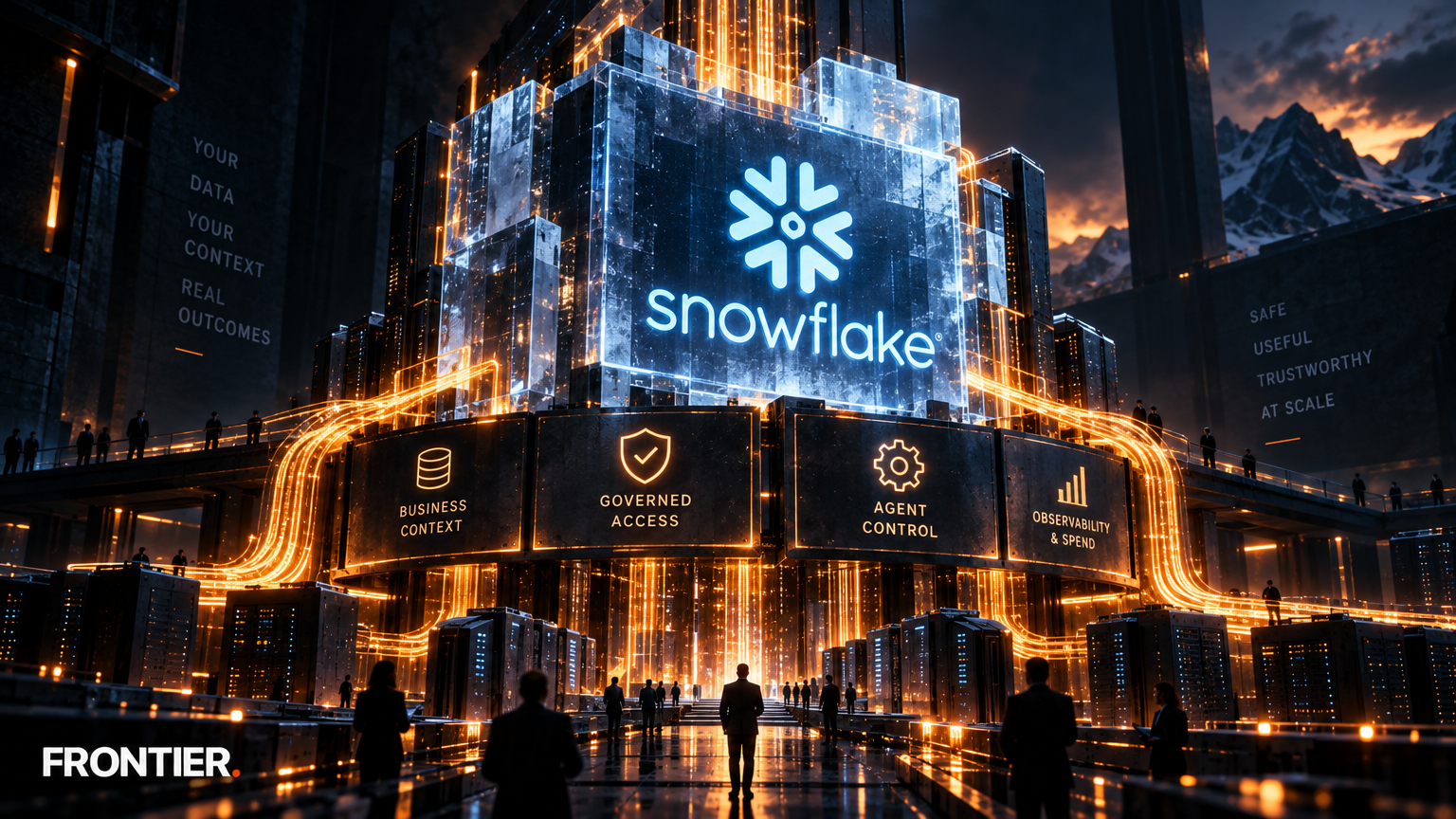
Snowflake announced an expansion of its agentic AI portfolio at its Expedition 2026 event on November 3, centered on a new Business Ontology and additional governance capabilities associated with Cortex AI Gateway.1 The announcement connects two requirements that enterprises have often addressed separately: defining what business concepts mean and controlling what AI agents can access, invoke and spend.
Business Ontology, part of Snowflake Horizon Context, is designed to associate approved business terms, relationships and ownership with the semantic views, tables and views that implement them.2 Snowflake says this governed context can give agents consistent definitions and make their answers more traceable.1 That is a vendor claim about anticipated product behavior, not evidence that the capability has achieved those outcomes across production deployments.
Availability is material to the news. As of the announcement, Snowflake described Business Ontology as coming to public preview soon rather than as generally available.2 TechTarget independently reported the planned public-preview timing, while characterizing the broader portfolio move as part of Snowflake's effort to become a control plane for agentic AI.3 CIOs should therefore treat the ontology as an emerging capability to validate, not a production-standard foundation that can yet be assumed in architecture plans.
The Cortex AI Gateway portion is an expansion rather than a new product introduction. SiliconANGLE reported that Snowflake first unveiled the gateway in July 2026 and subsequently added controls around agent governance, monitoring and execution.4 Snowflake's detailed November product disclosure describes the gateway itself as being in public preview.5 The new or expanded capabilities are also at different stages: MCP tool governance and Cortex AI Guardrails are in public preview; Cortex Sandboxes, Agent Trace Intelligence and Dynamic Model Routing are in private preview; and observability and cost-governance capabilities are generally available.5 InfoWorld independently confirmed the ontology announcement and the private-preview status of several advanced execution and monitoring controls.6
Taken together, the announcement is a credible platform expansion, but it is not a uniformly production-ready release. Snowflake is assembling business meaning, access policy, tool governance, security, observability and cost management into a more coherent agent layer. SiliconANGLE independently corroborated the ontology and gateway additions while noting that the gateway had already been introduced.7 The event is therefore best understood as an expansion of Snowflake's control-plane ambitions, with maturity ranging from generally available operational controls to roadmap-level capabilities.
Why it matters
The CIO decision model shifts because model capability alone does not determine whether an agent is safe or useful inside an enterprise. Once an agent interacts with governed data, software tools and workflows, its operating quality depends on whether it receives approved business definitions and whether its actions are constrained, observed and economically managed. The architectural question shifts from “Which model performs best?” to “Which platform can bind shared meaning to enforceable runtime policy, with evidence that the required controls are deployable at the necessary maturity?”
Business Ontology addresses the meaning side of that question. By linking business terms, ownership and relationships to the data structures that implement them, Snowflake is proposing a governed route between an enterprise concept and the technical assets an agent uses.2 This matters because agent evaluation cannot stop at fluent output. CIOs need to know which definition was applied, who approved it and which underlying data representation supported the answer. Snowflake says the ontology will improve consistency and traceability, but enterprises still need to test that claim against their own conflicting definitions, ownership models and semantic assets.1
Cortex AI Gateway addresses the runtime side. Snowflake says the gateway can centralize policies for agent connections, tool calls and spending.1 Its disclosed portfolio spans governance, guardrails, observability, cost control, execution isolation, tracing and model routing, although those functions are not all generally available.5 The analytical implication is that semantic governance and runtime governance should be evaluated as one operating system for agents. An approved definition has limited value if an agent can invoke an unapproved tool, while a tightly controlled agent remains unreliable if it operates with ambiguous business meaning.
Procurement criteria should therefore separate architectural coherence from production readiness. A platform may present a convincing integrated design while its differentiating controls remain in preview. In Snowflake's case, generally available observability and cost-governance functions can be assessed differently from the forthcoming ontology and private-preview capabilities such as Dynamic Model Routing, Cortex Sandboxes and Agent Trace Intelligence.5 Treating all announced functions as equivalent would convert product roadmap risk into enterprise architecture risk.
Economics also becomes a real governance concern rather than a simple model-price comparison. Snowflake reports that Dynamic Model Routing produced up to three times greater token efficiency than a frontier-model-only approach at the same quality in its internal testing.5 That result is vendor-reported, and the routing capability is in private preview. It should inform a test hypothesis, not a business case. CIOs need workload-specific measurements that preserve approved context, output quality and policy enforcement while comparing total execution cost.
The resulting decision model has three dimensions: governed meaning, governed execution and verified maturity. A platform should pass all three before it becomes a production dependency. This is stricter than selecting a model endpoint or approving a standalone agent tool, but it reflects the structural change represented by Snowflake's announcement: the control plane is becoming as consequential as the intelligence it governs.
Frontier take
The medium-term enterprise AI battleground will be the governed agent control plane, not the model catalog. Models can be substituted or routed, but the layer that encodes approved business meaning, regulates tool use, records execution and controls spending becomes embedded in enterprise operations. Snowflake's announcement is strategically important because it brings those functions into one architecture, even though several of the most differentiated components are not yet generally available.5
That assertion does not mean Snowflake has already established a complete production standard. Business Ontology had not yet entered public preview at the time of the announcement, and important gateway capabilities remained in private preview.26 The defensible conclusion is narrower: Snowflake is aligning its product direction with the control problem that CIOs must solve as agents move from answering questions to using enterprise tools and workflows. Independent reporting similarly framed the announcements as an effort to strengthen Snowflake's position as an agentic AI control plane.3
This distinction should organize enterprise evaluation. CIOs should not score the announcement as a bundle of features or compare it with competitors using a checklist detached from availability. They should examine whether the platform can preserve a governed chain from business definition to data implementation to agent action—and whether every link required for a production use case is available, observable and enforceable. Preview capabilities can support pilots and influence roadmap negotiations, but they should not silently become dependencies for controls that a production system needs on day one.
The larger strategic shift extends beyond Snowflake. As agents gain access to enterprise data and tools, competitive advantage moves toward the architecture that makes their decisions understandable, their actions governable and their costs measurable. Snowflake's portfolio expansion supplies evidence of that direction; it does not by itself prove production outcomes. The correct CIO response is neither to dismiss the previews nor to design around promises. It is to use the announcement to establish a stricter control-plane standard and require vendors to demonstrate it against real enterprise semantics, actions and economics.
Three moves for CIOs
-
— Make the context-to-action chain a single architecture gate Select one consequential agent workflow and document the complete chain from approved business term and owner to its implementing semantic view, table or view, then to every permitted tool call and policy decision. Require the platform pilot to show how an operator can trace an answer or action through that chain. Use Snowflake's ontology and gateway architecture as a testable design proposition, not as proof that the chain already works in production.21
- Decision trigger: Apply this gate before an agent is allowed to cross from retrieval into tool use, or whenever conflicting definitions could change a business decision or downstream action.
- Why now: Snowflake is explicitly connecting governed business context with centralized agent controls, but the ontology is not yet in public preview and portions of the execution layer remain pre-GA.5 Defining the gate now lets the enterprise test the architecture without making preview software an unexamined production dependency.
-
— Contract for control maturity, not announced feature breadth Create a control matrix that labels every required capability as generally available, public preview, private preview or roadmap. Assign an acceptable operating mode to each: production dependency, bounded pilot or nonbinding roadmap item. Put required availability, evidence and fallback provisions into architecture approvals and commercial negotiations rather than scoring all announced capabilities equally.
- Decision trigger: Escalate the decision whenever a mandatory security, traceability, isolation, routing or semantic-governance control is not generally available by the production design freeze.
- Why now: Snowflake's portfolio currently spans materially different maturity levels: observability and cost governance are generally available, some gateway controls are in public preview, and Sandboxes, Agent Trace Intelligence and Dynamic Model Routing are in private preview.5 A maturity-weighted decision prevents architectural coherence on slides from being mistaken for operational readiness.
-
— Benchmark policy-adjusted agent economics Measure cost per successfully governed task rather than token price alone. The benchmark should hold business definitions, output quality and policy enforcement constant while recording model consumption, tool calls, exceptions and operator review. Treat Snowflake's reported routing efficiency as a hypothesis and compare it with a fixed-model baseline using the enterprise's own workload and acceptance criteria.5
- Decision trigger: Run the benchmark before approving scaled agent spending, and repeat it when model routing, guardrails or tool policies change enough to alter quality, risk or execution cost.
- Why now: Snowflake reports up to three times greater token efficiency from Dynamic Model Routing at the same quality in internal testing, but the result is vendor-reported and the capability remains in private preview.5 CIOs need an economic measure that rewards lower cost only when governed context and runtime controls remain intact.
Sources
- Snowflake Helps Enterprises Deploy AI Agents with Trusted Business Context and Built-In Controls 1
- Business Ontology Governs Business Concepts and Metrics for AI and Analytics 2
- Build Trust in AI Agents with Governed Business Context and AI Security 5
- Snowflake expands agentic AI platform with business context and governance tools 7
- Snowflake debuts Cortex AI Gateway to govern and monitor enterprise AI agents 4
- Latest Snowflake blast targets trust in AI and efficient development 3
- Snowflake launches Business Ontology to boost AI agent reliability 6
- Snowflake ups AI agent context, governance game 8
[^snowflake-press-release][^snowflake-business-ontology-blog][^techtarget-report][^siliconangle-original-gateway-report][^snowflake-governance-blog][^infoworld-report][^siliconangle-candidate-report][^constellation-report]