ServiceNow’s Control Tower Alliance Turns AI Governance Into a Cross-Vendor Control-Plane Decision
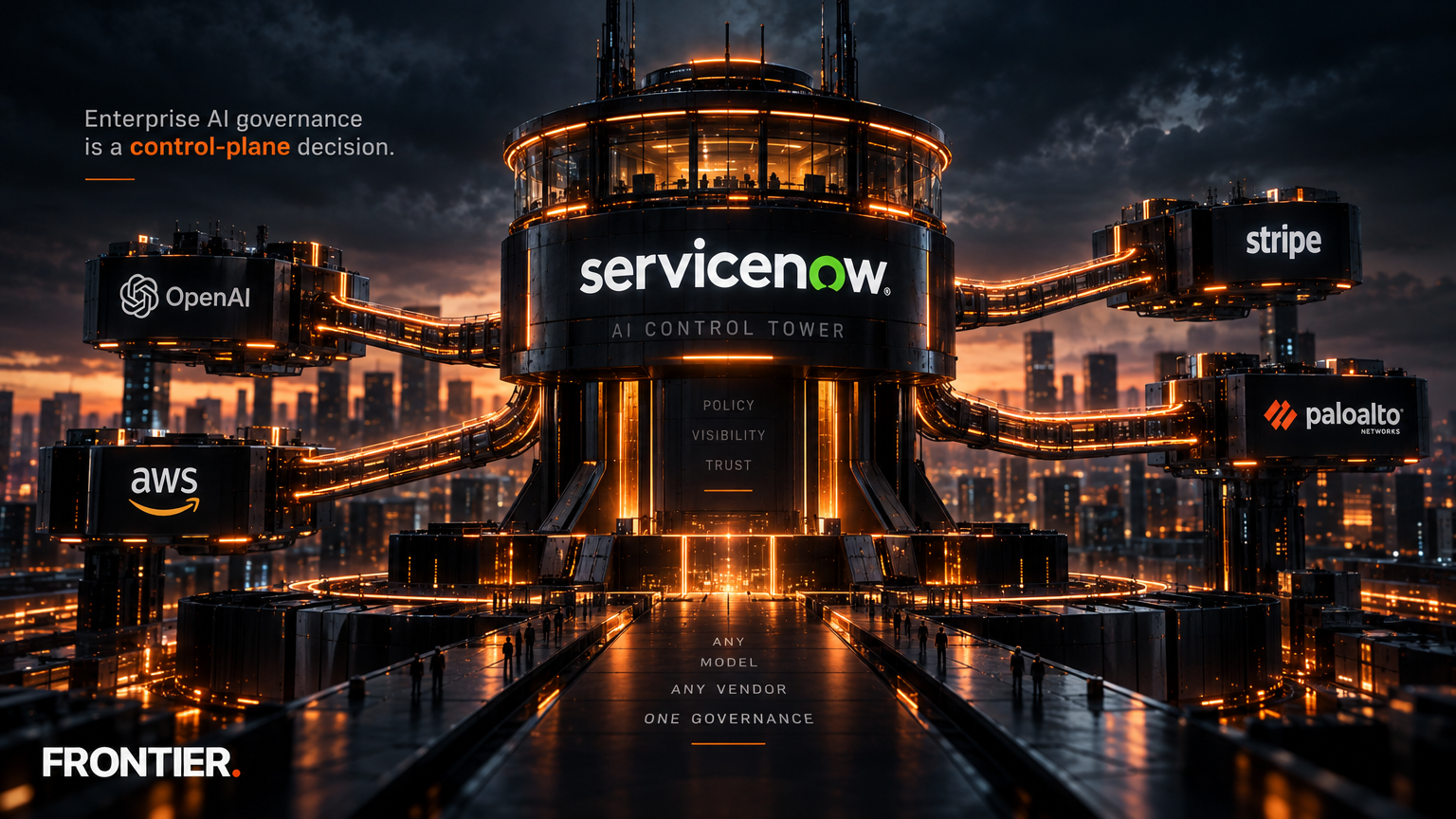
ServiceNow has formed an 11-member alliance with OpenAI, Stripe, AWS and other infrastructure and security vendors, signaling a larger shift from governing individual AI products to controlling heterogeneous AI estates through shared qualification, integration, policy and cost-management layers.
Take the argument with you.
Read the publication-ready report. Generated from the canonical News article.
What changed
ServiceNow announced the ServiceNow Control Tower Alliance on October 28, 2026, with 11 founding members: Anthropic, Amazon Web Services, Cisco, HiddenLayer, Kong, NVIDIA, Okta, OpenAI, Stripe, WitnessAI and Zenity.1 Independent coverage from StreetInsider and The Paypers reported the launch and the same founding-member roster.23 Stripe and OpenAI are therefore important participants, but they are not the alliance’s only partners.
ServiceNow describes the initiative as an ecosystem for building, certifying, integrating and co-selling partner solutions governed through its Super Intelligence Control Tower.1 According to the company, curated partner offerings will undergo qualification, certification and integration testing before being made available to customers.1 Kong separately confirmed that it is a founding member and said its participating solutions will go through ServiceNow qualification and certification, corroborating the proposed operating model from the perspective of one partner.4
The composition of the alliance is quite a bit more important than any single member. It spans leading model providers, cloud infrastructure, accelerated computing, networking, identity, API infrastructure and AI security. That breadth reflects the operational reality that enterprise AI is not one product category. A production AI service can depend on a model, cloud environment, gateway, identity layer, security controls and metered consumption mechanisms, each supplied by a different vendor. The governance challenge consequently sits across the connections among products, not solely inside the products themselves.
ServiceNow also says Stripe’s proposed contribution will come through Metronome and is intended to provide usage-based billing, usage visibility and spending controls.1 That is a vendor-stated plan rather than evidence of a completed deployment. More broadly, the available disclosures verify the alliance’s formation and membership, but they do not establish that every integration is generally available, that every partner solution has completed certification, or that customers have achieved quantified operational, risk or financial outcomes. Pricing and adoption levels also remain undisclosed.1 The relevant news is therefore the creation of a cross-vendor governance structure—not proof that the structure has already delivered governance at enterprise scale.
Why it matters
The CIO decision model changes when AI governance shifts from a checklist attached to each model into a control layer spanning the full estate. A model-by-model evaluation asks whether a particular service meets requirements for security, performance, compliance and cost. A control-plane evaluation asks a different set of questions: Can policies remain consistent when teams use multiple models and clouds? Can identity, traffic, security and consumption data be reconciled across vendors? Are integrations tested as a working system? Can the enterprise detect when a provider, dependency or pricing mechanism changes?
ServiceNow’s stated qualification and integration-testing approach addresses that systems-level problem in concept.1 Kong’s statement that its solutions will undergo qualification and certification reinforces that participation is intended to involve more than placement on a partner list.4 However, neither disclosure demonstrates the depth of the tests, the resulting technical assurances or their equivalence to a customer’s own control requirements. CIOs should treat certification as evidence to inspect, not as a substitute for architecture review, control testing or contractual accountability.
This reframes vendor selection. Standalone product capability remains necessary, but it is no longer sufficient. A highly capable AI product can increase enterprise risk if its identity model, telemetry, policy interfaces or usage records cannot be integrated into the operating environment. Conversely, an ecosystem control plane can reduce coordination costs only if its connectors expose meaningful controls and preserve enough underlying evidence for independent audit. The alliance’s announced breadth makes this integration question visible, but measurable performance remains unproven.25
Economic governance also becomes part of architecture governance. ServiceNow’s description of Metronome’s proposed role links usage visibility and spending controls to the same environment intended to manage security and operational policy.1 The analytical implication is that CIOs should stop treating AI cost management as a periodic finance exercise detached from technical controls. In usage-based systems, consumption is produced by architectural choices: model routing, application behavior, user access and automated workflows. A governance layer that sees policy but not consumption—or consumption but not workload context—cannot provide a complete decision record.
The procurement unit should therefore shift from the individual AI product to a governed service path. That path includes the model and every material dependency through which identity, requests, data, controls and charges flow. CIOs should compare platforms according to how well they govern that path across vendors, how much evidence they retain, and how easily components can be replaced without losing policy continuity. This does not mean selecting the ecosystem with the most logos. It means testing whether the control plane can reduce fragmentation without creating a new concentration point that the enterprise cannot independently verify or exit.
The distinction matters because alliance membership is not deployment evidence. The launch establishes a direction of travel toward cross-vendor governance, supported by prominent vendors across the AI stack.32 It does not yet establish production coverage, customer outcomes or universal interoperability. CIOs should recognize the structural shift while keeping approval contingent on demonstrated controls in their own architectures.
Frontier take
The strongest defensible conclusion here is that the strategic control point in enterprise AI is moving above the model layer. ServiceNow is positioning its control tower—and the partner qualification structure around it—as the place where heterogeneous AI services become governable. Whether ServiceNow ultimately secures that position is unresolved, but the category shift is already visible in the alliance’s cross-vendor design.1
This is not principally a contest over which vendor offers the best individual model, gateway or security tool. It is a contest over which layer can assemble trustworthy operational evidence across them. The winning control plane will need to connect policy decisions to identities, workloads, dependencies, usage and cost while allowing enterprises to verify those connections. ServiceNow’s announced testing and certification process is relevant because it attempts to standardize the connective tissue.1 Yet certification creates strategic value only when its scope, test results, version coverage and remediation obligations are transparent enough to support enterprise assurance.
CIOs should also resist equating ecosystem breadth with reduced risk. A broad alliance can simplify integration, but it can also move dependency upward. If policy definitions, audit evidence and spending records become inseparable from one orchestration layer, replacing that layer may be harder than replacing an individual model. The appropriate response is not to reject control planes; fragmented governance is itself an operational problem. The response is to demand portable policy definitions, accessible event records, explicit responsibility boundaries and tested fallback procedures before consolidating governance authority.
The alliance should consequently be evaluated as an emerging operating model rather than a finished product bundle. The confirmed facts are the launch, the 11-member roster and the stated qualification-and-integration framework.14 The claims that remain to be demonstrated include production readiness across the roster, the consistency of controls between partners, economic benefits and customer outcomes. That separation between fact and inference should govern procurement: the structural thesis warrants action now, while the unproven implementation warrants staged commitments rather than presumptive standardization.
Three moves for CIOs
-
— Procure a governed service path, not an alliance logo set Select two representative AI services—one high-volume workflow and one higher-risk workflow—and map every model, cloud, gateway, identity, security and metering dependency involved. Require ServiceNow or any competing control-plane provider to demonstrate policy enforcement, evidence collection and cost attribution across that complete path. Make qualification artifacts, integration-test scope, supported versions, remediation ownership and evidence-access rights contractual deliverables. Do not accept alliance membership or certification status alone as proof that the customer-specific path is controlled.
- Decision trigger: Use this test before approving an enterprise AI platform standard, committing to a multiyear control-plane agreement, or allowing a workflow to depend on three or more separately contracted AI-stack providers.
- Why now: ServiceNow says partner solutions will pass qualification, certification and integration testing, and Kong has confirmed its intent to participate in that process.14 Those statements create an opportunity to demand system-level evidence, but the disclosed research does not establish completed coverage or customer outcomes. Establishing the evidence standard before procurement prevents a partner roster from becoming a proxy for verified interoperability.
-
— Set an exit boundary around the control plane Define which governance assets must remain portable: policy definitions, identity mappings, decision logs, usage records, incident evidence and dependency inventories. Test whether those assets can be exported in usable form and whether a critical workflow can continue under a documented fallback process if the control plane or one partner integration becomes unavailable. Assign explicit ownership for controls that the platform cannot enforce consistently across vendors.
- Decision trigger: Require the portability and fallback test whenever a governance platform becomes the system of record for multiple model providers, clouds or security products, or when replacing it would interrupt audit evidence, access control or cost attribution.
- Why now: The alliance’s cross-vendor scope illustrates why centralized governance can reduce fragmentation, but the same scope can create a new concentration point.23 Because broad deployment and integration performance have not been demonstrated in the supplied evidence, CIOs should establish an exit architecture before operational dependence accumulates—not after policies and records have become bound to one platform.
-
— Join policy telemetry to consumption telemetry Create a single acceptance test that reconciles each governed AI workload’s identity, policy decision, provider route and metered consumption. Require variance thresholds for unexplained usage and escalation rules for workloads whose charges cannot be tied back to an authorized service path. Run the reconciliation in shadow mode before giving the control plane authority to automate spending limits or routing decisions.
- Decision trigger: Activate this requirement when AI services use consumption-based pricing across more than one provider, when automated agents can generate material usage without direct user approval, or when monthly spend cannot be traced to workload-level policy decisions.
- Why now: ServiceNow says Stripe’s proposed contribution through Metronome will address usage-based billing, visibility and spending controls.1 That is not yet a demonstrated customer outcome, but it exposes an important architectural requirement: economic and policy governance must operate from the same workload context. Testing reconciliation now lets CIOs determine whether the control layer can govern both risk and consumption before granting it automated authority.
Sources
- ServiceNow launches Control Tower Alliance to help enterprises adopt AI safely at scale 1
- Kong joins ServiceNow Control Tower Alliance 4
- The Paypers: ServiceNow launches AI governance alliance with Stripe and OpenAI 3
- StreetInsider: ServiceNow forms AI governance alliance with 11 founding members 2
- AI Affairs: Kong joins ServiceNow's 11-member alliance to govern enterprise AI 5
[^kong1]