ServiceNow’s AI Passport Turns Agent Governance Into a Platform Bet
The strategic announcement is not another employee assistant. It is a proposed link between business permissions and agent execution. CIOs should test that architecture—and its full operating cost—before expanding their dependence on ServiceNow.
Take the argument with you.
Read the publication-ready report. Generated from the canonical News article.
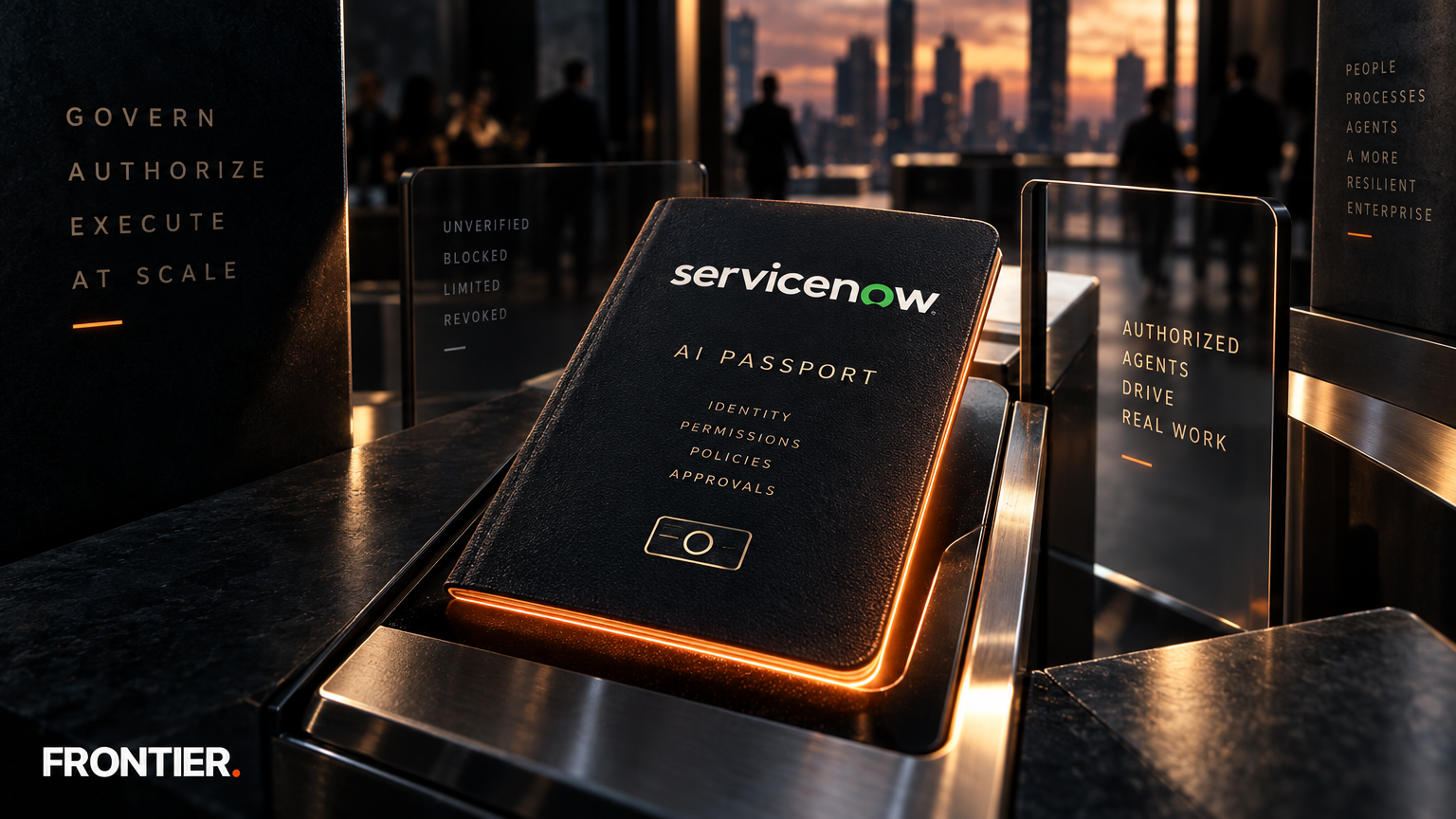
CIOs should evaluate ServiceNow’s latest announcements as a bid to govern overall business execution, not simply improve employee assistance. Connecting the tools that create automation with the controls that authorize it could reduce integration work. It could also make ServiceNow harder to replace: the platform would help run business processes and determine what their agents are allowed to do.
The investment decision is therefore narrower than “Should ServiceNow become our total business platform?” Fund evidence that its controls and workflows work together in your estate. As always, CIOs should not fund platform expansion merely because they appear together on a roadmap.
What changed
On October 15, 2026, ServiceNow announced expanded AI governance capabilities and EmployeeWorks automation tools. The most consequential governance addition is AI Passport, which ServiceNow describes as a signed credential defining an agent’s authorized scope using business context, policies and approvals. The company says it supports narrowing delegated authority and revoking permissions, with NVIDIA serving as a design and launch partner for enforcement through its Open Agent Safety Platform.1
Note that these are not all generally available products. ServiceNow expects AI Passport, shadow-AI detection and AI Cost Management during Q4 2026. Its Operational Resilience offering for financial services was available on October 15. That distinction should separate current procurement decisions from roadmap evaluations.1
The EmployeeWorks announcement expands both automation creation and distribution. Productivity Assistants support specialized work; Productivity Routines perform repeatable background tasks. ToolSmith generates and troubleshoots integrations through conversation, while a Conversations API embeds EmployeeWorks capabilities in existing applications. The announced assistants, routines, execution environment, ToolSmith and Conversations API are in controlled availability.2
Not everything was first introduced on October 15. Moveworks published its ToolSmith notice on September 17, 2026, scheduling controlled availability for September 22, 2026. The October announcement broadens the platform proposition rather than establishing ToolSmith’s debut.3
For CIOs, the strategic shortlist is AI Passport, integration development and embedded access. Together, they could change authorization architecture, delivery effort and how employees reach automation. Research and calendaring assistants are more tactical unless they retire existing tools or improve a measured process. AI Cost Management deserves scrutiny, but a spending dashboard is not evidence of predictable unit economics.
ServiceNow already operates across ITSM, IT operations, HR, customer service, risk and enterprise workflows. Its May announcements explicitly positioned AI Control Tower around discovering, observing, governing, securing and measuring AI across heterogeneous environments. The company has been building this control-plane strategy for some time.
But overall, it is clear that ServiceNow is trying to turn its accumulated business-process context, workflow infrastructure, and integration position into an enterprise control plane for AI-mediated work, and it should almost certainly try to do this. And CIOs must figure out where these capabilities ultimately live in their organization.
Why it matters
The architectural question is where authority becomes enforceable. An agent’s permission to perform a task is useful only if the systems executing that task check it. ServiceNow’s existing AI Gateway documentation makes this boundary explicit: third-party agents can use its controls, but their connections must flow through the gateway. That is cross-platform governance, not universal control over routes that bypass it.4
AI Passport therefore needs to be tested at execution boundaries, not judged by the presence of a signed credential. Can an external agent call a downstream API directly? Does revocation stop delegated actions already queued? What happens when the control service is unavailable? Those are acceptance questions, not findings that the announced product fails.
This is also an operating-model decision. If employees can create more automation, IT inherits more production behavior to support. ToolSmith’s early-access guidance says shared-asset dependencies are not displayed in the conversation; developers must inspect dependencies elsewhere and test generated changes.3 Conversational development may reduce authoring effort without reducing the need for release management, ownership and recovery procedures.
CIOs should consequently distinguish development speed from delivery throughput. Measure the time to put a maintainable workflow into production, including integration testing and support preparation—not merely the time to generate it. An automation without an accountable owner is an operating liability, however quickly it was built.
The commercial question is what a completed transaction costs. SiliconANGLE reports seat-based licensing with bundled AI credits, called assists, and purchases of additional capacity. CIO’s May 12, 2026 reporting separately identified uncertainty around subscription-plus-consumption economics, including retries that can consume additional credits. Neither establishes a universal price per successfully completed workflow.56
Use a customer-specific metric:
Fully loaded cost per verified completion = allocated licensing, consumption, integration, operations, human review and rework costs ÷ correctly completed business transactions.
This is a proposed evaluation measure, not a published ServiceNow benchmark. Compare it with the existing process for equivalent request types and service levels. Separate implementation costs from recurring costs, but include both in the investment case. Require enough consumption detail to reconcile retries and failures with invoices; otherwise, the CIO may own the outcome while lacking visibility into its cost.
Adoption needs equally careful denominators. Measure active use among eligible employees, verified completion without reopening, exception workload and service quality. A request that never becomes a ticket is not necessarily resolved. Nor is staff time redirected to other work automatically a cash saving.
The handoffs matter. The CIO should own integration, delivery and lifecycle economics. The CISO should approve authority and containment requirements, while HR and other process owners define permitted business actions and acceptable outcomes. Finance should distinguish released capacity from spending actually removed. These dependencies belong in the pilot design, not in a benefits dispute after deployment.
Frontier take
The strategic hypothesis holds: linking business authorization to agent execution could make ServiceNow more valuable than a collection of assistants. The stronger proposition—that ServiceNow should therefore own the whole control architecture—does not have to follow.
There is evidence against treating lock-in as inevitable. ServiceNow says AI Passport uses open specifications and allows other governance products and identity providers to issue and verify credentials. DigiCert announced its own AI Passport integration with NVIDIA’s Open Agent Safety Platform on September 28, 2026. That establishes another proposed approach, not equivalent functionality, proven interoperability or lower cost.17
The remaining dependency may sit above the credential: business context, approval logic, workflow definitions and employee access. A portable credential does not make those assets cheap to move. CIOs should ask whether an alternative issuer or agent can be substituted without reconstructing the process around it.
Adoption is unresolved for the new releases, but blanket pessimism would also overreach. In a vendor-published case dated October 8, 2026, ServiceNow reported that Raleigh, North Carolina, resolved nearly half of IT support requests autonomously and reduced service-desk costs by 66%, attributing the cost reduction to redirecting staff time. The case does not disclose a measurement window, dollar baseline or complete reconciliation of incremental costs. It is evidence of reported operational use, not an independently established cash return—and not evidence of adoption of the October 15 features.8
Raleigh’s reported decade of ServiceNow workflows also supports a competing explanation: mature knowledge and standardized processes may account for much of the benefit.8 The newest agent features may amplify that foundation rather than substitute for it. A fragmented enterprise should not budget as though it already possesses the same prerequisites.
Security evidence warrants similar precision. AppOmni’s November 19, 2025 research demonstrated configuration-dependent agent-to-agent prompt injection in Now Assist despite enabled prompt protection. It did not test AI Passport and does not establish that the new controls fail. It does justify testing delegation and configuration rather than accepting a demonstration of one blocked action.9
The strongest counterargument to cautious platform expansion is economic: a mature ServiceNow customer might spend less by reusing established workflows and ownership than by assembling separate governance, orchestration and employee-access systems. That is a credible scenario. For a fragmented customer, however, the same purchase might add another control layer without retiring anything.
The decision should turn on which scenario the customer can demonstrate. Reliable enforcement across external agents, sustained improvement in fully loaded completion costs and practical portability would justify broader investment. Bypassable controls, persistent exception costs or overlapping licenses would weaken it. The supplied evidence does not yet establish production-scale Passport effectiveness or full-cost returns for the newly announced EmployeeWorks capabilities.
Three moves for CIOs
-
Make execution control an acceptance test. Commission architecture and security teams to test external-agent delegation, direct-API bypasses, stale permissions, revocation and recovery after interrupted transactions. Identify the owner and approval boundary for each permitted business action. Decision boundary: retain human approval wherever enforcement or safe recovery cannot be demonstrated. Why now: establish customer-defined acceptance criteria before expected Q4 availability turns into procurement momentum.
-
Fund bounded workflows, not an enterprise adoption target. Select a high-volume service process and a cross-system employee process with accountable owners. Baseline verified completion, operating effort, rework, consumption and service quality; include integration and ongoing support in the business case. Expansion trigger: sustained improvement against the existing process without worse control or quality, with finance confirming whether benefits are capacity gains or cash savings. Why now: limited deployment is the least expensive stage at which to discover that exceptions and integration maintenance consume the promised savings.
-
Buy expansion rights while preserving replacement options. Negotiate explicit metering rules, overage protections and usable telemetry exports. Require a practical test of replacing an agent or credential issuer, and tie additional modules to named costs or systems being retired—or to separately justified service improvements. Decision boundary: no enterprise-wide commitment based solely on bundled access, presumed interoperability or roadmap promises. Why now: leverage is greater before workflows, permissions and employee access become deeply coupled to one platform.
[^employeeworks][^gateway]