SAP’s Agent Expansion Moves the CIO Choice From AI Tools to Control Architecture
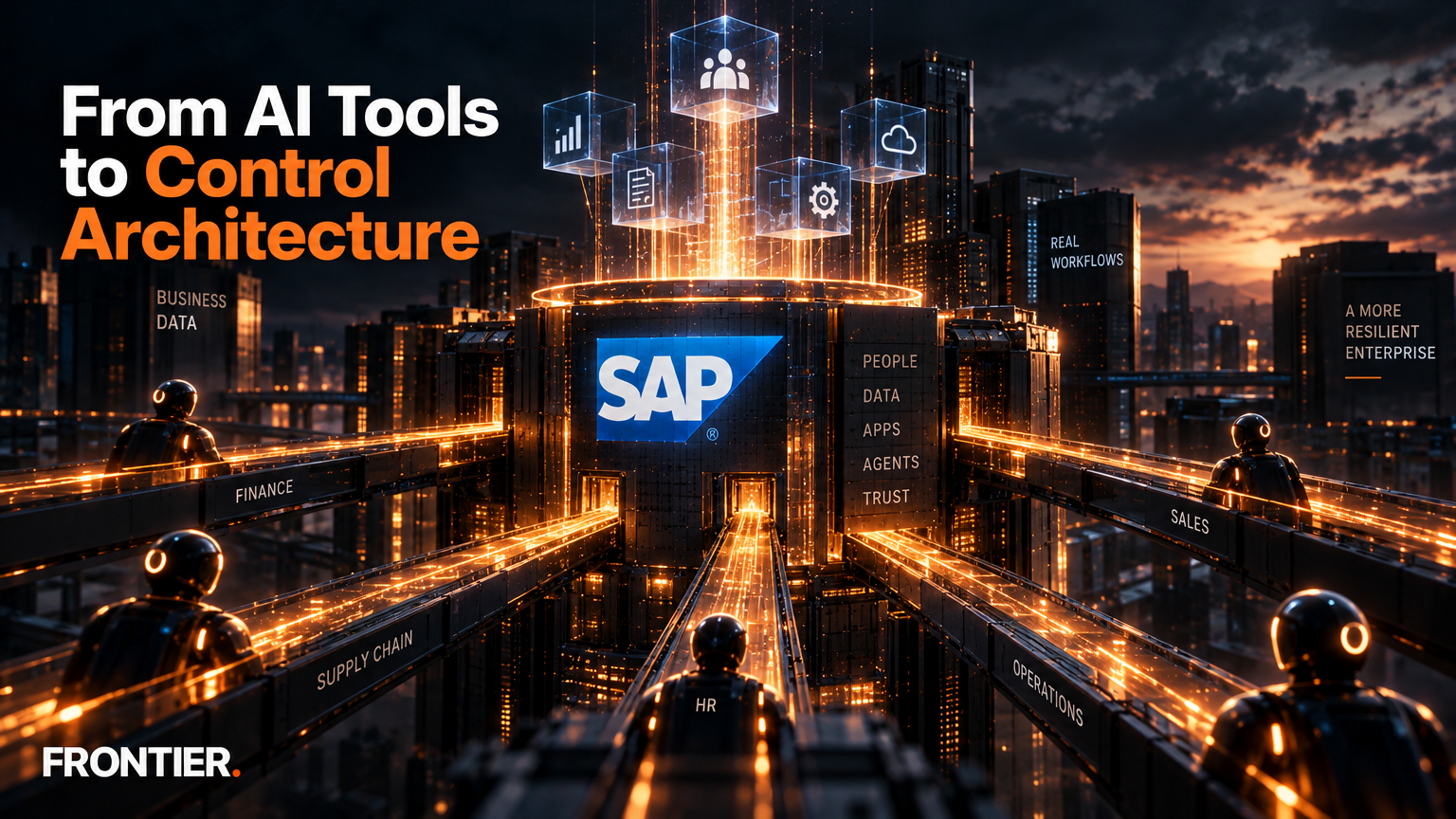
SAP has expanded Joule Studio, agent interoperability, Business Data Cloud integration and AI-governance capabilities, reflecting a larger structural shift toward governed agent ecosystems that can coordinate work across enterprise data, applications and organizational boundaries.
Take the argument with you.
Read the publication-ready report. Generated from the canonical News article.
What changed
SAP announced a broad expansion of its enterprise AI portfolio at SAP TechEd on October 27, 2026, spanning Joule Studio, Joule Work, SAP Business AI Platform, Business Data Cloud, governance tooling and tabular AI models.1 The event is not a single product launch. It is a coordinated attempt to connect four layers that enterprises have often evaluated separately: agent development, business-data context, cross-platform interoperability and centralized governance.
For agent creation, SAP says Joule Studio will support both no-code and pro-code development and provide access to more than 70 AI models. The company also says n8n workflow design and execution is available to early-adopter customers, with wider availability planned later.1 These are vendor claims about capability and availability, not evidence that every customer can deploy the complete stack in production today.
A narrower but already available interoperability change is more concrete. SAP’s architecture disclosure says inbound Agent2Agent interoperability through its existing Agent Gateway became generally available in October 2026. Authorized third-party clients can use that gateway to invoke supported SAP agents.2 This existing Agent Gateway must be distinguished from the newly announced SAP Enterprise AI Gateway, which is intended to provide broader governance and control. Independent reporting and the German-speaking SAP user group DSAG place general availability of the Enterprise AI Gateway in the first quarter of 2027.34
SAP also announced Business Data Cloud Ontology Manager, which is intended to create domain-specific views of SAP Knowledge Graph, and an expanded Databricks integration covering Lakeflow, Agent Bricks, Unity Gateway and Lakebase.5 The architectural direction is to give agents business context while linking SAP-managed data and processes with external data and AI services.
Independent reporting corroborates the broader package: additions to Joule Studio, agent orchestration, Model Context Protocol and Agent2Agent interoperability, Enterprise AI Gateway controls, Knowledge Graph integration and Business Data Cloud tooling.36 It also introduces an essential qualification. Techopia notes that availability varies by component and that the announcement does not establish that every gateway, governance or agent capability is immediately usable by every customer.6
The October 29 BigDATAwire page within the HPCwire domain should not be treated as separate independent validation. The page identifies SAP as its source and is a syndicated vendor release.7 The verified event is therefore SAP’s platform announcement, with independent sources supporting its scope while also highlighting the gap between architectural direction and present production availability.
Why it matters
The CIO decision model changes because enterprise agents are beginning to cross boundaries that conventional assistants did not. An assistant can be assessed largely through user experience, model performance and application fit. An agent that invokes business functions, uses governed data and coordinates with other agents must also be assessed through identity, authorization, context quality, interface compatibility, observability, operating cost and failure containment. The unit of evaluation becomes an agent control architecture rather than an isolated AI feature.
SAP’s announcement illustrates that shift. Agent development in Joule Studio is being connected to interoperability mechanisms, business semantics and gateway-based controls.12 Business Data Cloud Ontology Manager and the expanded Databricks integration are positioned to connect AI systems with enterprise context rather than leaving them dependent on unstructured prompts or disconnected data stores.5 The Enterprise AI Gateway is separately positioned as a governance layer, although independent sources place its general availability in Q1 2027 rather than at the time of the announcement.34
Reported fact and analytical inference need to remain distinct. The reported fact is that SAP has made inbound Agent2Agent access through the existing Agent Gateway generally available for supported agents and authorized third-party clients.2 The analytical inference is that CIOs can now test a meaningful portion of cross-platform agent architecture without assuming that SAP’s entire announced governance stack is ready. That makes staged validation possible, but it does not justify buying roadmap elements as though they were production services.
Procurement must consequently separate architecture commitment from feature availability. A traditional software evaluation might compare functions, license terms and implementation requirements at a release level. For an agent platform, each architectural dependency needs its own status: generally available, beta, early adopter or roadmap. The distinction is material here because the existing Agent Gateway, n8n support and Enterprise AI Gateway do not share the same availability posture.123
The operating model must change as well. Open protocols can reduce interface isolation, but protocol support alone does not establish safe interoperability. CIOs still need evidence that an external agent can be authenticated, restricted to approved actions, supplied with appropriate business context, monitored and stopped. They also need to know which platform records the decision trail and which team owns failures that cross SAP and non-SAP systems. These are analytical requirements implied by the move to authorized, cross-platform agent invocation; they are not capabilities proven merely by an announcement.
Cost evaluation also moves closer to architecture. DSAG welcomed SAP’s emphasis on governance, open interfaces and non-SAP data, while warning that practical integration effort, pricing after promotional periods and predictable operating costs remain unresolved.4 For CIOs, that means a favorable demonstration is insufficient. A viable decision requires measured integration labor and an operating-cost model covering agent calls, models, data access, orchestration and governance. The strategic question is whether the control architecture remains manageable as agents and workflows multiply—not whether one pilot produces an impressive result.
Frontier take
The decisive enterprise AI control point will be the agent gateway and its surrounding policy architecture, not the model catalog. Models will remain important components, but CIO leverage will come from controlling which agents can act, what enterprise context they can use, which systems they can invoke and how every action is governed across vendor boundaries.
SAP’s expansion is strategically relevant because it assembles the pieces of that control plane: agent development in Joule Studio, inbound Agent2Agent interoperability, business context through Knowledge Graph and Business Data Cloud capabilities, and a separate Enterprise AI Gateway intended to govern a broader environment.125 Independent reporting supports that architectural interpretation while making clear that the pieces are not all available on the same schedule.36
That availability mismatch is not a peripheral execution issue; it is the central CIO risk. If an enterprise designs around the future gateway before its controls, economics and integration requirements can be tested, it converts an architectural direction into an unpriced dependency. If it dismisses the announcement because some components remain on the roadmap, it may miss the significance of the generally available Agent2Agent capability that can already support bounded interoperability tests.2 The appropriate response is neither immediate platform standardization nor passive waiting. It is a staged control-architecture decision tied to verifiable release states.
This framing also prevents open interfaces from being mistaken for automatic openness. MCP and A2A support can make technical connection easier, according to the independently corroborated scope of SAP’s announcement.36 They do not by themselves determine whether customers can substitute components, export policies, preserve audit records or forecast cross-platform operating costs. DSAG’s call for clarity on integration effort and predictable costs is therefore an architectural concern as much as a commercial one.4
The durable shift extends beyond SAP. Enterprises are moving toward ecosystems in which authorized AI systems can use shared business context and coordinate work across application and organizational boundaries. SAP’s announcement is credible evidence of that direction, but not proof that its complete implementation is production-ready. CIOs should make the gateway, policy model and evidence of operability the primary decision objects, then treat individual agents and models as replaceable components within that governed structure.
Three moves for CIOs
-
— Create a release-state contract for the agent architecture Build a control-architecture ledger that maps every required capability—agent development, identity, authorization, A2A or MCP interoperability, business context, auditability and gateway policy—to a named product component and a verified status of generally available, beta, early adopter or roadmap. Require procurement, security and architecture teams to approve the same ledger. For SAP evaluations, keep the generally available Agent Gateway separate from the planned Enterprise AI Gateway and record n8n early-adopter functionality as a distinct dependency.123
- Decision trigger: Use the ledger as a mandatory decision gate whenever a proposed production workflow depends on more than one agent, invokes a third-party client or requires a capability that is not contractually confirmed as generally available. Defer platform-wide commitment if a critical control exists only in beta, early access or a Q1 2027 roadmap.
- Why now: SAP’s portfolio expansion combines capabilities with materially different availability dates, while independent reporting cautions that the full announced stack is not immediately usable by every customer.6 A release-state contract prevents roadmap language from becoming an undocumented production dependency and operationalizes the thesis that CIOs are selecting a control architecture, not buying a feature bundle.
-
— Test control portability before testing agent intelligence Run a bounded interoperability exercise in which an authorized external client invokes a supported SAP agent through the existing Agent Gateway. Evaluate identity propagation, least-privilege access, permitted actions, context boundaries, logging, revocation and failure handling before comparing model quality. Document which controls are native to the gateway, which depend on adjacent SAP services and which must be supplied by the enterprise or another vendor.2
- Decision trigger: Advance beyond the pilot only when the same policy can be demonstrated across at least one SAP and one non-SAP interaction without manual permission changes, missing audit evidence or uncontrolled data exposure. Stop the evaluation if protocol compatibility is present but policy enforcement cannot be demonstrated end to end.
- Why now: Inbound A2A interoperability is already generally available for supported SAP agents, providing a testable foundation without assuming the future Enterprise AI Gateway is in production.2 Testing control portability now distinguishes real interoperability from interface compatibility and produces evidence that can inform the later gateway decision.
-
— Price the governed workflow, not the individual agent Construct a unit-cost model for one end-to-end business workflow that includes agent and model usage, data access, orchestration, gateway controls, monitoring and integration labor. Model current availability separately from the target architecture so that planned governance components do not appear as zero-cost assumptions. Require vendors to identify promotional terms, expected post-promotional pricing and the cost implications of invoking non-SAP services.
- Decision trigger: Require redesign or commercial renegotiation when the workflow lacks a predictable cost envelope, when integration effort cannot be estimated from a working pilot, or when scaling the number of agents causes governance and orchestration costs to grow without an accountable owner.
- Why now: DSAG has explicitly welcomed greater control and openness while warning that practical integration effort, post-promotional pricing and predictable operating costs still need to be established.4 Measuring the governed workflow aligns financial approval with the actual control architecture and prevents a low-cost agent demonstration from obscuring the economics of production autonomy.
Sources
- SAP: SAP Empowers AI Developers to Build What Matters and Turn Intent into Autonomous Execution 1
- SAP Architecture Center: Third-party agents can now interoperate with SAP Agents via the Agent Gateway 2
- SAP: Lakehouse and Data Fabric Innovations in SAP Business Data Cloud 5
- BigDATAwire/HPCwire: SAP Expands AI Agent Development, Data Integration and Governance Tools 7
- Computerwoche: SAP TechEd 2026 – das Autonomous Enterprise wird konkreter 3
- Techopia: SAP puts business controls behind AI agents 6
- DSAG: More control and openness for AI, with demand for predictable costs 4
[^sap-press-release][^sap-agent-gateway-disclosure][^computerwoche][^sap-bdc-disclosure][^techopia][^hpcwire-bigdatawire]