Red Hat and NVIDIA Expand AI Factory Around OpenShell, Moving Agent Governance Into Infrastructure
Red Hat and NVIDIA have expanded their AI Factory collaboration with planned OpenShell integration, a governed inference design and next-generation infrastructure support—evidence of a larger shift that is embedding agent controls across the enterprise AI stack rather than attaching them to individual applications.
Take the argument with you.
Read the publication-ready report. Generated from the canonical News article.
What changed
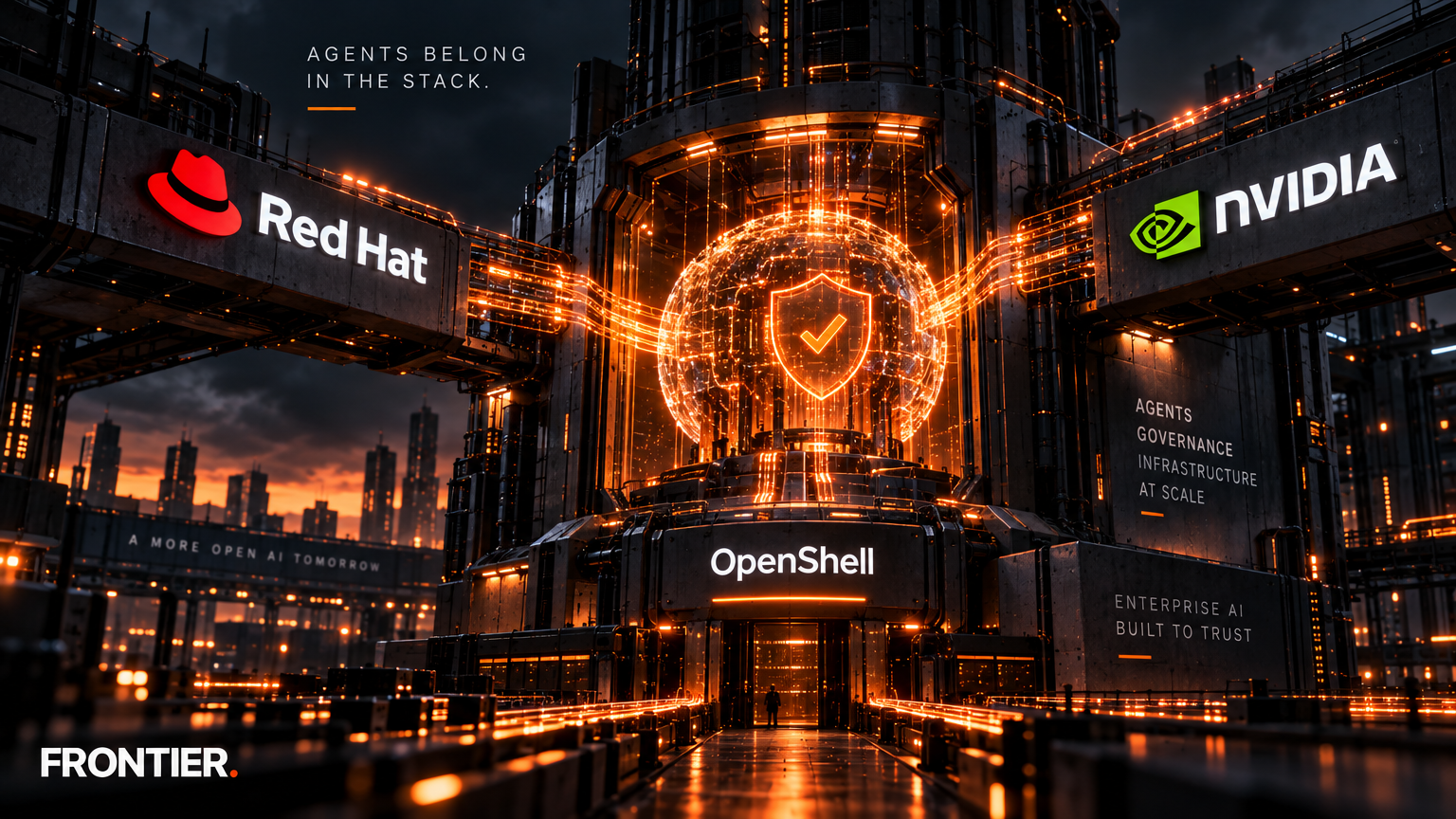
Red Hat announced an expansion of its collaboration with NVIDIA on October 21, 2026, at NVIDIA GTC Berlin. The announcement spans three connected areas: security architecture for autonomous agents, a reference design for governed inference and planned support for NVIDIA’s next-generation Vera Rubin infrastructure.1 Independent reporting corroborated the expanded partnership and its emphasis on securing autonomous AI agents.2
The central security element is NVIDIA’s OpenShell Reference Architecture, which NVIDIA launched separately on the same day. NVIDIA identified Linux and Kubernetes environments based on Red Hat technology among the platforms intended to support the architecture.3 Independent coverage from The Register and SDxCentral also documented OpenShell’s launch, its relationship to NVIDIA’s broader infrastructure stack and Red Hat’s participation.45
The availability boundary matters. Red Hat says it is actively working to make OpenShell a native capability of Red Hat AI and Red Hat AI Factory with NVIDIA.1 That language describes continuing integration work, not confirmation that a complete native implementation is generally available today. SiliconANGLE likewise reported the integration in the context of the companies’ expanded partnership rather than as evidence of a fully mature production deployment.2 CIOs should therefore treat OpenShell integration as a verified roadmap direction whose production status, operating boundaries and delivery timing still require validation.
Red Hat also described a joint reference design that combines Model-as-a-Service access controls and AI Gateway capabilities with vLLM, llm-d, NVIDIA Dynamo, NVIDIA NIM microservices and GPU orchestration.1 This is a vendor-described architecture rather than an independently validated security outcome. Its significance lies in where the controls are being placed: across model access, inference services, orchestration and accelerated infrastructure, rather than solely inside the agent application.
The announcement includes additional model and hardware commitments. Red Hat claims support for NVIDIA Nemotron 3.5 Super VL through vLLM and Red Hat AI Factory with NVIDIA, including FP8 and speculative-decoding checkpoints intended to lower inference latency while retaining accuracy.1 It also announced Day 0 enablement plans for NVIDIA’s upcoming Vera Rubin architecture and said Red Hat Enterprise Linux for NVIDIA supports Vera CPUs.1 NVIDIA’s own announcement connects OpenShell with its infrastructure roadmap.3 Any performance assertions, including claims about faster agentic CPU performance, remain vendor claims in the supplied evidence and have not been independently benchmarked by the cited reporting.
The main news event is the Red Hat-NVIDIA expansion and the OpenShell launch; the advertised security, performance and Day 0 benefits remain a mixture of vendor claims and forward-looking commitments. 6
Why it matters
The CIO decision model for enterprise AI platforms now has to extend beyond model quality, accelerator performance and deployment flexibility. As agents receive access to models, enterprise data, tools and infrastructure, the decisive architectural question becomes where policy is enforced while those agents act. The Red Hat-NVIDIA roadmap places that question inside the platform design by connecting access controls, gateways, inference components, orchestration and compute.13
This changes platform evaluation in three ways. First, buyers must assess the control path, not merely the application surface. An agent-level permission mechanism is not equivalent to a policy that follows requests through model access, inference routing and infrastructure execution. Red Hat’s reference design indicates that the vendors see these layers as connected parts of the governance problem.1 That does not prove the design delivers complete protection; it does show that agent governance is becoming an infrastructure requirement rather than an isolated feature.
Second, hybrid consistency becomes a security criterion. NVIDIA identifies Red Hat-based Linux and Kubernetes infrastructure as a supported OpenShell environment, while Red Hat positions the collaboration across an open hybrid cloud footprint.31 The relevant CIO question is therefore not simply whether a control exists, but whether its policy meaning and enforcement behavior remain consistent as an agent workload moves among supported environments. This is an analytical requirement derived from the announced architecture, not a claim that the vendors have already demonstrated uniform enforcement across every hybrid deployment.
Third, roadmap status must become part of risk classification. The announcement combines currently described platform components, ongoing OpenShell integration, planned Day 0 hardware enablement and performance claims from the vendors.13 Those categories cannot be treated as interchangeable. A production control with documented operating behavior can support an approval decision; a planned native capability can inform architecture direction but should not satisfy a present control requirement. Independent reports confirm the partnership and OpenShell initiative, but they do not convert every advertised integration or outcome into a production-proven capability.245
That distinction affects procurement and governance. A conventional platform scorecard might award credit for an announced feature or broad ecosystem alignment. An agentic AI scorecard needs separate evidence for availability, enforceability, observability and environmental coverage. It should also identify which party owns each control boundary when Red Hat and NVIDIA components are combined. This is an analytical inference from the multi-layer reference design, not a reported statement that the vendors have supplied a complete responsibility model.
CIOs should consequently evaluate AI infrastructure as a governed execution environment. Model and accelerator choices still matter, but they now sit inside a wider decision: whether the platform can constrain how agents reach models, data, services and compute. The Red Hat-NVIDIA announcement is important because it makes that emerging buying criterion visible in both the security architecture and the infrastructure roadmap.13
Frontier take
The enduring significance of the Red Hat-NVIDIA expansion is not any single gateway, model optimization or processor commitment. It is the emergence of a governed agent-execution layer as a distinct part of the enterprise AI stack. Agent controls are moving down from application-specific logic into shared infrastructure because autonomous activity crosses boundaries that no single application control can govern by itself.
OpenShell provides the clearest evidence of that direction. NVIDIA has introduced it as a reference architecture for safer AI agents and identified Red Hat-based infrastructure among its supported platform environments.3 Red Hat, in turn, says it is working toward native OpenShell capabilities in Red Hat AI and Red Hat AI Factory with NVIDIA.1 Independent reporting confirms both the wider OpenShell launch and Red Hat’s role.245 Together, those facts support a defensible conclusion about architectural direction, even though they do not establish that the complete integration is already production-ready.
This governed execution layer connects identity and access decisions with model consumption, inference routing, orchestration and accelerated compute. Red Hat’s vendor-described reference design groups Model-as-a-Service controls and AI Gateway functions with vLLM, llm-d, NVIDIA Dynamo, NVIDIA NIM and GPU orchestration.1 The strategic implication is that governance effectiveness will increasingly depend on the interfaces among these components. A control that operates only at one layer may leave policy interpretation or enforcement to another layer as an agent request moves through the stack.
The same thesis should shape infrastructure refresh decisions. Red Hat’s planned Day 0 enablement for Vera Rubin and its statement about Red Hat Enterprise Linux support for Vera CPUs connect future hardware adoption to the broader AI Factory roadmap.1 NVIDIA also positions OpenShell alongside its infrastructure architecture.3 CIOs should not infer that new hardware automatically produces stronger governance, nor should they accept unverified performance claims as proof of operational maturity. They should require the governance layer to qualify alongside the compute layer.
The strong assertion is this: enterprises should no longer approve agentic AI platforms unless the agent-control architecture is evaluated as infrastructure. The Red Hat-NVIDIA announcement demonstrates that major platform suppliers are designing in that direction, but its mixture of launched architecture, active integration work and future enablement also shows why buyers must demand evidence at each control boundary. Product-roadmap alignment is strategically meaningful; it is not a substitute for production validation.
Three moves for CIOs
-
— Create an enforceability ledger for every agent control Require architecture and procurement teams to map each proposed agent control to its enforcement point across model access, gateway, inference, orchestration and compute. Record whether each capability is generally available, under active integration, planned or supported only by a vendor performance claim. Attach test evidence and an accountable owner to every control that is required for production approval.
- Decision trigger: Make the ledger mandatory before an autonomous agent is approved to call an enterprise model, data source, service or infrastructure tool outside a limited test environment.
- Why now: Red Hat’s announcement combines existing components with ongoing OpenShell integration and future Vera Rubin enablement.1 Treating all three as equivalent would obscure current control gaps. A capability-status ledger operationalizes the thesis that governance is part of infrastructure while preventing roadmap commitments from being counted as deployed safeguards.
-
— Test policy continuity across the full hybrid execution path Build a portability test that sends the same governed agent workflow through every supported deployment environment and compares access decisions, inference routing, audit output and failure behavior. Require teams to document any point where policy is reinterpreted, delegated or no longer observable between Red Hat and NVIDIA components.
- Decision trigger: Run the test whenever an agent workload is intended to operate in more than one infrastructure environment, or when a platform upgrade changes the gateway, inference, orchestration or accelerator layer.
- Why now: The vendors are positioning OpenShell and the AI Factory architecture across Red Hat-based Linux and Kubernetes environments, with controls spanning multiple layers.31 That direction makes consistent enforcement—not nominal platform support—the relevant CIO acceptance criterion. Testing the complete execution path exposes whether the proposed governed layer actually survives hybrid deployment.
-
— Tie accelerator approval to governance-layer qualification Separate hardware performance evaluation from production authorization, then require both to pass. For any Vera Rubin-related plan, validate the claimed workload benefit independently while also confirming that required agent controls, audit behavior and responsibility boundaries operate on the target infrastructure. Do not let Day 0 enablement language satisfy the governance gate.
- Decision trigger: Apply the dual gate before signing a next-generation accelerator commitment or approving a production migration justified by Vera Rubin enablement, Nemotron optimization or other vendor performance claims.
- Why now: Red Hat has announced future-facing Vera Rubin support and optimization claims alongside its agent-security roadmap, but the supplied reporting does not independently benchmark those performance assertions or prove complete native OpenShell maturity.12 Qualifying governance with compute ensures that infrastructure modernization does not move faster than the controls needed to govern agent execution.
Sources
- Red Hat: Red Hat AI Factory with NVIDIA Accelerates Agentic AI Security Capabilities Across the Open Hybrid Cloud 1
- NVIDIA: NVIDIA Launches OpenShell Reference Architecture for Safe AI Agents 3
- Yahoo Finance republication of Red Hat's Business Wire release 6
- SiliconANGLE: Red Hat and Nvidia expand their partnership to secure autonomous AI agents 2
- The Register: Nvidia picks OpenShell to tame AI agents 4
- SDxCentral: Nvidia wraps OpenShell around full-stack silicon to stop AI agents going rogue 5