OpenAI’s GPT-6.1 Terra launch turns model selection into a workload-routing decision
OpenAI has released GPT-6.1 Terra with lower API pricing, a larger operating envelope and vendor-reported speed gains on computer-use tasks—evidence of a broader shift from one-time model selection to continuous workload-level optimization.
Take the argument with you.
Read the publication-ready report. Generated from the canonical News article.
What changed
OpenAI released GPT-6.1 Terra on October 26, 2026, under the API identifier gpt-6.1-terra.12 The model is available through the OpenAI API and to Plus, Pro, Enterprise and Edu customers using ChatGPT Work and Codex, according to the company.1 BleepingComputer and 9to5Mac separately reported the release and its lower-cost positioning.34
The immediate economic change is straightforward. OpenAI lists standard API pricing of $1 per million input tokens, $0.05 per million cached-input tokens and $5 per million output tokens.56 OpenAI says those standard prices are 50% below the corresponding prices for GPT-5.6 Terra and GPT-6.1 Sol.1 That comparison is a vendor claim, but the published Terra prices themselves give enterprise buyers a concrete basis for recalculating the cost of workflows currently assigned to more expensive models.
The performance claim requires more precision. OpenAI says GPT-6.1 Terra completed tasks more than three times faster than GPT-6 Astra and GPT-6.1 Sol on its Agents’ Last Exam computer-use evaluation.1 That is not independent evidence that every enterprise agent will run three times faster. It is a benchmark-specific result reported by the vendor, based on a particular evaluation and comparison set. BleepingComputer accurately surfaced the claim while also identifying OpenAI as its source.3 CIOs should therefore treat the result as a testable hypothesis for relevant computer-use workflows, not as a universal performance multiplier.
Terra also expands the technical envelope available at this price point. OpenAI documents a 1,050,000-token context window, a maximum output of 128,000 tokens and a June 1, 2026 knowledge cutoff.5 Those specifications can make the model a candidate for workflows that need to process large bodies of supplied context or produce unusually long outputs. They do not, by themselves, establish that the model will be more accurate, reliable or economical for any specific enterprise task; those outcomes depend on workload behavior, token consumption and application design.
The release also carries a material risk signal. OpenAI’s safety disclosure classifies GPT-6.1 Terra as Critical in cybersecurity capability and High in biological and chemical capability. The company says it is applying the same safeguards stack used for GPT-6.1 Sol and GPT-6 Astra.7 Those classifications and safeguards are vendor disclosures rather than independent assessments, but they mean Terra cannot be evaluated only as a cheaper inference option. Its deployment case must include access controls, tool permissions, monitoring and escalation requirements appropriate to the tasks it is allowed to perform.
Why it matters
The CIO decision model changes because the conventional question—Which model should the enterprise standardize on?—is becoming too coarse. Terra combines lower published token prices, a large context window and vendor-reported gains on a specific class of agent tasks.156 The strategic implication is not that Terra should replace every premium model. It is that model choice should move closer to the workload, where cost, latency, task completion and risk can be measured together.
A premium-model default obscures meaningful differences among enterprise workloads. An agent that manipulates a user interface, a workflow that summarizes a large supplied corpus and a process that generates long-form output may consume tokens differently and fail in different ways. Terra’s published input, cached-input and output prices make those distinctions economically consequential.6 A workload with repeated context may benefit from cached-input pricing, while an output-heavy process may remain dominated by output-token costs. This is an analytical inference from the pricing structure, not a vendor-reported outcome, and it should be validated using actual traces from the enterprise environment.
The same applies to speed. OpenAI’s greater-than-three-times result is tied to its Agents’ Last Exam computer-use evaluation.1 A CIO should not insert that multiplier into a business case without reproducing the comparison on representative tasks. End-to-end agent latency can include application logic, tool calls and retries in addition to model execution. The supplied research does not quantify those components. The decision criterion should therefore be completed business tasks within an acceptable time and error boundary, not an isolated benchmark headline.
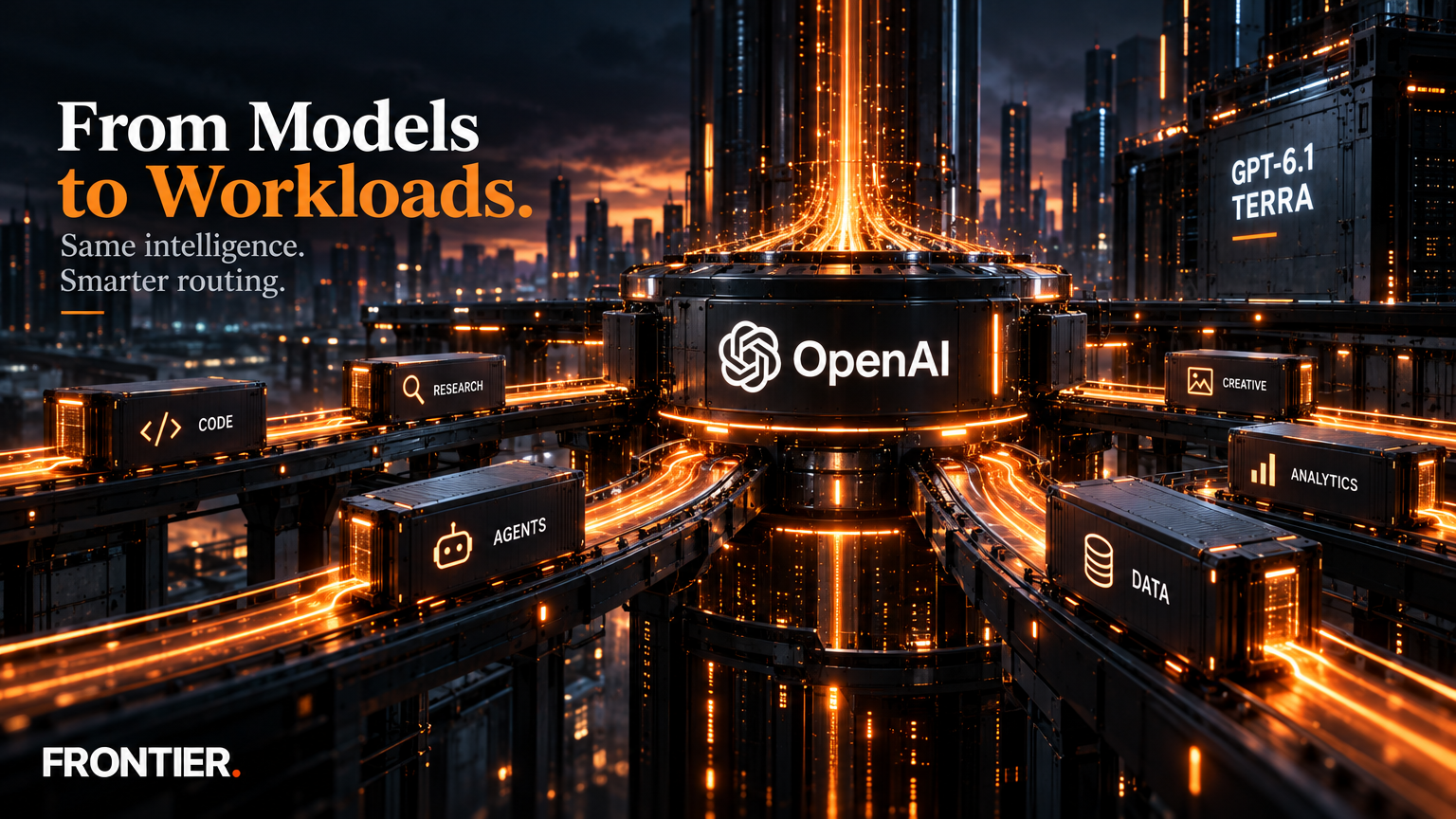
This shifts model governance from periodic procurement to an ongoing architecture discipline. When pricing and model capabilities change rapidly, a model selected during design may no longer remain the best execution tier for every task. The appropriate response is not indiscriminate model switching. It is a controlled routing layer that can assign workloads based on verified performance, unit cost and policy constraints. Under that model, a less expensive model can handle tasks when it meets the required service level, while a higher-cost tier remains available for workloads that demonstrably need it.
Risk must become part of the routing decision rather than a separate review performed after selection. OpenAI’s Critical cybersecurity and High biological and chemical capability classifications indicate that access to tools, sensitive data or consequential actions should affect eligibility for deployment.7 A low token price does not compensate for an unacceptable control gap. Conversely, a workload with restricted tools, bounded data access and human approval may present a different deployment profile from an autonomous process with broad permissions. That distinction follows from the disclosed capability levels and is an enterprise governance inference, not a claim that OpenAI’s safeguards will succeed or fail in a particular environment.
For CIOs, the practical change is a move from vendor-level approval to workload-level qualification. Procurement still matters, but the durable decision record becomes a matrix: which model may execute which workflow, at what measured cost, with what observed quality, under which permissions and with what fallback. Terra’s launch makes that operating model more urgent because its published economics create a credible reason to retest existing assignments, while its capability disclosures make simplistic cost-based substitution inappropriate.
Frontier take
The decisive enterprise capability will not be access to the newest model; it will be the ability to reassign workloads safely when the cost-performance frontier moves.
GPT-6.1 Terra illustrates why. OpenAI is presenting a model with standard API prices 50% below GPT-5.6 Terra and GPT-6.1 Sol, alongside a benchmark-specific claim of more than threefold speed on selected computer-use tasks.1 The first figure can be checked against published pricing.6 The second must be reproduced against enterprise workflows before it can support a deployment decision. Together, they create a strong reason to benchmark—but not a sufficient reason to migrate.
The strongest architecture is therefore neither a permanent commitment to the premium model nor an uncontrolled race toward the cheapest one. It is a governed portfolio in which models operate as interchangeable execution tiers only after they clear workload-specific thresholds. Interchangeability here does not mean identical behavior. It means applications are designed so that model assignments can change without rebuilding the business process, while evaluation and policy gates prevent an unqualified model from receiving a task.
This approach changes the source of advantage. A competitor can purchase access to the same OpenAI API and the same published prices. It cannot instantly reproduce an enterprise’s benchmark corpus, task-level telemetry, routing policies, permission boundaries and evidence about where lower-cost models succeed or fail. Those operational assets turn a public model release into proprietary execution knowledge.
CIOs should also resist treating context capacity as a substitute for information architecture. Terra’s documented 1,050,000-token context window creates options for large-context workflows, but it does not prove that loading more material will improve task outcomes or lower total cost.5 The relevant measure is whether additional context improves completion quality enough to justify its token and latency footprint. Cached-input pricing may alter that calculation, but only observed workload data can settle it.6
The same discipline must govern risk. OpenAI’s capability classifications make clear that Terra should not enter an enterprise as merely a discounted model.7 Routing policy must account for what the model can access and do, not just what it costs. The strategic conclusion is firm: enterprises that institutionalize workload-level qualification and routing will be positioned to capture price and performance improvements without repeatedly reopening the entire platform decision. Enterprises that continue to select one default model by headline ranking will either overpay for routine work or accept poorly measured operational and security exposure.
Three moves for CIOs
-
— Build a workload qualification ledger, not a single model leaderboard Select a representative set of production agent workflows and evaluate GPT-6.1 Terra against the models currently assigned to them. Record completed-task quality, end-to-end latency, input and output consumption, retry behavior and effective cost per accepted result. Keep OpenAI’s computer-use benchmark as a hypothesis to test rather than a score to inherit.1 Segment results by workflow because Terra’s published input, cached-input and output rates can affect each usage pattern differently.6
- Decision trigger: Require a new qualification cycle when a candidate model changes effective workload cost by at least 20%, when a current model misses its service target, or when a vendor reports a material gain on an evaluation that resembles a production task.
- Why now: Terra’s published prices are 50% below the comparison models identified by OpenAI, creating enough economic distance to justify measurement without assuming migration.1 The benchmark-specific speed claim makes immediate validation more valuable than either acceptance or dismissal.
-
— Make model routing a controlled production capability Separate workflow logic from model assignment and introduce policy-based routing across approved execution tiers. Route only after a model has cleared the workload ledger’s quality, latency, cost and risk thresholds. Preserve an approved fallback for failed or borderline tasks, and log every routing decision so finance, architecture and risk teams can trace why a model was selected.
- Decision trigger: Implement routing when two or more qualified models can execute the same material workflow, or when quarterly model-cost variance exceeds the cost of maintaining the routing and evaluation controls.
- Why now: Terra demonstrates that the relative economics of available models can change materially with a single release.63 A routing layer turns that change into an optimization opportunity without making a new vendor-wide default the only path to adoption.
-
— Bind model eligibility to permissions and capability disclosures Create deployment classes based on data sensitivity, tool access, autonomy and consequence of failure. Require stronger approval, sandboxing, monitoring and human authorization as those factors increase. Map Terra’s eligibility by workload rather than granting blanket access, explicitly incorporating OpenAI’s Critical cybersecurity and High biological and chemical capability classifications into the review.7
- Decision trigger: Escalate a deployment whenever an agent can execute code, change external systems, access sensitive technical or scientific data, or act without human approval—regardless of whether the candidate model is cheaper or faster.
- Why now: Terra’s lower price may encourage broader use, while OpenAI’s own disclosure identifies elevated capability categories.17 Connecting routing eligibility to permissions prevents unit-cost optimization from silently expanding the enterprise risk boundary.
Sources
- OpenAI — Introducing GPT-6.1 Terra 1
- OpenAI API changelog — October 26 GPT-6.1 Terra release 2
- OpenAI API — GPT-6.1 Terra model documentation 5
- OpenAI API pricing 6
- OpenAI Deployment Safety Hub — GPT-6.1 Terra system-card addendum 7
- BleepingComputer — OpenAI launches GPT-6.1 Terra 3
- 9to5Mac — OpenAI upgrades ChatGPT and Codex with GPT-6.1 Terra 4
[^openai-announcement][^openai-api-changelog][^bleepingcomputer-report][^9to5mac-report][^openai-model-documentation][^openai-pricing][^openai-system-card]