NVIDIA’s Six-Partner Capacity Push Makes Supply Assurance Part of AI Architecture
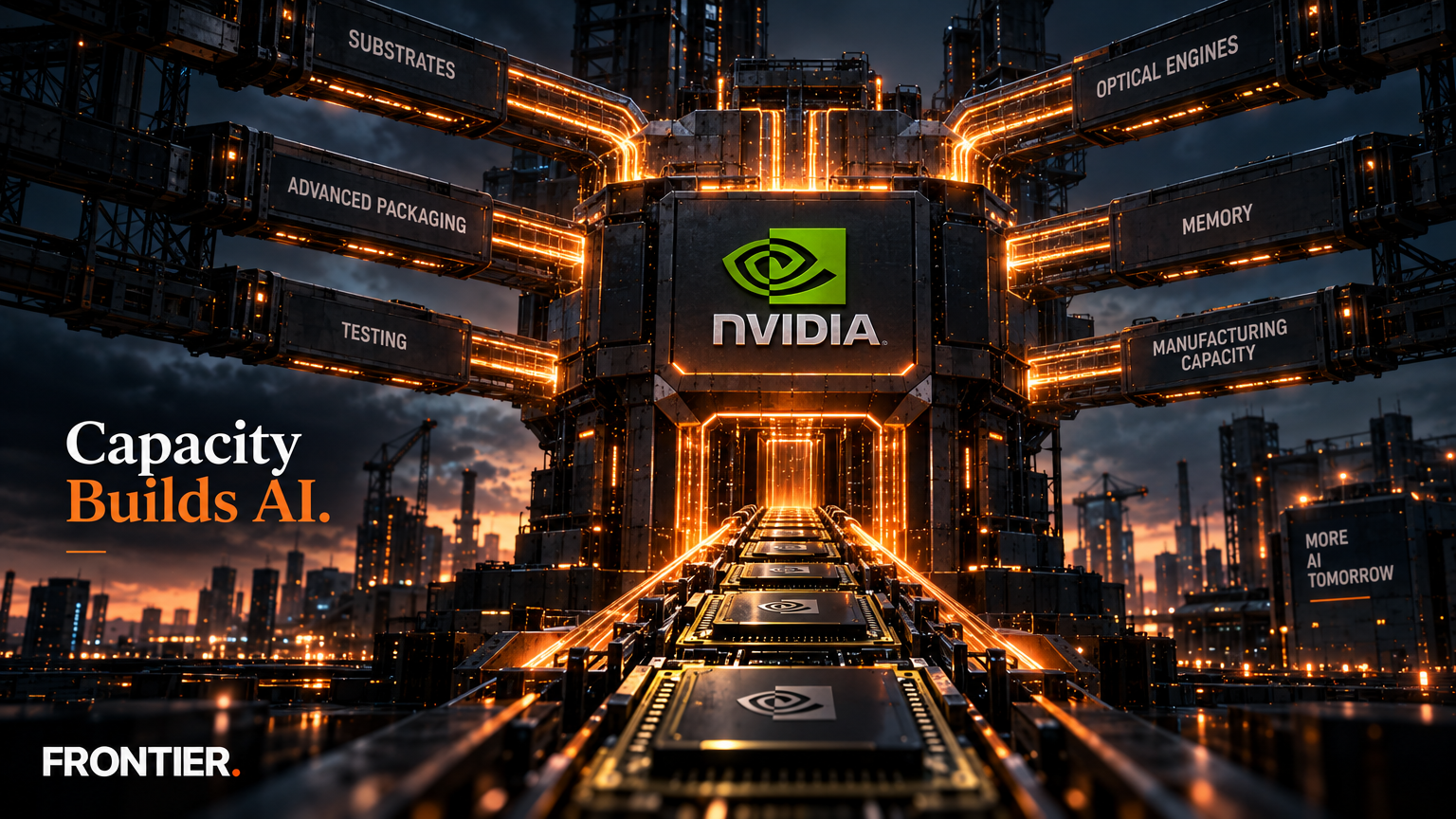
NVIDIA has announced capacity arrangements with six semiconductor suppliers spanning substrates, advanced packaging, testing and optical engines, signaling a structural shift in which enterprise AI availability depends on coordinated, multiyear industrial capacity rather than processor performance alone.
Take the argument with you.
Read the publication-ready report. Generated from the canonical News article.
What changed
On October 21, 2026, NVIDIA announced supply-chain capacity initiatives involving Amkor Technology, IBIDEN, King Yuan Electronics, Samsung Electro-Mechanics, Siliconware Precision Industries and Unimicron Technology.1 The initiatives cover several distinct stages required to turn processor designs into deployable AI systems: substrates, interposer-wafer capacity, semiconductor testing and optical engines for co-packaged optics. Independent reporting from SDxCentral and RTTNews corroborated the broader supplier initiative and its principal capacity targets.23
The largest disclosed commitments illustrate the breadth of the effort. NVIDIA said its agreements with IBIDEN, Samsung Electro-Mechanics and Unimicron are intended to increase aggregate substrate capacity by 2.5 times over three years.1 NVIDIA and Amkor are targeting an increase of more than 300% in South Korean interposer-wafer capacity by the end of 2028.1 Amkor separately disclosed an additional $1.3 billion agreement supporting South Korean expansion and said its Arizona and South Korea agreements with NVIDIA now total $3 billion.4
Testing and optics are also part of the plan. NVIDIA disclosed a $1.1 billion capacity-reservation advance to King Yuan Electronics for new testing facilities and equipment in the United States, with high-volume production targeted for April 2027.1 The company expects its total semiconductor-testing capacity to double between calendar 2026 and 2027 through buildouts in the United States, Taiwan and Singapore.1 With Siliconware Precision Industries, NVIDIA is targeting a fifteenfold increase in Taiwanese optical-engine capacity by mid-2027, followed by a possible further doubling by the end of 2028.1 SDxCentral independently reported the optical-engine target and connected it to NVIDIA’s wider supplier expansion.2
These figures are reported plans, targets and reservations—not evidence that all of the capacity is already built, qualified or producing at the projected volume. The event is therefore not simply an increase in current NVIDIA output. It is a coordinated attempt to secure future capacity across multiple production constraints, with important milestones extending into 2027 and 2028.1
Why it matters
The CIO decision model for AI infrastructure has traditionally emphasized accelerator performance, system architecture, software compatibility and purchase or consumption price. NVIDIA’s announcement shows why that model is incomplete. A high-performing processor roadmap does not by itself establish when complete systems will be available at enterprise scale. Availability also depends on whether suppliers can provide sufficient substrates, packaging, testing and optical components on compatible timelines.
The reported arrangements make this dependency visible. NVIDIA is not addressing one isolated constraint; it is coordinating investments and reservations across six suppliers and several manufacturing stages.13 That means delivery risk can migrate between stages. Additional substrate capacity will not create usable systems if testing capacity is late, while packaged accelerators will not resolve deployment constraints if the required optical-engine capacity is unavailable. This is an analytical inference from the structure of the announced initiatives, not a claim that any specific stage will miss its target.
CIOs should consequently treat supply assurance as an architectural criterion. Vendor evaluation must ask not only what a platform can deliver under benchmark conditions, but also which planned production stages support its delivery schedule, when those stages are expected to enter high-volume production and whether qualification milestones have been completed. NVIDIA’s disclosed April 2027 target for high-volume U.S. testing and the 2027-28 timelines attached to other expansions demonstrate the gap that can exist between a capacity commitment and usable production.1
The economic model also changes. A capacity reservation can improve a vendor’s future supply position, but it does not automatically establish the delivered cost, timing or qualification status of enterprise systems. Amkor’s separate disclosure confirms that material capital commitments are being made around advanced packaging capacity, while NVIDIA’s disclosure shows a substantial advance for testing capacity.41 For CIOs, those disclosures are evidence that manufacturing access is becoming part of the platform’s economic structure—not proof that every announced benefit will flow through to enterprise buyers.
This changes roadmap governance. Long-range AI plans should distinguish currently deliverable infrastructure from capacity dependent on future construction, equipment installation, process qualification or ramp targets. They should also compare providers on the credibility and transparency of their full-stack capacity plans. The relevant question is no longer only, “Which accelerator architecture should we standardize on?” It is also, “What production system must perform, by what dates, for that architecture to arrive at the required scale?”
That shift matters beyond NVIDIA. The evidence here concerns NVIDIA and its named partners, but the decision principle is broader: enterprise AI capacity is produced by an interdependent manufacturing system. CIOs that evaluate processors in isolation risk treating a system-level constraint as a component-purchasing issue. The proper unit of evaluation is the deliverable AI platform and the chain of qualified capacity behind it.
Frontier take
The decisive AI infrastructure advantage is becoming control over coordinated, qualified capacity—not chip design in isolation. NVIDIA’s six-partner initiative is strong evidence for this assertion because it spans substrates, advanced packaging, semiconductor testing and optical engines rather than concentrating on a single manufacturing step.1 The separate Amkor disclosure and independent reporting strengthen confidence that this is a substantive counterparty-backed initiative, even though most of the announced capacity remains forward-looking.423
That distinction should organize the enterprise response. CIOs should neither dismiss these commitments as supply-chain detail nor treat them as completed capacity. Reservations and expansion agreements can create strategic options, but usable supply depends on execution and qualification. The appropriate posture is therefore milestone-based confidence: give vendors credit for disclosed commitments, then increase deployment reliance only as the relevant capacity becomes operational and qualified.
This produces a more defensible way to compare AI platforms. Benchmark leadership measures technical potential. Capacity coordination measures whether that potential can become deployable infrastructure on the enterprise timetable. Both matter, but the second is increasingly capable of invalidating assumptions made from the first. NVIDIA’s initiative indicates that the company itself is managing AI scale as a multi-stage industrial problem. CIO governance, sourcing and architecture processes should now do the same.
The practical consequence is a shift from product-roadmap diligence to production-system diligence. Every major AI infrastructure decision should map promised availability to the manufacturing stages, counterparties and dated milestones on which it depends. Where that mapping is unavailable, the uncertainty should appear explicitly in deployment sequencing, financial scenarios and concentration-risk decisions rather than remaining hidden inside a vendor delivery estimate.
Three moves for CIOs
-
— Create a qualified-capacity gate for AI platform commitments Require every strategic AI infrastructure proposal to separate currently qualified supply from capacity that is reserved, under construction or targeted for a future production ramp. For each material dependency, record the supplier or manufacturing stage, expected qualification evidence, high-volume production date and an approved fallback. Do not count announced capacity as available capacity until the agreed evidence is supplied.
- Decision trigger: Apply the gate whenever a proposed deployment depends on production beginning after contract signature, including plans tied to the April 2027 testing target or the 2027-28 packaging and optical-capacity expansions disclosed by NVIDIA.1
- Why now: NVIDIA has disclosed substantial commitments, but the associated dates remain forward-looking. A qualification gate lets CIOs recognize the strategic value of those commitments without converting vendor targets prematurely into enterprise delivery assumptions.
-
— Model AI demand against bottleneck stages, not aggregate accelerator counts Build three capacity scenarios—committed, milestone-achieved and delayed—for each major AI roadmap. Translate planned accelerator demand into dependencies across substrates, packaging, testing and optics, then sequence applications according to the scenario they can tolerate. Assign business owners to decide which workloads are deferred or redirected if one stage fails to meet its milestone.
- Decision trigger: Run the scenario review before approving any roadmap in which a single future expansion supports a material deployment wave, or when the vendor cannot show aligned availability dates across all four production stages highlighted by the NVIDIA initiative.
- Why now: The six-supplier program demonstrates that aggregate chip demand can depend on multiple industrial ramps with different dates and counterparties.13 Stage-level modeling exposes schedule risk that a top-line accelerator allocation can conceal.
-
— Separate reservation confidence from delivered-capacity economics Add a supply-assurance schedule to commercial evaluations. Score disclosed reservations and counterparty commitments positively, but require pricing scenarios for on-time, delayed and partially available capacity. Negotiate decision points that permit volume rephasing, alternative deployment models or architecture reconsideration if named production milestones are not met.
- Decision trigger: Use this structure when a provider’s supply case relies on material advances or multiyear expansion agreements, such as NVIDIA’s $1.1 billion testing-capacity advance or the Amkor agreements reported at a combined $3 billion.14
- Why now: Capital commitments can improve confidence that suppliers intend to expand, but they do not establish final system availability or economics. Separating reservation evidence from usable-capacity economics prevents the enterprise from paying for certainty that still depends on construction, qualification and ramp execution.
Sources
- NVIDIA Newsroom — NVIDIA and Supply Chain Partners Expand Capacity to Accelerate AI Infrastructure Buildout 1
- Amkor Technology investor relations — Amkor Technology and NVIDIA Advance Strategic Partnership for AI Infrastructure 4
- SDxCentral — Nvidia targets 15x optics capacity expansion by 2027 to meet CPO demand 2
- RTTNews — NVIDIA To Expand Global Manufacturing Capacity To Meet AI Demand 3
[^nvidia-primary][^sdxcentral-reporting][^rttnews-reporting]