Microsoft’s Copilot Hiring Surge Shows Who Really Sets the AI Talent Agenda
Copilot’s rise in job postings exposes an underestimated Microsoft advantage: enterprise distribution can shape the skills employers demand. CIOs need that talent pool—but not a workforce strategy written by their software supplier.
Take the argument with you.
Read the publication-ready report. Generated from the canonical News article.
The AI industry watches model leaderboards. CIOs should also watch the next job description.
A hiring requirement is where technology strategy starts becoming organizational muscle memory: what recruiters screen for, what employees learn, and which expertise the next project can readily access. Microsoft's enterprise reach gives it an unusual opportunity to shape that process. The latest Copilot hiring data suggests that opportunity is becoming tangible.1
The Frontier thesis: Microsoft does not need to win every model contest to shape the AI workforce. It needs its platform to become the default description of competence. For CIOs, the danger is mistaking a vendor's expanding talent ecosystem for the skills their own business actually needs.
The hiring signal is strong. Read the denominator.
QAlpha AI's October figures, published by its co-creator through UncoverAlpha, put Copilot mentions at 1.76% of monitored new job openings, versus approximately 1.33% for Claude, 1.20% for ChatGPT and 0.50% for Gemini. The series uses an 84-day moving average. Copilot rose from 0.377% in August 2025: about 4.7 times the starting share over 14 months, not a verified calendar-2026 growth rate.1
Over roughly 90 days, its share rose from about 1.30% to 1.76%, approximately 0.46 percentage points, against Claude's reported 0.10–0.15-point gain. That supports the recent-acceleration story among the compared assistants—not a universal ranking of every AI skill.1
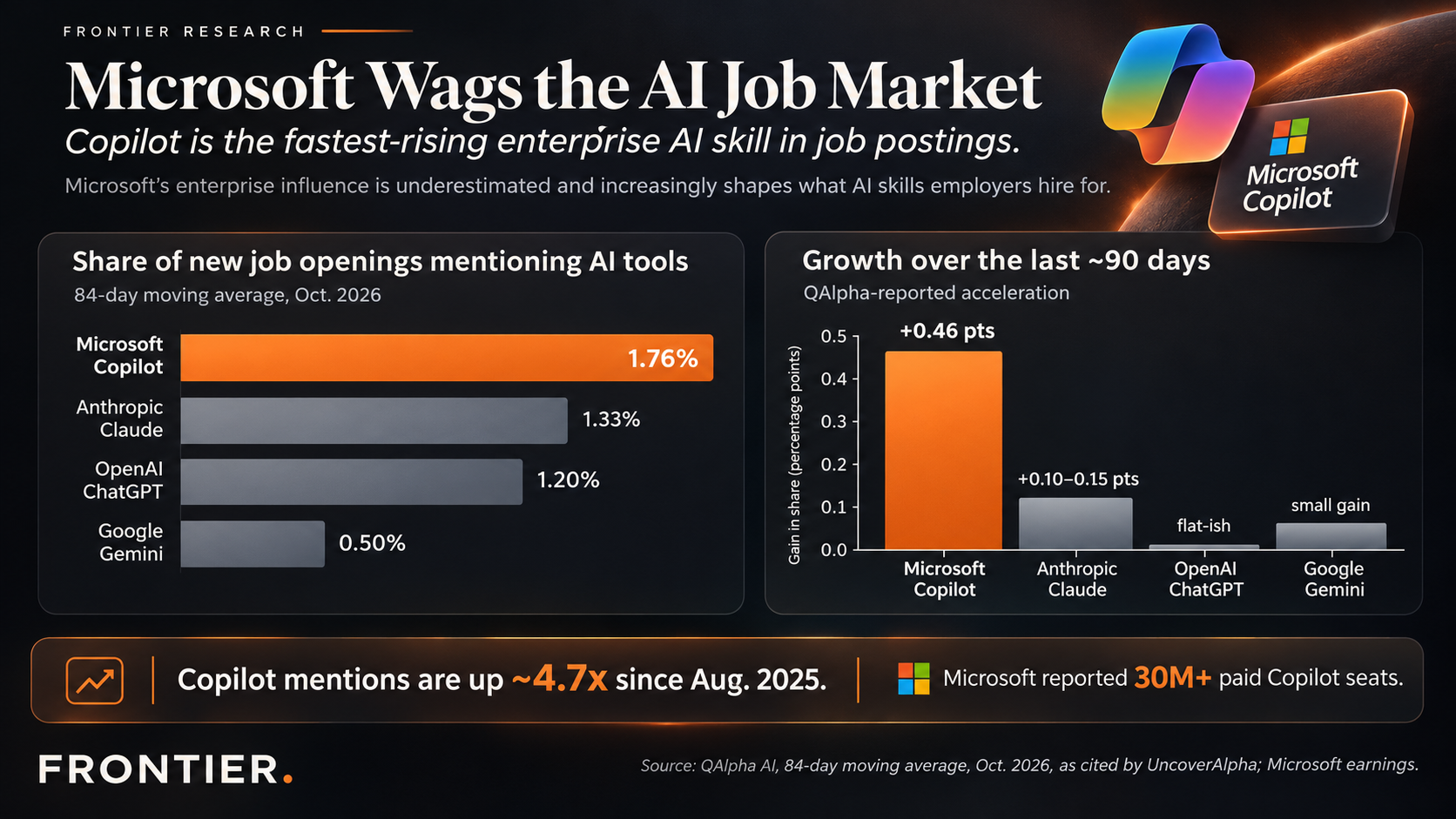
These are mentions, not completed hires or necessarily mandatory requirements. The public account does not fully resolve Copilot product classification. We therefore treat the series as an ecosystem signal, not a clean Microsoft 365-versus-GitHub comparison. An advertisement may express ambition rather than deployment; its wording cannot establish productivity or causation.1
Independent evidence shows the foundation predates this quarter. Lightcast data in Stanford's 2026 AI Index records 6,395 US AI job postings mentioning Microsoft Copilot in 2025, against 1,416 in 2024, a reported 352% increase. Copilot Studio rose from 549 to 3,366, or 513%. Those are different periods, populations and measures from QAlpha; they corroborate growing demand without validating an identical growth rate.2
The implication is larger than a chatbot popularity contest. Employers are beginning to specify an enterprise AI environment, not merely an interest in AI.
Microsoft's distribution advantage becomes a talent advantage
Microsoft reported more than 30 million paid Microsoft 365 Copilot seats in July. On its October 28 earnings call, it said Copilot daily users had grown nearly 50% quarter over quarter and more than fivefold year over year. Paid seats and daily users are different metrics; neither alone demonstrates business returns. Together, the disclosures make a substantial deployment footprint credible.34
Satya Nadella expressed the ambition plainly: “We think of Copilot as the new OS for work.”4
Here is the mechanism Frontier sees. An enterprise already manages identities, documents, collaboration and business processes in Microsoft's environment. Choosing Copilot can reduce the number of institutional boundaries an AI project must cross. The next requisition then asks for experience operating within that environment. Candidates respond by learning it. More available expertise makes the next Microsoft deployment easier to justify. Microsoft's documented integration and security architecture supplies the starting conditions for that reinforcing cycle; the hiring data is consistent with it, not proof of each causal step.5
That is how the enterprise installed base can wag the dog of IT employment. The vendor does not have to dictate a company's hiring policy. It can influence the environment in which hiring managers decide what counts as useful experience.
There is a second-order effect. A platform decision changes the available skills; the resulting skills then constrain the next platform decision. Architecture and staffing start reinforcing each other. Exiting becomes a matter of retraining, operating practices and organizational confidence—not just replacing licenses.
For Microsoft, this could be a durable advantage. For a CIO, it is both a useful labor pool and a potential dependency. The correct response is not to pretend Microsoft's influence is absent. It is to exploit that influence without letting it write the entire workforce plan.
The scarce skill is not knowing where the Copilot button lives
Consider an illustrative hiring choice. One candidate can produce a polished Copilot demonstration. Another can find an overexposed document library, define an agent's permissions, test its answers, recognize a bad business decision, and design the human escalation path. The first may accelerate adoption. The second can help make adoption survivable.
This is not an abstract distinction. Microsoft's security guidance says Copilot operates within existing access controls. That does not make existing permissions correct. Its deployment guidance directs organizations to find sensitive, overshared content and remediate access. A permissive information estate does not become well governed because an assistant respects its permissions.56
The workforce consequence is our judgment: experienced identity administrators, data stewards, security engineers, application owners and process specialists may be better raw material for enterprise AI operations than a pile of freshly branded AI résumés. They know where the organization's exceptions, obligations and operational hazards live.
The broader labor signal supports urgency, but not indiscriminate recruiting. LinkedIn reported on October 27 that the share of postings requiring AI literacy had risen roughly 65% over 12 months. Its finding that members listing AI literacy were 78% more likely to be hired is an association, not proof that adding a skill to a profile causes that uplift. LinkedIn is Microsoft-owned, so its evidence should not be mistaken for independent validation of Microsoft's competitive position.7
Indeed offers a separate warning: 71% of the increase in US software-development postings between May 2025 and May 2026 came from senior roles. Demand for experienced judgment can intensify even when the broader labor market remains difficult. That finding is not specific to Copilot and does not establish that AI caused the change.8
The trap for CIOs is to answer an execution problem with a keyword filter. Requiring exact vendor experience for every role can reject capable people, inflate recruiting costs and leave the underlying operating-model gap untouched. Conversely, refusing all platform-specific requirements wastes time where immediate technical depth genuinely matters.
The better boundary is task-specific: hire for what must be done safely on day one; train for the interface that can be learned afterward.
Microsoft wins again. Or does it?
Not every important contest favors Microsoft. Stack Overflow's 2026 survey found that 65.5% of the 12,255 respondents answering its coding-assistant usage question reported using Claude Code, compared with 58.7% for GitHub Copilot. Respondents could name multiple tools. This self-selected developer survey is not enterprise market share, but it is meaningful counterevidence to any claim that Copilot dominates every AI workflow.9
More importantly, the apparent rivals are not mutually exclusive. GitHub's own documentation lists Anthropic, OpenAI and Google models inside Copilot. An employer can standardize on Microsoft's development interface while depending on another company's model capabilities. A Copilot hiring requirement is not necessarily a vote against Claude.10
Our interpretation: Microsoft can win the interface, purchasing relationship and deployment environment while another supplier wins the reasoning task. The enterprise contest is partly about who packages and governs intelligence, not simply who invents the strongest model.
That makes vendor-neutral skills more valuable, not less. Evaluation design, data quality, access boundaries, cost control and incident handling remain necessary when the model changes behind a familiar interface. Model choice inside one platform is useful, but it does not automatically make workflows, permissions or operational knowledge portable outside it.
Microsoft's advantage can also fail to produce customer advantage. A large license estate without useful workflows is shelfware with a fashionable name. Employees trained to follow one interface without testing outputs create a dependency rather than a capability. A hiring surge says employers are placing a bet; it does not tell CIOs the bet has paid off.
Three CIO decisions before the next hiring cycle
1. Replace “Copilot experience required” with a role-specific proof of competence
Within 30 days, review AI-related requisitions with HR and the accountable business owner. Separate ordinary AI users, workflow builders and production operators. Specify the actual product and task wherever vendor experience is indispensable; accept equivalent experience where it is not.
For production roles, use a sanitized work sample: diagnose an oversharing problem, define an evaluation set, explain a failed output and propose a safe recovery. Require candidates to state uncertainty and escalation boundaries. For business roles, test domain judgment and output verification rather than administrative trivia. Trigger this rewrite whenever a job description lists an AI brand without a concrete responsibility. Measure qualified-candidate yield and later job performance, not résumé keyword density.
2. Build an internal conversion path before bidding for everyone else's experts
Launch a 90-day cohort pairing Microsoft-platform specialists with process owners, security and data colleagues. Give each small team a bounded workflow, protected learning time, an accountable supervisor and a measurable acceptance test. Purchase outside expertise where a genuine security or architecture gap blocks delivery—not as a substitute for developing institutional knowledge.
Expand only when a workflow clears agreed quality, access-control and cost thresholds and someone owns ongoing operation. Track time to competent deployment, rework and incidents. Protect supervised entry-level routes alongside senior recruitment: consuming today's experienced talent without developing tomorrow's is not a sustainable strategy. The trigger is repeated hiring difficulty combined with capable internal staff who understand the work but lack the AI-specific practice.
3. Make portability a demonstrated team capability, not a procurement slogan
Before a major platform renewal or AI expansion, have the team solve one representative, non-sensitive workflow on the preferred Microsoft path and one credible alternative. Hold the business task, evaluation criteria and data restrictions constant. Compare total operating effort, quality, failure recovery and cost per accepted outcome—not demonstration polish.
Keep evaluation cases, business rules, interface contracts and operating instructions outside vendor-only training materials. Do not duplicate every production system: maintain enough alternative capability to make switching a real option. Revisit placement when measured outcomes or terms deteriorate. The point is negotiating leverage and operational resilience, not a ceremonial multivendor policy.
Microsoft may be winning the right to define the enterprise AI job description. CIOs should make sure they still define the job.
[^lightcast-stanford][^microsoft-july][^microsoft-october][^copilot-security][^copilot-foundation][^linkedin]