Meta Adds Muse Ember and Spaces as Agent Economics Shift From Model Choice to Workload Routing
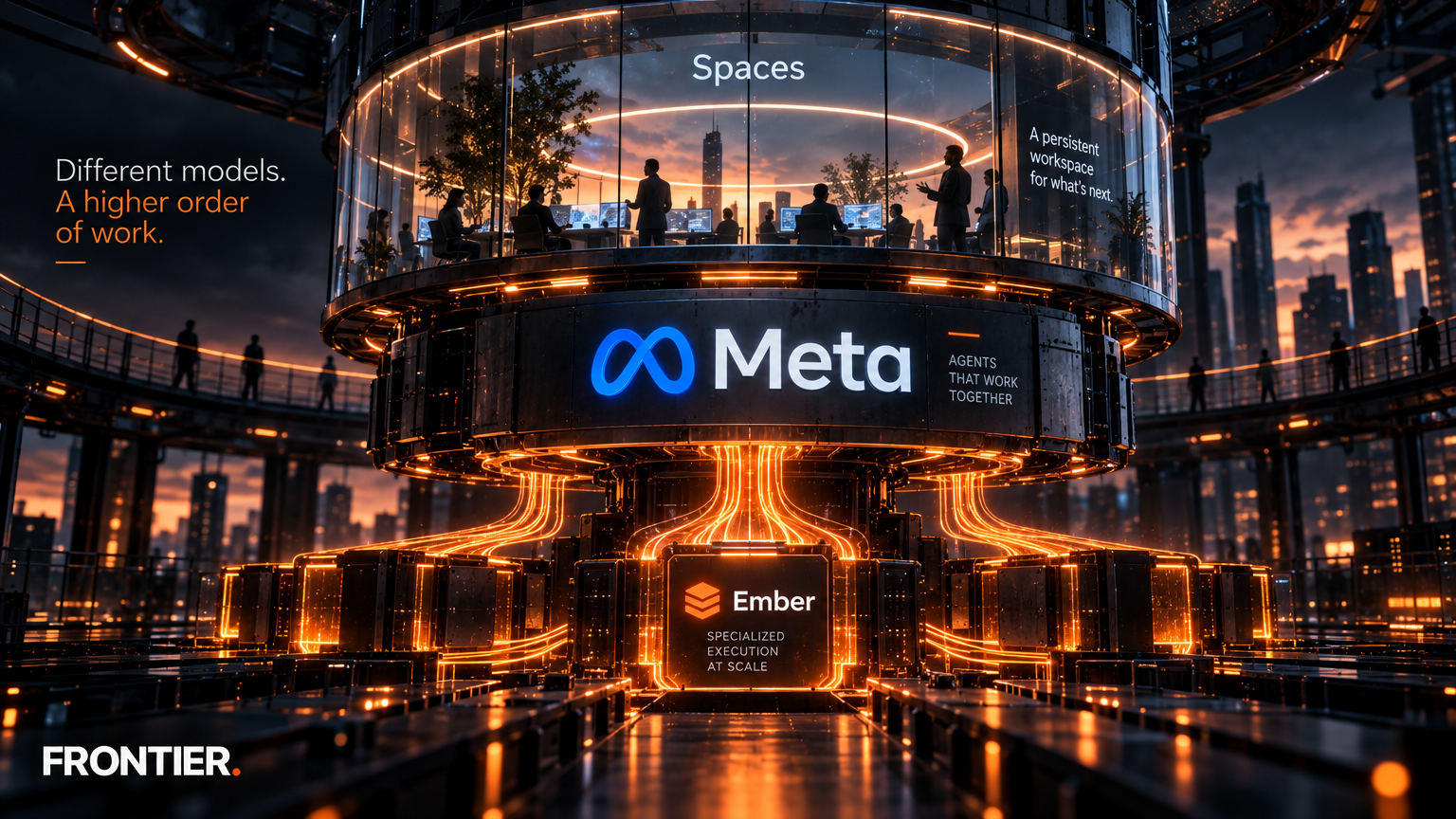
Meta introduced the Muse Ember execution model on November 9, 2026, three days after launching persistent Spaces in Muse, illustrating a broader separation between the agent workspace users experience and the specialized models that execute high-volume work.
Take the argument with you.
Read the publication-ready report. Generated from the canonical News article.
What changed
Meta introduced Muse Ember on November 9, 2026, describing it as its smallest and most efficient model for repeated agent operations such as tool calls, routing, extraction, coding subtasks and long-document processing.1 Google Cloud documentation independently records Muse Ember 1.0 as a preview model released on the same date.2 This is the verified material event date; November 10 was the publication date of the candidate article, not a separate Meta product announcement.
Ember is available as muse-ember-1.0 through the Meta Model API and Muse Code, with a one-million-token context window.1 Meta lists standard pricing through 200,000 input tokens at $0.10 per million uncached input tokens, $0.004 per million cached input tokens and $0.50 per million output tokens, with higher rates applying beyond that context threshold.1 Those specifications position Ember for repeated execution inside agent workflows rather than as a single, universal model for every interaction.
Meta claims that Ember approximately matches Claude Haiku 5.5’s best rounded Artificial Analysis score at about one-third of the benchmark cost per task.1 That comparison requires an important qualification. VentureBeat corroborated the reported benchmark figures but noted that Ember’s standard uncached input and output token prices match those cited for Claude Haiku 5.5 and GPT-6 Luna.3 The defensible interpretation is therefore not that Ember universally undercuts those models on list token pricing. Meta’s claimed advantage concerns measured cost per benchmark task, which can reflect how many tokens, retries or other resources a model requires to complete the evaluated work.
The Ember release followed Meta’s November 6 introduction of Spaces, customizable experiences generated inside Muse from a user’s description.4 Meta said Spaces became available everywhere Muse was available and could receive background updates from connected applications.4 TechCrunch independently described them as persistent, topic-focused experiences within the Muse interface.5 The two announcements were separate events, but together they expose a coherent architectural direction: a persistent environment can hold context and organize work while a smaller execution model handles recurring operations behind it. That architectural reading is an analytical inference from the verified capabilities, not a claim that Meta has declared a formal enterprise reference architecture.
Why it matters
The immediate CIO implication is that selecting an agent platform can no longer be reduced to comparing the strongest general-purpose model or the lowest advertised token rate. A persistent workspace and an execution model perform different jobs. The workspace manages the user’s ongoing experience, topic and connected context; the execution layer processes the repeated calls, extraction steps, routing decisions, coding subtasks and long documents that accumulate as an agent acts.41 Once those functions separate, the quality of orchestration between them becomes a first-order procurement and architecture concern.
This changes the economic unit of analysis. Token prices remain relevant, but they do not by themselves reveal the cost of a completed workflow. Meta’s own comparison is framed around benchmark cost per task, while the independently reported list-price comparison shows standard token rates matching the cited competing models.3 CIOs should therefore evaluate the full execution path: model calls, cached versus uncached context, long-context premiums, retries, tool use and completion rates. Some of those measurements must come from an enterprise’s own workload telemetry because the supplied sources do not establish how Ember will perform on any specific corporate process.
The decision model also becomes workload-specific. Ember is explicitly positioned for repeated agent operations, not merely conversational response generation.1 A CIO evaluating an extraction pipeline, coding agent or document-processing workflow should ask whether a specialized model completes that workload reliably and economically, rather than assuming that the platform’s flagship model is the appropriate default. Conversely, a low per-task result on a vendor benchmark does not establish suitability for a workflow with different accuracy, latency, context or control requirements. Reported benchmark evidence should define a test hypothesis, not close the purchasing decision.
Persistent Spaces raise a second governance issue. Meta says they can receive background updates from connected applications, while independent coverage characterizes them as persistent, topic-focused environments.45 In an enterprise setting, that pattern would make state management, connector permissions and model routing interdependent. This is an inference about how CIOs should assess comparable architectures, not evidence that Muse Spaces already satisfies enterprise governance requirements. The practical question becomes whether persistent state can be governed separately from whichever model currently executes a task.
As a result, platform evaluations should examine whether the workspace layer, stored context, connectors, policies and execution models can evolve independently. A platform that makes a specialized model inexpensive but binds persistent work state tightly to that model may create migration and control costs elsewhere. A platform that supports explicit routing, observable task economics and replaceable execution models gives the CIO more ways to respond when workload volumes, model performance or pricing change.
Frontier take
The durable advantage in enterprise agents will come from controlling the routing layer, not from standardizing every workflow on one model. Meta’s sequencing of persistent Spaces and the execution-oriented Ember model makes that conclusion visible: the user-facing environment can remain continuous while the model performing repeated work is selected for a narrower economic and operational profile.41
That does not prove Meta will win enterprise agent deployments, nor does it validate its benchmark claim for corporate workloads. Ember is documented as a preview model by Google Cloud, and Meta’s cost comparison remains benchmark-dependent.23 It does, however, provide concrete evidence that agent platforms are being assembled as layers rather than presented only as wrappers around a single general-purpose model.
CIOs should consequently treat model choice as a governed routing policy. The strategic asset is the ability to decide which model receives which task, with what context, under which quality threshold and at what measured cost. Persistent workspaces make that policy more important because they can generate recurring background activity rather than only responding to discrete prompts.4 Efficient execution models make the policy more feasible because not every operation needs to consume the same model profile.1
The strongest architecture will therefore be the one that preserves continuity for users while keeping execution contestable. Workspaces, permissions and business state should persist; execution models should be benchmarked, routed and replaceable by workload. That is the shift CIOs should operationalize now, before persistent agents accumulate enough state and integrations to turn an early model default into a long-lived platform constraint.
Three moves for CIOs
-
— Replace token-price comparisons with a completed-task ledger Instrument each production candidate to record total model calls, cached and uncached input, output, long-context usage, retries, tool calls, successful completions and human rework. Compare models on cost per accepted business outcome for each workload, while retaining token prices as an input rather than the final metric.
- Decision trigger: Require the ledger before approving any agent workflow that performs recurring background work, invokes multiple tools or crosses the model’s standard context-pricing threshold.
- Why now: Meta’s claimed advantage is expressed as benchmark cost per task even though independently reported standard token prices match the cited competing models.13 That gap makes aggregate token pricing an insufficient basis for a routing or procurement decision.
-
— Make persistent agent state portable before expanding connectors Separate workspace state, connector permissions, task history and policy metadata from the execution-model interface. Test whether a workflow can switch to another approved model without recreating its persistent workspace or granting the replacement model broader access.
- Decision trigger: Run the portability test when an agent environment begins receiving background updates from connected applications or when a business process depends on state that must persist across sessions.
- Why now: Spaces demonstrate how persistent, topic-focused environments can coexist with connected background updates.45 Once those environments become operational records, tightly coupling their state to one execution model would make future routing changes harder.
-
— Create routing change control for specialized execution models Define workload classes for extraction, coding subtasks, routing, tool use and long-document processing, then assign each class an approved model, quality floor, cost ceiling and fallback path. Introduce new execution models through workload-specific canaries rather than platform-wide default changes.
- Decision trigger: Activate formal routing control when a platform offers more than one model for the same workflow or when a specialized model is proposed to replace a general-purpose default in high-volume execution.
- Why now: Ember is explicitly designed for repeated agent operations and carries different economics once inputs exceed 200,000 tokens.1 Its release makes model specialization actionable, but its preview status and benchmark-dependent cost claim make controlled routing more defensible than blanket standardization.23
Sources
- Meta AI Research — Introducing Our Smallest, Most Efficient Model: Muse Ember 1
- Meta Newsroom — Design the Muse App, Just for You 4
- TechCrunch — Meta introduces Spaces, a new way to collaborate with your Muse agent 5
- VentureBeat — Meta’s proprietary Muse Ember nearly matches Claude Haiku 5.5 at 1/3 the estimated per-task cost 3
- Google Cloud documentation — Muse Ember 1.0 2
- AI Insider — Candidate article under verification 6
[^google-cloud-ember][^venturebeat-ember][^meta-spaces][^techcrunch-spaces][^ai-insider-candidate]