IBM Wants Apptio to Show AI ROI. Counting Tokens Is the Easy Part.
IBM has expanded Apptio's AI cost connectors, unit economics and ROI tracking. It can make fragmented AI spending legible—but CIOs still have to prove which business results the investment caused.
Take the argument with you.
Read the publication-ready report. Generated from the canonical News article.
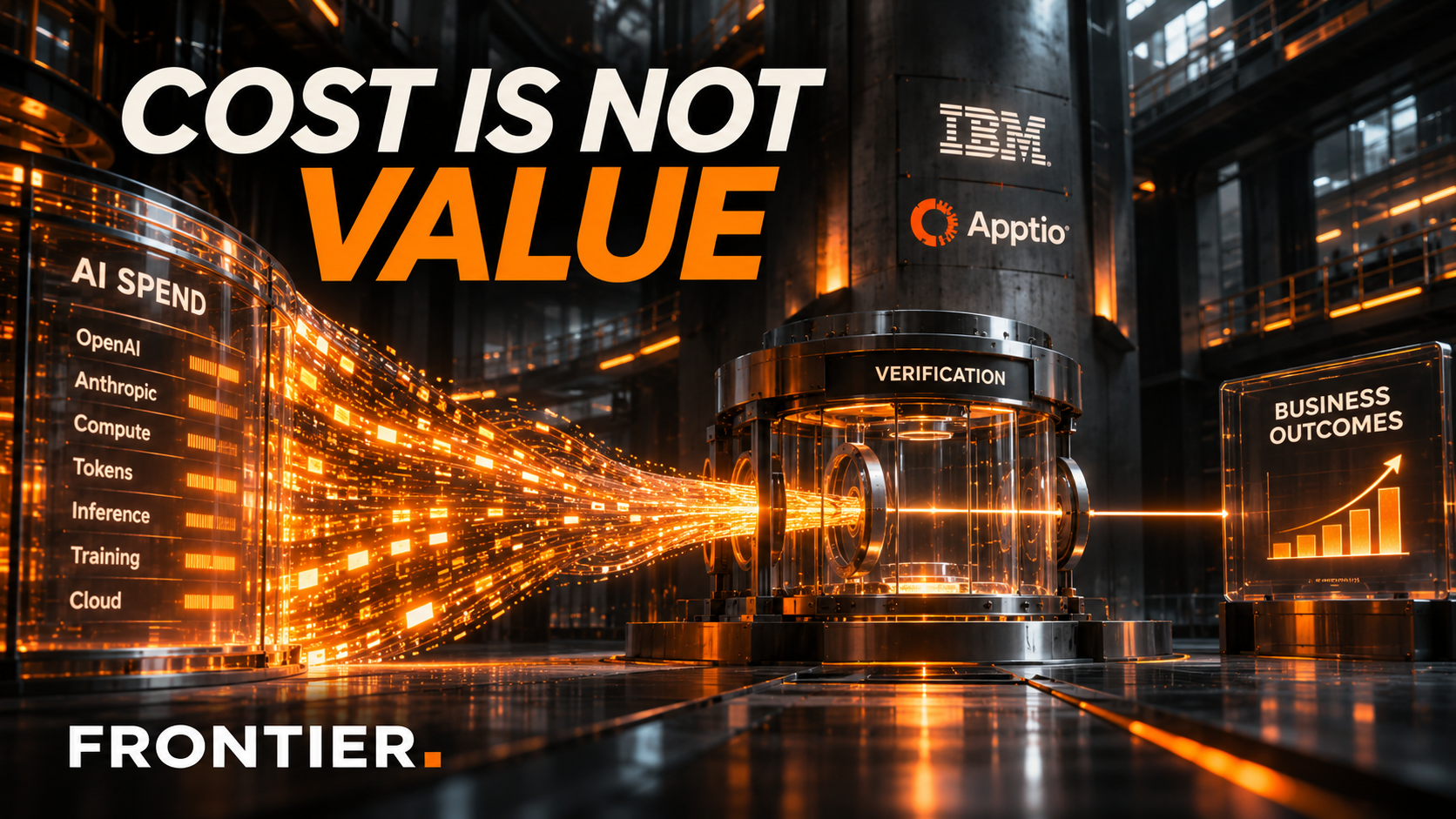
The AI boom has produced an accounting paradox: enterprises can pay for tokens, GPUs, copilots and agents instantly, but often cannot identify which business outcomes those payments purchased. On November 9, IBM expanded its Apptio portfolio with direct AI-provider cost connections, forecasting, unit economics and business-value measurement.1
The strategic significance is not another dashboard. IBM is attempting to join three historically separated records: what technology consumed, what it cost, and what it demonstrably contributed to revenue, cost, speed or risk. If those records agree, AI initiatives can finally compete for capital on evidence instead of demos and license counts.
The Frontier thesis: CIOs are grappling with the issue that AI spend has a highly variable invoice. Business value needs an effective counterfactual. IBM can build the financial map, but only the enterprise can prove the journey was worth taking. That distinction determines whether a CIO buys Apptio, builds an equivalent system or refuses another measurement layer.
The accountability gap is becoming a CIO problem
IBM cites an Institute for Business Value study in which 85% of surveyed technology executives reported lacking full visibility into real-time AI spending. That research covered 2,000 senior technology executives across 33 geographies and 19 industries, surveyed with Oxford Economics from January through April 2026. It measures self-reported visibility, not whether 85% of enterprises have no budget controls.1
Independent evidence points in a similar direction. The FinOps Foundation's 2026 survey collected 1,192 responses; 98% reported managing AI spending, compared with 63% in 2025 and 31% in 2024. Another 78% of FinOps practices reported into the CTO/CIO organization. This is a practitioner sample, not the population of CIOs, but it makes clear where the operational burden is landing.2
Traditional cloud FinOps does not automatically solve it. One initiative can pay an AI provider, a hyperscaler, a software subscription, a vector database, Kubernetes infrastructure and human reviewers. Retries, evaluation, observability and corrective work may add materially to the bill. A line item labeled “AI” is not a product's total cost; lower spend per token does not necessarily mean lower spend per completed, accepted task.
What shipped, and what IBM still intends to ship
Provider-level connections. IBM says AI-provider cost and usage connectors are generally available. Its product community identifies OpenAI Platform and Codex, and separately Anthropic Claude Platform and Claude.ai Enterprise, as feeds. It also describes GitHub Copilot enterprise consumption, model metadata and spending; the Cursor connector remains in public preview. This is useful segmentation: developer API inference, AI coding assistants and employee subscriptions have different purchasing and usage models. The IBM announcement does not establish complete account, reseller, product or geography coverage; verify each connector and refresh interval with an actual tenant.13
IBM Cloudability. Generally available AI Unit Economics and AI financial planning connect usage and token data with application costing, budgets and forecasting. AI commitment support started in Q3; further increments are scheduled during Q4 and the first half of 2027. This creates a path from monthly invoices to cost per business service, but the meaningful denominator must be supplied by the enterprise.1
IBM Apptio AI Value & ROI. This capability did not originate on November 9. It entered public preview on August 6; IBM now says it became generally available November 6. It can organize AI initiatives and proof metrics across revenue, cost, speed, productivity and risk, tracking baseline, target, actual and realized results and bringing in modeled token, technology and labor costs. That is a credible framework for finance governance; it is not an embedded economic experiment that proves causation.41
AI assistance and network costs. Apptio AI Assistant, AI Lens and AI Data Assistant are GA, while Kubecost's improved network-cost attribution is GA across product tiers, including AWS NAT Gateway and cross-zone or cross-region traffic. The roadmap is mixed: IBM lists the Kubecost MCP server as GA in Q3, but Cloudability, Apptio and Targetprocess MCP servers for Q4. Driver-based and AI scenario planning are also Q4 targets. A portfolio announcement should not be converted into a claim that every capability is live in every customer's tenant.15
The control plane IBM wants: cost, owner, outcome
The economic architecture CIOs should require begins at the request, not the invoice. Each AI or agent run needs an application identifier, business owner, cost center, environment, model and outcome type. A reconciliation ledger joins that context to provider bills and contracts. A separate system—ERP, CRM, transaction log or validated workflow—must record whether the action succeeded and what business result followed.
Fully loaded cost per accepted business outcome means the attributable model and infrastructure cost plus integration, licensing, human review, evaluation and rework, divided by outcomes that meet a defined completion and quality threshold. A model with low token cost but repeated failures, expensive retrieval and heavy human cleanup may be a worse economic choice than a pricier model that completes the work.
Apptio can substantially improve the numerator through consistent ingestion and attribution. Its proof-metric capabilities can make the denominator visible. It cannot itself determine whether AI caused faster case resolution, incremental sales or cash savings. Those claims need an appropriate pre-deployment baseline, comparison group or credible counterfactual, and sign-off by the business and finance owners.4
Consider a service desk as an illustration, not a reported customer result. After introducing an agent, tickets closed per person could rise while headcount, escalations and customer satisfaction remain unchanged. That shows throughput or available capacity, not necessarily realized operating savings. The CIO should track completed work, accuracy, time released, capacity actually redeployed, cash avoided and risk separately. Without that distinction, an ROI module can turn optimistic assumptions into beautiful charts.
Four ways the ledger can still lie
Double counting. A model may be purchased directly, through a hyperscaler or within an application subscription. Provider consumption and reseller invoices can overlap; discounts, credits and commitments can change effective rates. Finance needs authoritative invoice reconciliation, not a blind sum of connectors.
Attribution gaps. Model project IDs, billing entities, seat assignments and business process IDs often do not match. AWS's own Bedrock guidance makes the problem concrete: invoice-level aggregated costs from tags and inference profiles are different from per-request metadata in invocation logs. When a shared gateway calls a model for hundreds of users, it can make all usage appear to belong to one principal unless developers instrument the workload deliberately.67
False forecast certainty. Usage and unit rates change with model upgrades, caching, longer contexts, multi-agent orchestration and workflow design. An attractive AI-service commitment can become stranded if the organization moves models or actual qualified demand falls. A budgeting tool should run downside and upside scenarios in successful business tasks, not merely extrapolate tokens.
Unproven benefits. Seat activation is not proficient use, and “hours saved” is not automatically an expense reduction. Unmeasured error costs, hallucinations, manual review or security incidents can erase apparent productivity gains. A measurement system can faithfully record a forecast whose assumptions remain false.
A useful counterweight is the open FinOps Open Cost and Usage Specification (FOCUS). It defines normalized billing structures across providers and technology categories. Customers should preserve raw provider exports, FOCUS-compatible transformations and their business identifiers outside any vendor's exclusive model. Financial semantics are strategic enterprise assets.82
Does the expansion actually help?
Yes, when consumption is scattered across suppliers and operating budgets. Existing Apptio and Cloudability customers can gain a better financial map spanning direct-model APIs, coding tools, cloud infrastructure, Kubernetes network charges and initiative budgets. Combining cloud financial management, technology business management and portfolio accounting is more consequential than a standalone model-spend dashboard.
Much less, when the real failure is organizational. A CIO without trustworthy business owners, properly tagged workloads, outcome definitions or reconciled finance data will acquire another lens on ambiguity. Smaller enterprises with fewer providers may obtain sufficient visibility through native billing feeds, their finance system and a deliberately simple cost model.
A final boundary matters: MCP exposes sensitive technology-finance data to other AI clients. IBM's material describes existing authentication and product-level permission controls, but the buyer still needs to test actual tool scopes, client identity, audit logging, prompt-injection resilience and whether any agent can change plans or commitments. Let the agent explain cost drivers before letting it alter financial decisions.3
The broader shift is not uniquely IBM's. The FinOps Foundation has expanded its mission from managing cloud value to managing technology value as cloud, AI, SaaS and labor economics converge. IBM has a credible integration position, but it needs to demonstrate that consolidating the work inside Apptio produces better decisions at lower total operating cost than interoperable tools and processes customers already possess.2
Three decisions CIOs should make now
1. Establish a vendor-independent AI cost ledger within 30 days
Inventory the direct AI APIs, hyperscaler model services, embedded SaaS, employee subscriptions and internally hosted workloads. Assign a stable initiative ID and accountable business owner. Reconcile provider consumption to invoices, credits, commitments and allocated infrastructure. Preserve raw source exports and FOCUS-compatible transformations. Trigger: two purchasing channels fund the same workload or material spending cannot be assigned to a business service. Make IBM demonstrate completeness and reconciliation on this ledger before trusting an “enterprise AI spend” total.
2. Fund only outcomes with a defensible counterfactual
For every material initiative, establish its primary outcome and quality threshold before scaling. Capture pre-rollout baseline and suitable comparison; track accepted outputs, retries, human review, rework, security and total cost. Distinguish capacity released from people or money actually redeployed. Have the business sponsor and finance partner sign the realized benefit. Trigger: a rollout request depends on time-saved surveys, adoption, or token savings alone. Release the next tranche on verified business economics, not modeled optimism.
3. Benchmark Apptio against the existing finance stack before committing
Run a 60–90-day trial that tests vendor coverage, billing freshness, mapping accuracy, charge reconciliation, planning scenarios, staff hours, license cost, auditability and recovery after missing feeds. Restrict MCP tools to least-privileged, read-only access until proven otherwise; require separate approvals for plan changes or service commitments. Preserve data export and contract exit rights. Trigger: a new or expanded Apptio agreement, AI service commitment, or agent-driven cost optimization. Buy capabilities that are GA and work in your tenant, not a roadmap diagram.
IBM is making real progress toward an accounting layer for enterprise AI. But the most important figure will not be token spend. It will be the set of business results that would not have occurred without the investment—and whose verified economics justify doing more.
[^ibm-launch][^finops-survey][^ibm-connectors][^apptio-aug][^ibm-kubecost][^aws-cost]