IBM and Microsoft Unveil Imagine Enterprise as Governed Agent Platforms Become the New Architecture Layer
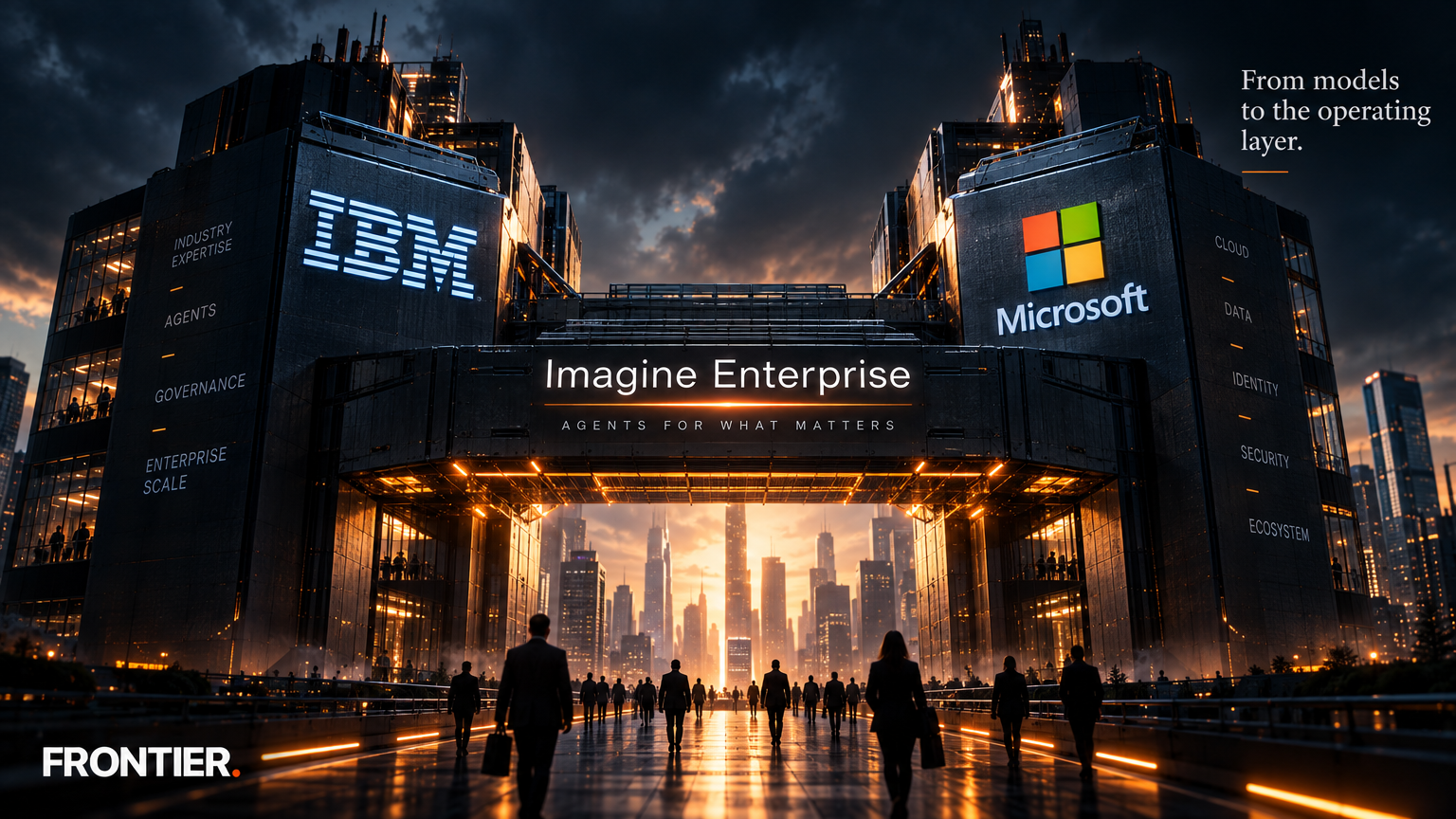
IBM and Microsoft introduced Imagine Enterprise on November 10, 2026, combining industry-specific agents, governance and enterprise infrastructure in a joint platform that signals a structural shift from buying model access to choosing an operating layer for repeatable AI workflows.
Take the argument with you.
Read the publication-ready report. Generated from the canonical News article.
What changed
IBM and Microsoft jointly announced Imagine Enterprise on November 10, 2026. The companies describe it as a platform for building, running and governing industry-specific AI agents, positioning IBM Consulting and IBM’s agent assets alongside Microsoft’s cloud, data, AI, identity, governance and security technologies.12 Independent reporting also characterizes the offering as a joint IBM-Microsoft platform rather than a Microsoft-only product.34
IBM says it is contributing more than 6,000 AI agents and other assets, while Microsoft is supplying the underlying portfolio of enterprise technologies. Those figures and capability descriptions are vendor claims, not independently demonstrated measures of production performance.12 The initial frameworks target financial services, insurance and retail. The companies say organizations will be able to use IBM Consulting for delivery or manage implementations themselves, creating a choice between services-led adoption and greater internal control.124
The announcement identifies SEI as exploring the technologies, but the cited materials do not disclose pricing or identify a customer already operating Imagine Enterprise in production.12 That distinction matters: the verified event is the introduction of a jointly developed platform and delivery model, not evidence that the platform has already produced repeatable operating results at enterprise scale. CIOs should therefore treat the announcement as a new sourcing and architecture option whose commercial and operational maturity still requires validation.
The associated power-cost coverage needs separate treatment. Microsoft reiterated its position on November 11, 2026 that it would pay its own way for data-center electricity rather than transfer those costs to residential customers.5 But the underlying commitment was not introduced alongside Imagine Enterprise. Microsoft had already announced its Community-First AI Infrastructure initiative, including that electricity-cost commitment, on January 13, 2026.67 The November comments were therefore a reaffirmation of an earlier policy, while the November 10 IBM-Microsoft platform announcement was the genuinely new event. Conflating the two would overstate the novelty of the power pledge and obscure that Imagine Enterprise is a joint offering rather than a Microsoft-only platform.
Why it matters
Imagine Enterprise changes the CIO decision model because it presents agentic AI as an integrated architecture and operating choice, not simply a model-selection exercise. The proposed package spans reusable agents, industry frameworks, data and cloud foundations, identity, security, governance and implementation services.12 The relevant comparison is therefore no longer limited to which model offers the strongest capability. CIOs must compare an integrated platform and delivery model with the alternative of assembling equivalent controls, integrations and workflows internally.
That comparison requires a broader unit of analysis. A reusable agent has limited enterprise value if its permissions, data access, auditability and operating ownership cannot be managed consistently. Conversely, a platform’s apparent completeness does not establish that its individual components will work across a company’s existing estate or satisfy its deployment constraints. The vendors’ description supports the conclusion that Imagine Enterprise is intended to connect agents with established enterprise systems; whether it does so economically and reliably in a particular organization remains a question for technical and commercial validation.12
The build-versus-buy decision also becomes more granular. CIOs do not have to choose only between a fully bespoke agent estate and complete dependence on a managed offering. IBM and Microsoft disclose both IBM Consulting-led delivery and a self-management option.124 That creates a spectrum of operating models, but it also forces decisions about which party owns workflow design, policy configuration, runtime operations, incident response and future portability. An organization may adopt reusable industry assets while retaining some deployment control, yet that outcome should be established contractually and technically rather than inferred from platform positioning.
The absence of disclosed pricing and a named production deployment is consequential. Without those data points, CIOs cannot assume that a library of more than 6,000 agents and assets translates into lower implementation cost, faster time to production or better business outcomes.12 Those benefits remain vendor propositions until tested against a defined workflow, existing controls and the full cost of integration and operation. The appropriate procurement object is not the asset count; it is a governed production workflow with measurable acceptance criteria.
Analytical inference: if governed agent platforms become a durable enterprise architecture layer, differentiation will move toward integration quality, reusable domain workflows, control consistency and deployment economics rather than model access alone. Imagine Enterprise is evidence of that direction because it combines industry assets with infrastructure and governance in one proposition.13 It is not, by itself, proof that this particular platform has achieved that outcome. CIOs should adjust their evaluation framework now while withholding production-scale commitments until the vendors provide evidence relevant to their own environments.
Frontier take
The decisive enterprise AI contest will be won at the governed workflow layer, not at the model endpoint. Imagine Enterprise is strategically important because IBM and Microsoft are packaging agents, industry frameworks, enterprise infrastructure and delivery into a common operating proposition.12 That makes the platform a test of whether repeatable domain workflows can become a managed architecture layer across existing technology estates.
This assertion does not depend on accepting the vendors’ asset count or transformation claims. It follows from the scope of the offering itself. A model supplies capability, but a production workflow also requires authorized access to data and systems, governance, security, operational ownership and a deployment method. Microsoft is positioned as providing technologies across AI, data, cloud, identity, governance and security, while IBM contributes industry-oriented agents, assets and consulting delivery.12 The combination attempts to move the buying decision from isolated AI components toward an integrated operating system for enterprise agents.
For CIOs, the strategic risk is evaluating that system as a conventional product bundle. A large catalog can create the appearance of maturity while leaving unanswered questions about how many assets fit the organization’s processes, what customization they require and how their behavior will be governed after deployment. The announcement’s reference to more than 6,000 agents and assets should therefore be treated as an inventory claim, not a proxy for usable enterprise coverage.12 The lack of disclosed pricing and an identified production customer reinforces the need to test workflow economics and operating evidence before making a broad commitment.
The strongest evaluation method is to begin with a consequential domain workflow and work backward into architecture. The organization should specify the permitted actions, required data, identity boundaries, human approval points, audit evidence and failure handling before comparing platforms. It can then determine whether reusable assets reduce implementation work without weakening control or creating unacceptable dependence on vendor-specific orchestration. This is an analytical recommendation derived from the platform’s disclosed composition, not a reported product capability.
The power-cost pledge should not influence that platform assessment as though it were a newly introduced economic concession. Microsoft’s November 11 remarks repeated a position first announced in January 2026.675 Infrastructure policy may still matter to enterprise risk reviews, but the timing correction prevents an older commitment from being used to amplify the apparent significance of the new IBM-Microsoft offering. The architecture decision should rest on production evidence, governance fit, deployment control and total workflow economics.
The enduring implication extends beyond either vendor: CIOs need an architecture policy for governed agents before platform adoption accelerates. Such a policy should define which workflows may use packaged agents, which controls must remain portable, what evidence is required for production approval and when managed delivery is preferable to internal assembly. Imagine Enterprise creates a concrete occasion to establish that policy, but the policy should govern every agent platform rather than encode one supplier’s product structure.
Three moves for CIOs
-
— Run a workflow portability test before selecting the platform Choose one material workflow in financial services, insurance or retail that aligns with the initial frameworks, then require IBM and Microsoft to map every agent, data dependency, identity permission, governance control and human approval point. Test whether the workflow definition, operating data and audit records can be retained or reconstructed if the organization changes the agent, model, delivery partner or runtime. Score the platform against an internally assembled alternative using the same acceptance criteria rather than comparing feature lists.
- Decision trigger: Start the test when a business sponsor requests production funding for an industry-agent use case or when procurement proposes a multi-workflow platform agreement.
- Why now: Imagine Enterprise explicitly combines reusable industry assets with Microsoft infrastructure and IBM delivery options.12 That integration may reduce assembly work, but it may also concentrate dependencies. Portability must be measured before workflows and controls become embedded in a platform whose pricing and production record were not disclosed in the announcement.
-
— Make production evidence the gate for portfolio-scale commitment Convert the proposed use case into a production-evidence contract. Require an agreed workflow baseline, control tests, implementation effort, operating responsibilities, exception rates, audit outputs and full run-cost reporting. Fund only a bounded deployment until those criteria are met. Do not use the reported library of more than 6,000 agents and assets as a purchasing metric; count only assets that pass the organization’s workflow and governance tests.
- Decision trigger: Apply the gate whenever the vendor seeks an enterprise-wide commitment, consumption minimum or expansion beyond the first governed workflow.
- Why now: The vendors report a substantial asset library, but the cited announcement does not provide pricing or identify a customer already running Imagine Enterprise in production.12 A bounded evidence gate converts an architecture narrative into comparable operating data before the organization commits to a platform-level dependency.
-
— Separate platform governance from infrastructure-policy signals Create two decision records: one for the agent platform’s architecture, security, governance, deployment control and economics, and another for infrastructure externalities and supplier commitments. Record Microsoft’s electricity-cost position with its original January 13, 2026 date, then assess Imagine Enterprise independently on its November 10 platform evidence. Require future sourcing briefs to distinguish newly introduced commitments from repeated policies.
- Decision trigger: Use this separation whenever an AI sourcing proposal combines product capabilities with sustainability, community-impact, energy or infrastructure-policy claims.
- Why now: Microsoft’s November 11 pay-its-own-way remarks reaffirmed a policy announced in January rather than introducing a new pledge.675 Separating those records prevents an older infrastructure commitment from changing the perceived maturity or economics of a newly announced joint platform.
Sources
- Microsoft Source: IBM and Microsoft announce Imagine Enterprise 1
- IBM Newsroom: IBM and Microsoft announce Imagine Enterprise 2
- CIO Dive: Microsoft, IBM team up on AI agent platform 3
- StorageReview: IBM and Microsoft launch Imagine Enterprise 4
- Microsoft: Building Community-First AI Infrastructure 6
- Bloomberg News: Microsoft vows to pay its own way for data-center power 5
- Axios: Microsoft's five-point data-center plan 7
[^microsoft-launch][^ibm-launch][^cio-dive][^storage-review][^bloomberg-power][^microsoft-community-first][^axios-power-plan]