HPE Adds Mixed-Nvidia Clusters and Vera CPU Rack as AI Infrastructure Shifts to Workload-Fit Compute
HPE Private Cloud AI can now combine Nvidia H200 and RTX PRO 6000 Blackwell Server Edition GPUs in one cluster, while HPE has introduced a liquid-cooled Vera CPU rack—evidence that private AI architecture is moving from uniform accelerator estates toward governed pools of heterogeneous compute.
Take the argument with you.
Read the publication-ready report. Generated from the canonical News article.
What changed
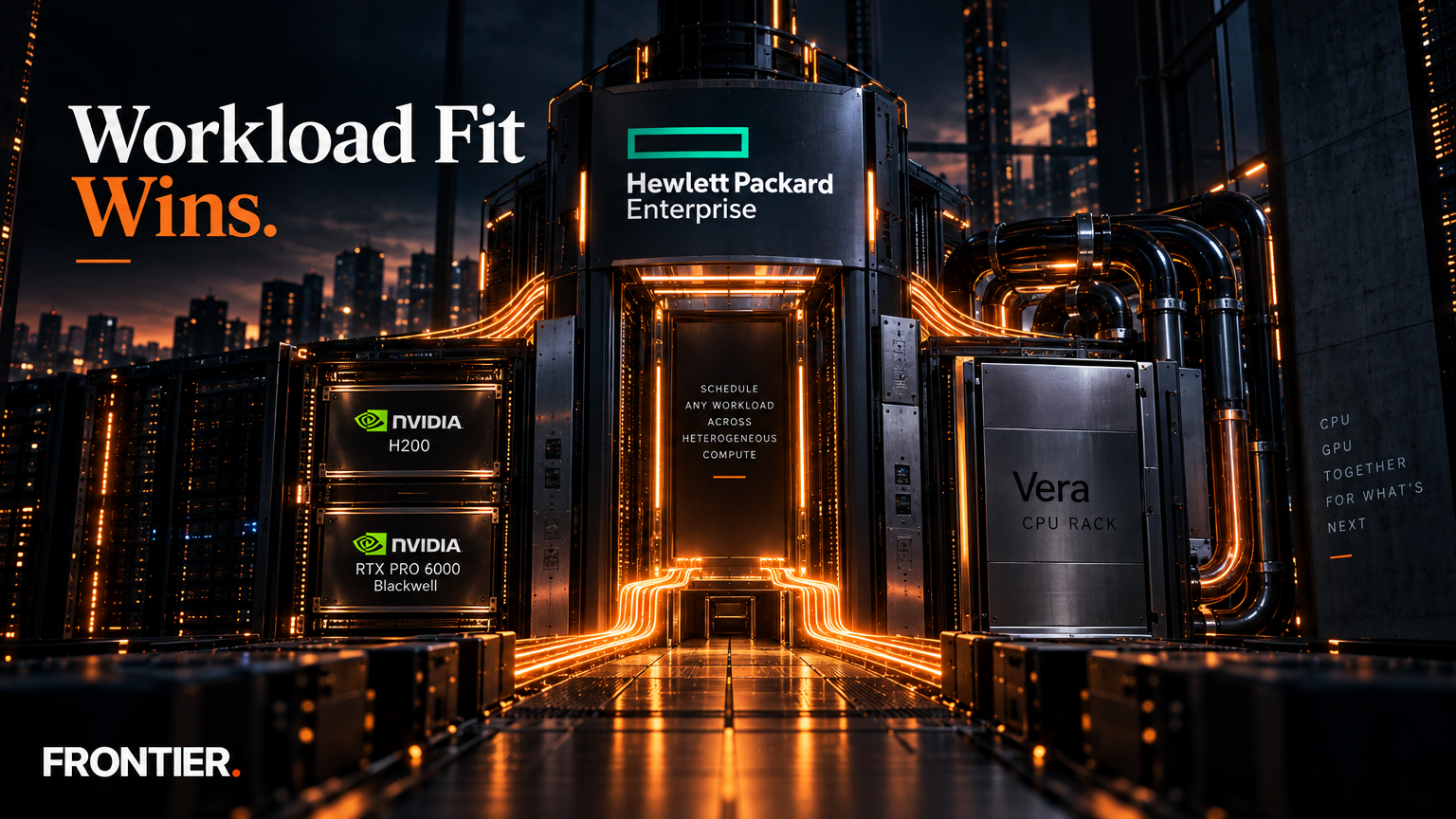
Hewlett Packard Enterprise announced at Nvidia GTC Berlin on October 21, 2026, that HPE Private Cloud AI can combine Nvidia H200 GPUs and Nvidia RTX PRO 6000 Blackwell Server Edition GPUs within the same cluster. HPE says the heterogeneous-GPU capability is generally available, giving customers a way to operate two accelerator classes through one Private Cloud AI environment rather than treating each as the foundation for a separate stack.1 Data Center Dynamics, StorageReview and ITPro independently reported the mixed-cluster expansion.234
The change is more consequential than a routine hardware qualification. H200 and RTX PRO 6000-class GPUs can now be presented as components of a shared platform, with Nvidia's open-source KAI Scheduler providing quota- and priority-based scheduling. HPE and Nvidia assert that this scheduling layer can improve utilization and workload placement, but that outcome remains a vendor claim rather than an independently demonstrated result in the supplied research.1 StorageReview reported that support for the mixed cluster and KAI scheduling is generally available.3
HPE also introduced the Nvidia Vera CPU Rack by HPE, a liquid-cooled, high-density system based on Nvidia's Vera CPU architecture. HPE describes its implementation as containing 256 Vera CPUs and supporting approximately 22,500 agent or reinforcement-learning sandboxes.1 Nvidia's own product material similarly describes the generic Vera CPU Rack as integrating as many as 256 CPUs and running more than 22,500 concurrent environments.5 Those capacity figures are vendor-supplied and should be treated as design claims until validated against an enterprise's models, software stack and operating constraints.
The timing requires precision. HPE introduced its branded implementation in October, but Nvidia had already detailed the underlying Vera CPU Rack architecture in March 2026.6 The event is therefore HPE's addition of a Vera-based rack to its enterprise infrastructure portfolio, not the first public disclosure of Nvidia's generic architecture. Data Center Dynamics and StorageReview both characterized the HPE system as liquid-cooled, while StorageReview reported the 256-CPU configuration.23
HPE also promotes an 80% improvement in agentic CPU performance. That figure should not anchor a purchasing decision: StorageReview noted that HPE did not identify a detailed baseline, while Nvidia frames its comparison against traditional or x86 CPU infrastructure.3 The verified development is the packaging of mixed Nvidia accelerators and CPU-dense infrastructure into HPE's private-AI direction; the performance and utilization benefits remain propositions that customers must test.
Why it matters
The CIO decision model for private AI has typically begun with a dominant compute specification: choose an accelerator, size a cluster around it and attach a software environment. HPE's expansion points toward a different unit of evaluation. The relevant question is increasingly whether a platform can govern several compute classes as one operational pool and assign each workload to an appropriate resource—not whether one accelerator offers the strongest headline specification.
That distinction matters because heterogeneous infrastructure creates value only if heterogeneity is manageable. Merely installing different GPU models does not establish a coherent shared service. The platform must expose allocation policies, priorities and quotas that determine which teams receive which resources. Nvidia's KAI Scheduler supplies quota- and priority-based scheduling, and HPE positions it as the mechanism for workload placement across the mixed environment.1 The reported general availability of mixed H200 and RTX PRO 6000 clusters makes that governance question immediate rather than hypothetical.3
CIOs should consequently shift evaluation weight from isolated component performance toward placement control. A platform review must establish whether administrators can segment access, protect priority workloads, observe allocation decisions and prevent a convenient shared pool from becoming an opaque source of contention. This is an analytical implication of the product design, not a reported proof that HPE's implementation delivers those outcomes in every environment. The supplied evidence verifies quota- and priority-based scheduling; it does not provide independent measurements of utilization, queue behavior or service-level performance.1
The Vera rack extends the decision beyond GPUs. HPE and Nvidia are positioning high-density CPU infrastructure for agent and reinforcement-learning environments, with both companies citing a 256-CPU design and roughly 22,500 concurrent environments or sandboxes.15 For CIOs, the important signal is architectural: private AI capacity planning may need to distinguish accelerator-intensive model work from CPU-intensive orchestration, simulation or environment execution. The supplied sources do not independently validate which enterprise workloads will benefit or by how much, so buyers should not assume that the published capacity figure maps directly to production throughput.
Procurement should therefore move away from one-time cluster selection and toward a portfolio model. Each compute class needs a declared workload role, an admission policy and evidence that the scheduler can enforce that role. A mixed pool can reduce the need to create a separate homogeneous stack for every workload, but that is a strategic inference rather than a measured result in the research. It will be true only where the platform's scheduling, observability and operating processes are strong enough to make unlike resources behave as a governed service.
This also changes benchmark design. A single throughput result cannot demonstrate the value of a heterogeneous platform. CIOs need workload-level tests that examine placement accuracy, queue time, policy enforcement and the effects of contention. HPE's claimed 80% agentic CPU performance advantage is insufficient for that purpose because the detailed comparison baseline was not identified in the reporting.3 The decision standard should be reproducible performance under the enterprise's own workload mix, not an aggregate vendor claim.
Frontier take
The decisive layer in private AI is moving from the accelerator to the scheduler. HPE's announcement is strategically important not because it adds another qualified Nvidia component, but because it treats unlike GPUs—and, at the portfolio level, CPU-dense systems—as resources to be assigned according to workload fit. Mixed H200 and RTX PRO 6000 support makes that operating model concrete inside HPE Private Cloud AI.14
Our assertion is that heterogeneous compute should now be the default evaluation assumption for private AI, while homogeneous clusters should require a workload-specific justification. That is an analytical recommendation, not a claim that every workload should span multiple hardware types. Some workloads may still warrant dedicated infrastructure. The strategic change is that CIOs should no longer accept uniformity as a proxy for operational simplicity without testing whether governed heterogeneity offers a better fit.
This reframes platform differentiation. Hardware access remains necessary, but the durable enterprise control point is the ability to convert diverse resources into predictable services. KAI's quota and priority features are relevant because they address who gets capacity and when.1 They do not, on the available evidence, prove that HPE's platform will maximize utilization or meet a particular service level. Independent reports corroborate the capability's availability, not its performance under customer workloads.23
CIOs should also resist collapsing HPE's two announcements into one benchmark story. The mixed-GPU cluster is an available platform capability; the Vera CPU Rack is HPE's implementation of an architecture Nvidia had described earlier.6 The vendors' 256-CPU and 22,500-environment figures help define intended scale, but they are not substitutes for application-level validation.15 Likewise, the reported lack of a detailed baseline for the 80% performance claim makes that number unsuitable as a primary business-case input.3
The practical organizing principle is workload fit under governance. Every accelerator or CPU class entering the private-AI estate should have a defined workload category, placement policy, measurement plan and exit condition. The scheduler should then be evaluated as production infrastructure with explicit service levels, rather than treated as an implementation detail bundled with hardware. If HPE Private Cloud AI can demonstrate that discipline in a customer's environment, its mixed-cluster support becomes an architectural advantage. If it cannot, heterogeneity merely adds operational variables. The purchasing decision should turn on that distinction.
Three moves for CIOs
-
— Run a placement-policy bake-off, not a peak-performance benchmark Build a representative queue containing at least two workload categories and test whether the platform consistently assigns them to the intended H200 or RTX PRO 6000 resource class. Measure queue time, completion time, policy exceptions and behavior under contention. Require administrators to demonstrate quota and priority controls, then compare the results with a deliberately homogeneous configuration. Treat claimed utilization gains as unverified until this test produces reproducible evidence.1
- Decision trigger: Initiate the bake-off when a private-AI proposal includes more than one accelerator class, or when a team requests a new dedicated cluster because its workload is said to require different hardware.
- Why now: HPE says mixed H200 and RTX PRO 6000 support is generally available, and independent reporting corroborates that availability.34 CIOs can therefore test governed heterogeneity as a current platform capability rather than accepting a roadmap promise.
-
— Make workload roles mandatory before approving new compute classes Require every proposed GPU or CPU class to have a documented workload role, scheduling policy, owner, success metric and retirement condition. For a Vera-based rack, validate the actual agent or reinforcement-learning environments against the enterprise software stack rather than using the vendor's approximately 22,500-environment figure as a capacity forecast.15
- Decision trigger: Apply the requirement when architecture review adds a materially different accelerator generation or a CPU-dense system to the private-AI estate without identifying which workloads will move to it and how placement will be enforced.
- Why now: HPE's portfolio direction now spans mixed accelerator classes and a high-density Vera CPU implementation. That makes unmanaged hardware accumulation a near-term governance risk, while the available capacity and performance numbers remain vendor claims rather than independently validated production results.3
-
— Contract for scheduling evidence instead of benchmark promises Tie acceptance criteria to observable placement and governance outcomes: quota enforcement, priority behavior, queue visibility, workload isolation and performance under a defined mixed queue. Exclude the claimed 80% agentic CPU performance improvement from the core business case unless HPE supplies a relevant baseline and the result is reproduced in the buyer's environment.3
- Decision trigger: Use these terms when a proposal's return-on-investment case depends on higher utilization, workload consolidation or vendor performance comparisons that lack a detailed customer-relevant baseline.
- Why now: The architectural value of a heterogeneous pool depends on scheduling quality, while the supplied evidence confirms features but not independent utilization or service-level outcomes. Contracting around measured governance makes the same workload-fit thesis enforceable after purchase.
Sources
- HPE: HPE teams with NVIDIA to advance secure agentic AI across enterprises and industrial environments 1
- NVIDIA Vera CPU product and architecture page 5
- NVIDIA: Vera Rubin POD and Vera CPU Rack architecture, March 16, 2026 6
- Data Center Dynamics: HPE expands Private Cloud AI and launches Vera CPU rack 2
- StorageReview: HPE Private Cloud AI adds mixed GPU clusters and a 256-CPU Vera rack 3
- ITPro: HPE eyes infrastructure flexibility gains with Private Cloud AI announcements 4
[^hpe-announcement][^storage-review-report][^itpro-report][^nvidia-vera-product][^nvidia-rack-architecture]