Honeywell Technologies’ Forge Cognition Wants AI at the Controls. CIOs Must Own the Kill Switch.
Honeywell Technologies has introduced Forge Cognition with NVIDIA technology and Dell infrastructure, signaling a broader shift from AI that analyzes facility data to operational systems that can simulate environments and recommend or execute actions under defined human oversight.
Take the argument with you.
Read the publication-ready report. Generated from the canonical News article.
What changed
Honeywell Technologies introduced Forge Cognition on October 14, 2026, positioning it as an agentic AI and simulation platform for facility operations. Although the initial discovery headline described a building-automation product, Honeywell’s announced scope extends across buildings, campuses and industrial operations.1 Facilities Dive likewise reported that the platform adds operational AI capabilities to Honeywell Forge and is intended for use across multiple types of facilities.2
The platform brings together technologies that have often been procured and managed separately. Honeywell said Forge Cognition incorporates NVIDIA Nemotron models, Omniverse libraries, Cosmos models, Metropolis tooling and RTX PRO GPUs. Dell Technologies supplies infrastructure through the Dell AI Factory with NVIDIA.1 Dow Jones Newswires reported the same division of roles: Honeywell provides the operational platform, NVIDIA contributes AI and simulation technologies, and Dell supplies supporting infrastructure.3
That structure matters when interpreting the launch. The available evidence supports describing Forge Cognition as a Honeywell platform developed with technology from NVIDIA and Dell Technologies. It does not establish a separately incorporated joint venture or a jointly owned platform. CIOs should therefore evaluate the commercial and technical responsibilities of the three companies independently rather than treating the announcement as evidence of a single, unified supplier relationship. This is an analytical distinction based on the reported collaboration model, not an additional claim about undisclosed contract terms.14
Honeywell disclosed pilots at NVIDIA’s Voyager campus, Vanderbilt University, Dubai’s Fairmont Hotel, Singapore’s NEX Mall, and Honeywell campuses in Bangalore and Richardson, Texas.132 At Voyager, Honeywell reported reductions of up to 90% in unnecessary alerts, identification of up to 10% in potential energy and utility savings, and a comfort score above 95%.1 Fortune and Facilities Dive repeated those reported outcomes, but the retrieved evidence does not indicate that the figures were independently audited. They should be treated as vendor-attributed pilot results rather than established performance benchmarks.42
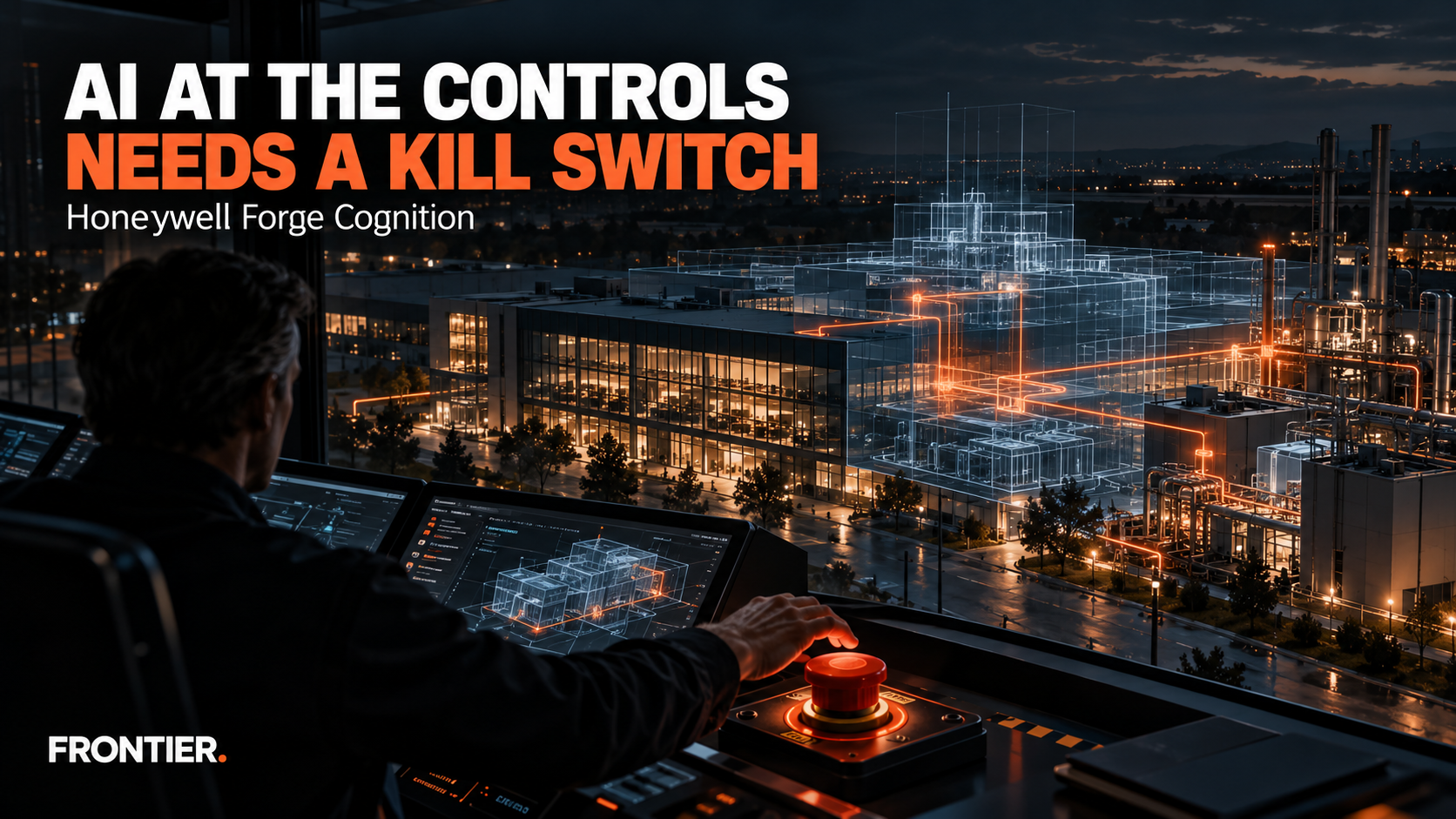
The most consequential qualification concerns autonomy. Honeywell presents Forge Cognition as supporting manual, semi-autonomous and autonomous operating modes. However, Honeywell’s chief technology officer told Fortune that full autonomous operation had not yet been enabled and that humans would remain in control for the immediate future.4 The launch is therefore not evidence that unattended AI control of facilities has become routine. It is evidence that simulation, computer vision, agentic models and dedicated infrastructure are being assembled into an architecture designed to move progressively from interpretation toward operational action.
Why it matters
The CIO decision is no longer limited to whether AI can improve dashboards, detect anomalies or summarize facility data. Forge Cognition’s announced architecture places AI closer to physical operations: models can interpret conditions, digital-twin technology can simulate environments, and the platform can recommend or potentially execute actions according to its configured operating mode.14 That changes the unit of evaluation from an analytics application to an operational system spanning software, infrastructure, simulation and human authority.
For CIOs, this widens the architecture decision. The relevant question becomes how facility data, models, simulation tools, computer vision and supporting compute should be assembled and governed across buildings, campuses and industrial environments. Honeywell’s use of multiple NVIDIA technologies and Dell infrastructure illustrates that the operational application cannot be assessed in isolation from its underlying technology stack.13 This does not prove that every deployment will require the same configuration. It does show that buyers must understand which supplier is responsible for each layer and how those layers affect deployment, operation and escalation.
The governance decision also becomes more concrete. A system that only surfaces information can be assessed largely through the quality and usefulness of its outputs. A system designed to support manual, semi-autonomous and autonomous modes must additionally be assessed according to what it is permitted to influence, when a person must approve an action, and how authority changes between operating modes. Fortune’s reporting that full autonomy had not yet been enabled reinforces the near-term importance of human control rather than diminishing the strategic significance of the launch.4 The immediate enterprise task is to define boundaries before broader autonomy is activated, not after.
CIOs should also separate technical feasibility from business proof. Honeywell’s disclosed pilots provide concrete environments in which the platform has been tested, and the Voyager figures offer hypotheses about alert reduction, energy performance and occupant comfort.12 But vendor-reported results are not a substitute for a buyer’s own baseline, measurement design and operating constraints. The appropriate decision model is therefore staged: first verify that the system accurately represents the environment; then test whether its recommendations improve selected outcomes; and only then consider expanding its authority.
This makes procurement accountability as important as model capability. Honeywell, NVIDIA and Dell Technologies occupy distinct positions in the announced stack, while the available reporting describes a technology collaboration rather than a new jointly owned entity.34 A CIO evaluating the platform must determine where operational accountability sits when a recommendation depends on Honeywell software, NVIDIA models or simulation components, and Dell-provided infrastructure. That is an analytical implication of the documented architecture; the sources do not report the contractual answer. The change is that these questions now belong inside the initial AI architecture and governance decision, rather than being deferred as implementation details.
Frontier take
Physical AI should be governed as an operational control architecture from the first pilot, even while humans retain final authority. That is the central implication of Honeywell’s launch. The significance is not that Forge Cognition has already delivered fully autonomous facilities; Fortune’s reporting explicitly indicates that it has not.4 The significance is that the technical components required to model an environment, interpret operating conditions and move toward action are being packaged as one facility-operations platform.
This distinction should organize the enterprise response. If CIOs classify the platform as another analytics tool, they risk evaluating it primarily through dashboard quality, model accuracy or aggregate return on investment. Those measures remain relevant, but they are insufficient for a system whose announced design includes different levels of operational authority. A more defensible evaluation asks what the system can observe, what it can simulate, what it can recommend, what it can change and who remains accountable at each stage. That conclusion is an analytical inference from the platform’s reported capabilities and operating modes, not a claim that Honeywell has removed human control.14
The reported Voyager outcomes should consequently be used as testable reference points, not purchasing assumptions. Alert reduction may improve operator focus, but CIOs still need evidence that suppressed alerts are genuinely unnecessary. Potential energy savings may support an investment case, but the cited figure is not an independently audited guarantee. A comfort score may help balance efficiency against occupant experience, but buyers must establish how their own environment measures that outcome.12 The strategic value of a pilot lies in validating the chain from environmental representation to operational recommendation—not merely reproducing a headline percentage.
The durable shift is that facility operations are becoming part of enterprise AI architecture. Honeywell’s announced scope across buildings, campuses and industrial operations makes this broader than a discrete building-automation upgrade.1 CIOs should respond by joining infrastructure, model governance and operational authority in one decision framework. Human control is the present boundary, but it should be implemented as an explicit architecture rather than treated as a reassuring assumption.
Three moves for CIOs
-
— Create an operational-authority ladder before selecting the pilot Define separate permissions for observation, simulation, recommendation, operator-approved action and autonomous action. For each proposed use case, document which mode is allowed, who approves movement to the next level, and which outcomes must be independently measured. Begin with a bounded workflow in which recommendations can be compared with operator decisions without automatically changing the physical environment. This operationalizes the thesis by treating human control as a designed system boundary rather than a general policy statement.
- Decision trigger: Require formal review whenever a deployment would move from producing insights to recommending a physical intervention, or from recommending an intervention to executing one without case-by-case human approval.
- Why now: Honeywell advertises manual, semi-autonomous and autonomous modes, while its CTO said full autonomy had not yet been enabled.4 The gap between architectural capability and current operating practice gives CIOs an opportunity to establish authority rules before pressure to expand automation emerges.
-
— Test the simulation-to-action chain, not just the AI output Design the pilot around a traceable sequence: source data, representation of the facility, simulated outcome, recommended intervention, operator judgment and measured result. Use Honeywell’s reported alert, energy and comfort outcomes only as hypotheses. Establish local baselines and test whether reducing alerts preserves necessary warnings, whether projected savings appear in measured operations, and whether efficiency changes maintain the organization’s selected comfort threshold.
- Decision trigger: Do not approve broader deployment until the pilot can show that recommendations derived from the simulated environment produce repeatable operational results against the buyer’s own baseline, without unacceptable degradation in another monitored outcome.
- Why now: Honeywell has reported up to 90% fewer unnecessary alerts, up to 10% potential energy and utility savings, and comfort above 95% at NVIDIA’s Voyager campus, but the retrieved sources do not establish independent auditing.12 CIOs need locally validated evidence before treating those figures as an investment premise.
-
— Contract by control layer rather than by brand bundle Map operational responsibility across Honeywell’s application layer, NVIDIA’s models and simulation technologies, and the Dell AI Factory infrastructure. For every critical workflow, assign responsibility for model behavior, simulation integrity, infrastructure availability, operator escalation and recovery from an incorrect recommendation. Make progression to higher-authority modes contingent on resolving any accountability gap across those layers.
- Decision trigger: Escalate the procurement for architecture and risk review whenever a critical operational recommendation depends on components from more than one supplier and no single contractual path covers diagnosis, escalation and remediation across the full stack.
- Why now: The evidence describes a Honeywell platform using NVIDIA technology and Dell infrastructure, not a separately incorporated joint venture or clearly unified accountability model.134 As AI approaches physical action, ambiguity between technology layers becomes an operational governance issue rather than routine vendor coordination.
Sources
[^honeywell-primary][^facilities-dive][^dow-jones][^fortune-report]