Google’s TPU 8tx and 8i Max Target AI’s Hardest Enterprise Workloads. Can CIOs Actually Get Them?
Google’s new TPU systems attack confidential inference and massive-context agents, two workloads where it could become a first-choice provider. But security proof, unknown pricing and the still-limited path to owned hardware complicate the CIO decision.
Take the argument with you.
Read the publication-ready report. Generated from the canonical News article.
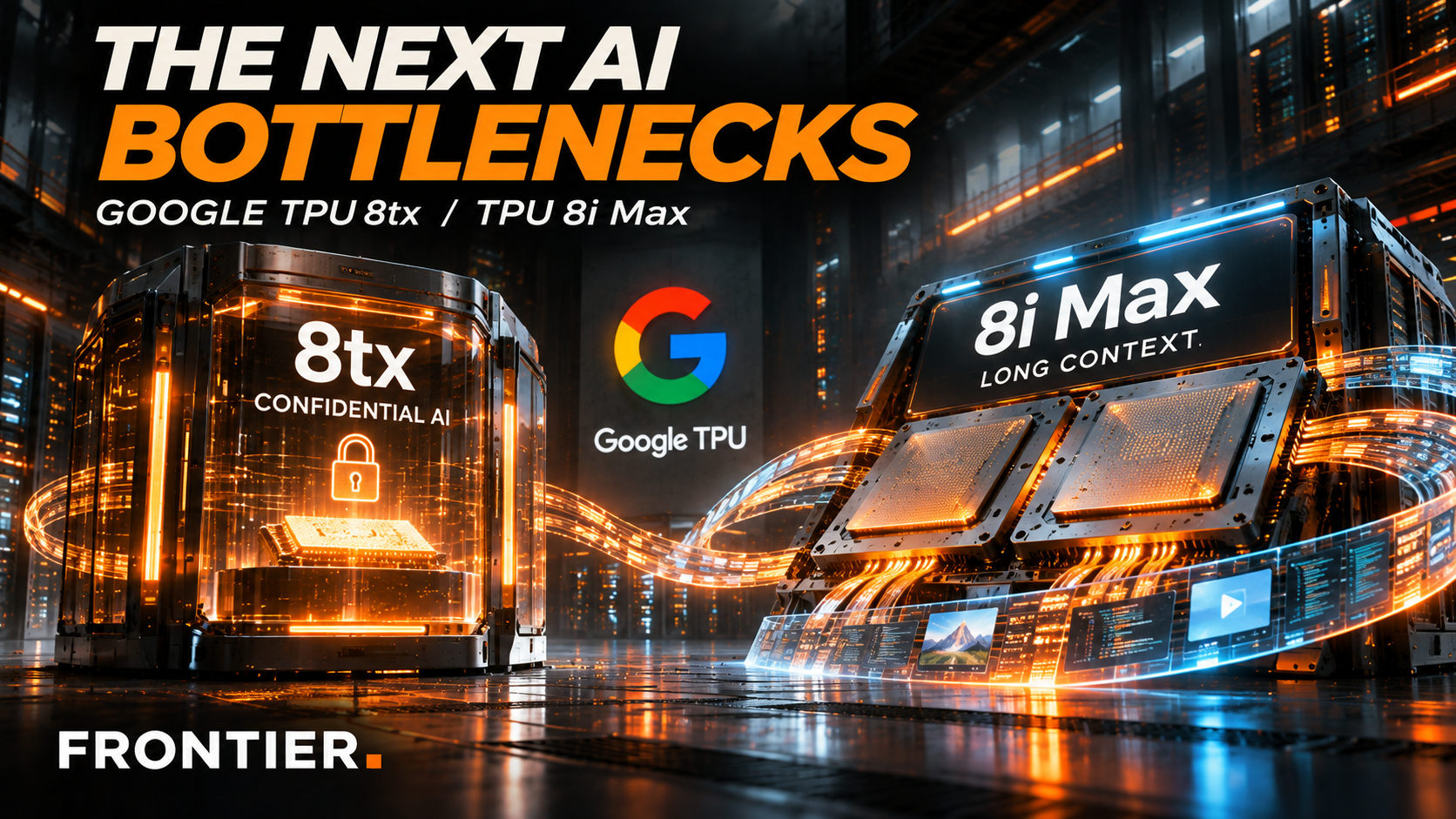
Google has just made one of the most competitively significant moves in the AI infrastructure race: instead of promising one faster accelerator for everything, it has built two eighth-generation TPU systems around the problems that keep high-value enterprise AI from scaling—protecting sensitive data while models actually use it, and feeding enormous working contexts to agents without starving the processors.
On November 9, Google introduced TPU 8tx, optimized for confidential inference and private model adaptation, and TPU 8i Max, engineered for memory-intensive, long-context reasoning. They join April's TPU 8t for training and TPU 8i for real-time inference. Google calls these new systems, not two wholly new silicon architectures: networking, memory configuration, packaging and security are being changed faster than a chip design cycle permits.12
This is where Google can become a first-choice infrastructure provider for specific, economically important AI workloads, even when an enterprise does not use Gemini as its main model or Google Cloud as its primary cloud. But CIOs have to separate an impressive architectural announcement from deployable capacity, security proof and total operating economics.
The Frontier thesis: the AI accelerator market is splitting by workload. Google is designing the computer around the bottleneck; CIOs must buy the measured system, not the chip story. And for most buyers, that still means renting scarce Google-controlled capacity.
A four-system portfolio, not a universal Nvidia replacement
Google says TPU 8t targets high-goodput model training, TPU 8i minimizes latency for iterative reasoning, TPU 8tx adds confidential computing to a training-class platform, and TPU 8i Max expands the memory and compute envelope for very large contexts. This is a coherent strategy: AI economics increasingly depend on communication, state movement, security and usable throughput, not merely peak tensor operations.1
The baseline performance claims deserve precise attribution. Google's April-generation comparison of up to 2.7 times better training performance and 80% better inference price-performance relates to the 8t and 8i base systems versus prior-generation TPUs, respectively. It is not an independently demonstrated claim that 8tx or 8i Max outperform Nvidia by either margin. No published price-performance benchmark or tariff yet establishes that these two new configurations will be the cheapest choice for a customer's workload.123
For a CIO, the consequential question is no longer simply GPU versus TPU. It is which part of the AI lifecycle dominates the bill and the risk: frontier training, rapid multi-step inference, protected proprietary intelligence, or persistent reasoning over vast working data. A homogeneous fleet will often be a poor answer to four different problems.
TPU 8tx: the regulated-enterprise wedge
TPU 8tx uses the same silicon foundation as 8t, adds fifth-generation AMD EPYC hosts, and uses Google's lower-latency Boardfly network. Google claims up to two times lower latency than TPU 8t, with negligible performance overhead from its security approach. That comparison is against another Google TPU configuration, not a blanket ranking against all accelerated platforms.1
The deeper change is confidential computing during use. Encryption at rest and in transit does not solve the exposure of prompts, model weights or intermediate state while the system processes them. AMD says the design uses EPYC Secure Encrypted Virtualization and extends hardware isolation to the connected accelerator; the host checks the accelerator's identity and security configuration before granting protected-memory access. The intent is to limit what infrastructure operators or compromised components can inspect while work executes.4
This makes Google a serious contender for sectors that previously had to choose between frontier-model capabilities and tightly controlled proprietary information: investment strategies and market data; drug discovery and sensitive research; insurer pricing; regulated legal or customer records; and proprietary model weights that a company cannot casually expose to an ordinary shared cloud runtime.
There is a second advantage. Google says 8tx can perform private inference, smaller-scale fine-tuning, distillation and reinforcement-learning adaptation on one system rather than moving restricted data through multiple clusters. That could reduce copies of sensitive datasets, cluster-to-cluster transfers, security reviews and the operational friction between customization and production. It does not remove the need for lawful data access, data minimization or model-output controls. An encrypted system can still produce a harmful answer or leak information through an authorized agent's tools.1
The security proof is not finished in the announcement. AMD explains high-level accelerator identity verification; however, the public launch materials do not establish a customer-verifiable TPU 8tx-specific attestation protocol, exact trusted computing base, firmware-update policy, tenant isolation evidence, operator threat model, independent assurance report or customer key-control boundary. Google's general Confidential Computing attestation documentation covers established environments, but cannot automatically be treated as certification of this brand-new TPU configuration. Regulated buyers should require those artifacts and test failure behavior before placing their most sensitive workloads on it.45
Our judgment: if the protections are independently verified and the price is competitive, 8tx can become a first-call bid for cloud-resident proprietary inference. It is not yet a license to declare every cloud data-sovereignty requirement solved.
TPU 8i Max: the long-context bottleneck moves into the hardware
The second system attacks a different scarcity: moving and retaining model state. Google combines two TPU 8i chips in a single package and reports twice the compute, SRAM and high-bandwidth-memory bandwidth of 8i, placing twice the silicon in an existing rack footprint. Those are configuration-level capacity claims; they are not a promise of double the usable context length or double the completed tasks for every model.1
Why this matters: an AI developer may want agents to reason simultaneously across an enterprise codebase, hours of video, transaction histories, product specifications or a persistent multiparty workflow. Attention and key-value caches consume and move memory as context grows. Even a chip with enormous matrix-compute potential can spend too much time waiting for memory or remote state. That becomes painfully expensive when thousands of agents each retain large contexts between tool calls.
8i Max is designed to increase the data supplied per processor and the compute packed into each rack, making Google an especially credible candidate for massive-context coding agents, multimodal analysis, scientific exploration and high-concurrency reasoning workloads. For video understanding, extended code analysis and multistep research agents, the meaningful outcome is the ability to finish more accurate, latency-compliant tasks per dollar, not the theoretical maximum context size of a model.
Google is also building software around that problem. TPU Sync is its announced open-source model-state layer, designed to tier KV caches across HBM, host DRAM, shared storage and networked nodes; Google claims greater than 90% reduction in certain KV-transfer and time-to-first-token measurements. That is a vendor-specific software claim requiring workload-level validation, not a guaranteed gain from 8i Max alone. Agent Compute Engine aims to suspend idle sessions, and Cloud Pathways, now generally available on GKE, orchestrates large TPU slices from one controller. GKE dynamic slicing is also GA, with Google-reported startup and recovery gains. Together, these potentially attack more idle and wasted system time than a simple chip upgrade.1
But there are hard limits. Long context does not guarantee useful recall or correct citations; context-window capacity, input prefill time, output decoding, memory pressure and tool-wait periods affect economics differently. An organization with short, high-volume classification jobs may find a smaller TPU, a GPU, an efficient CPU or a model API far cheaper. Do not pay for long-context density if better retrieval or summarization eliminates the need.
Renting is the rule. On-premises access is the exception—and these two systems remain unconfirmed
Here is the purchasing asymmetry CIOs cannot overlook. Most enterprise buyers get TPUs as a managed service, not as hardware they own. Google documents on-demand, Spot, Flex-start and reserved capacity arrangements for supported Cloud TPU generations. These differ in interruption risk, duration and guarantees; the documentation's presently enumerated purchasable versions do not establish general availability of either 8tx or 8i Max. Merely announcing a system does not create an orderable region, a public per-hour price, or a capacity reservation.67
Google has moved beyond cloud-only distribution for selected large customers. Its November announcement explicitly says some customers now deploy TPUs inside their own data centers. The April Google–Anthropic agreement describes additional capacity delivered partly through Google Cloud services and partly through Google-built TPUs supplied via Broadcom. Google is also expanding distribution through a planned Blackstone-backed TPU cloud and an Oracle partnership: OCI expects TPU availability in 2027, starting with the previously announced 8t/8i generation and ramping over several years.18910
What is not established as of November 10, 2026: no public announcement confirms that TPU 8tx or TPU 8i Max specifically can be purchased, installed or operated on-premises by enterprise customers. Google has not provided general availability dates, regional capacity commitments, public pricing, or an on-premises commercial and support contract for either new system. Nor should the OCI agreement or other TPU sales be read as proof that these two variants will be included. A small number of negotiated hardware arrangements is not a broadly available enterprise hardware channel.1310
For a CIO whose data or security policy absolutely requires a company-operated facility, this is a vendor-discovery conversation, not a deployment plan. Ask Google to identify the exact generation and configuration permitted on-site; who owns it; whether Google, a colocation partner or the customer controls firmware, attestation, networking and maintenance; the minimum purchase or term; spare-parts and repair rights; and how software, security updates and workload portability will be supported. Without written answers, “we offer on-prem TPUs” is too vague to support a regulated procurement decision.
Why Google might win even when Nvidia remains everywhere
TPU economics benefit from co-design across the accelerator, optical/network interconnect, compiler, orchestration and memory-state layer. Google's TorchTPU initiative now seeks to run PyTorch and Hugging Face models natively on TPUs, with vLLM/SGLang serving paths and a preview developer assistant suite. The open-source XLA Serving Engine adds an explicit multi-accelerator runtime direction. This matters: developers are less likely to consider a financially attractive accelerator if using it means an expensive framework rewrite.111
Still, open source is not frictionless portability. Production kernels, quantization, model operators, observability, checkpoint formats, security controls, capacity quotas and vendor-specific orchestration must all be tested. Nvidia's broad CUDA software ecosystem and GPU flexibility remain substantial alternatives; GPUs may be preferable for mixed workloads, custom kernels, uncertain model architectures, or where TPU capacity is difficult to obtain. Google may win a focused workload while the enterprise retains a heterogeneous fleet.
Third-party distribution is strategic, too. OCI availability and Google's Blackstone arrangement indicate that Google wants its silicon adopted beyond a single Google Cloud invoice. Anthropic's use of Google's TPUs while also using AWS hardware and GPUs demonstrates that these are not necessarily exclusive model-platform choices. But broad distribution could also create new supply constraints, different support responsibilities and cloud-by-cloud economics that erase the advertised advantage for smaller buyers.1098
Our forecast: Google becomes a first-choice finalist for confidential cloud inference and large-context agent infrastructure, and it can win those segments if the systems become available at the right price. It is unlikely to displace the GPU as the universal enterprise accelerator. More probable is a deliberately specialized market, with enterprises assigning different workload classes to different hardware.
Three CIO decisions to make now
1. Qualify the workload, not the accelerator brand
Within 30 days, select two representative applications: one involving sensitive or proprietary information and one involving large context or sustained multi-agent execution. Record model requirements, data locality, actual context distribution, latency SLOs, completed-task accuracy, throughput, retries and allowed security exposure. Evaluate Google TPU candidates against available GPU and model-service options using fully loaded cost per accepted business outcome, not a peak FLOP comparison. Trigger: a material inference expansion or new AI platform commitment. Why now: a workload-specific architecture can produce a better economic result than standardizing prematurely on one accelerator vendor.
2. Put confidential-compute evidence ahead of a regulated-data migration
Before authorizing 8tx for restricted workloads, request its exact confidential-compute threat model, customer-verifiable accelerator/host attestation, key and firmware trust boundaries, Google support-access design, isolation testing and independent assurance. Run a proof of failure: reject altered measurements, unapproved firmware and an untrusted host; verify audit evidence and how a compromised agent is contained. Keep the authoritative data store and irreversible transactions behind separate policy controls. Trigger: workloads involving regulated personal data, licensed IP, model weights or trade secrets. Why now: a security architecture claim is a candidate control—not sufficient evidence for a regulator or risk committee.
3. Run an availability-and-portability procurement contest before reserving capacity
Ask Google for written 8tx/8i Max SKUs, GA timing, regions, public or negotiated economics, reservation guarantees, SLA, quota and on-premises eligibility. Compare at least one operational alternative, including 8t/8i, GPUs or a managed model API; use Google Cloud and an exit-capable workflow only where it creates measurable value. Test a model migration and a hardware-shortage fallback, including memory-state behavior and observability. Trigger: long-duration accelerator commitment, data-sovereignty procurement or projected cloud lock-in. Why now: hardware that cannot be provisioned on acceptable terms is not an architectural option, however compelling its specifications.
Google has separated two genuinely strategic AI problems and built systems aimed directly at them. That moves it closer to becoming the preferred infrastructure provider for some of the enterprise's most difficult AI work. The decisive proof will come in real workloads—and in whether CIOs can actually obtain, secure and operate the systems they are being invited to choose.
[^google-launch][^google-april][^techtarget][^amd-8tx][^google-attestation][^google-consumption][^google-zones][^anthropic-google][^google-blackstone][^oracle-tpu][^google-news-reuters]