Dell Wants to Own What Your AI Agents Think They Know
Dell's proposed 2027 semantic layer and knowledge graph could solve a real agent failure mode—and create a new dependency over enterprise meaning. The architecture is intriguing. The evidence is not yet production-grade.
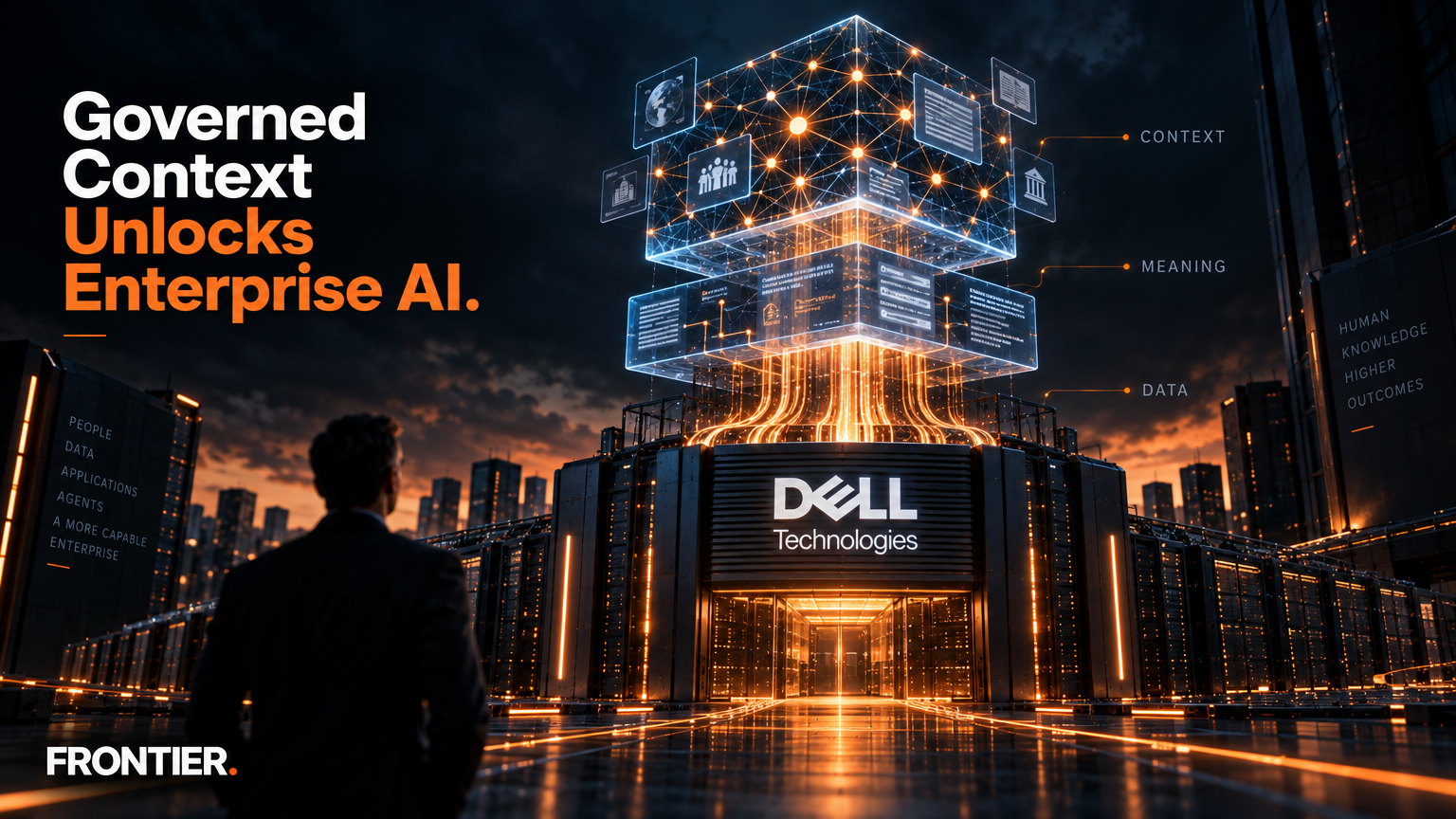
Dell is selling the missing layer between data and decisions
Dell's October 6 announcement is not principally about faster storage. It is a bid to make the layer that tells AI agents what enterprise information means into a repeatable infrastructure product. The catch: the three capabilities that make that proposition interesting—the Unified Semantic Layer, Enterprise Knowledge Graph and Knowledge Agents—are scheduled for the first half of 2027, not shipping as a proven integrated system today. Dell's release sets out the roadmap; SiliconANGLE's reporting independently confirms the schedule.
Arthur Lewis, president of Dell's Infrastructure Solutions Group, offered the unusually useful diagnosis: “Data without context is just noise.” In Dell's own announcement he distinguishes making information accessible from making it usable. That is more than marketing wordplay. An agent can retrieve a customer record and still mistake the account owner, jurisdiction, effective date or meaning of “active.” A retrieval hit is not a business decision. Dell, October 6.
Lewis was more explicit in an interview covered by SiliconANGLE: “In many cases, the model is not the next constraint, the data is.” That claim is plausible, but it needs qualification. Enterprise agents also fail because instructions conflict, permissions drift, tools behave unpredictably, and nobody owns the consequences of autonomous actions. Better data context removes one failure class; it does not certify an agent.
The architecture—and the uncomfortable dependency
Dell proposes three linked pieces. Its Unified Semantic Layer would standardize business definitions across structured and unstructured information, including imported taxonomies and ontologies. An Enterprise Knowledge Graph would connect entities and relationships using metadata, lineage and query history. Knowledge Agents would work against defined slices of that graph with customer-set instructions, quality thresholds, data permissions and spending limits. Dell also names NVIDIA Auto-Ontology and Nemotron Retriever components in the design. These are proposed capabilities, not demonstrated cross-enterprise outcomes. Dell technical announcement.
Vrashank Jain, Dell's lead product manager for the AI Data Platform, told SiliconANGLE's theCUBE that the semantic layer uses human verification when generating entities and definitions. This detail matters more than the fashionable phrase knowledge graph: enterprise meaning is negotiated, contested and revised by people. An automated ontology can confidently encode the wrong version of a customer, product or risk classification. Human-in-the-loop verification is a design admission that semantic truth cannot simply be mined out of a document pile.
The difficult question is not whether a graph can link a sensor fault to supplier batches and orders at risk—Dell's manufacturing example is reasonable. It is whether those relationships remain accurate as systems, ownership, policies and business definitions change. A stale relationship can turn a plausible recommendation into an expensive action. Lineage shows where a fact came from; it does not by itself prove that the fact is authorized for this agent, current enough for this decision, or semantically uncontested.
That distinction is the first architecture trap. Meaning, evidence and permission are separate controls. A semantic layer can say two labels refer to the same customer; a graph can show their relationship; an authorization system must still decide whether this agent, acting for this principal, may use that relationship now. Agent spending caps are valuable, but they are not substitutes for identity, policy evaluation, auditability, revocation and human escalation. CIOs should demand the seams between those controls, not a single glossy diagram that implies they are interchangeable.
Why today's fixes don't settle the problem
Vector search and retrieval-augmented generation can find relevant passages, but they do not automatically reconcile conflicting definitions, establish transaction-time truth or enforce action authority. Hand-built prompt instructions work for a narrow workflow but tend to fork when dozens of teams build agents independently. Traditional master-data and catalog programs provide useful ingredients, yet they were not designed to serve continuously changing, scoped context to software that can take actions. Knowledge graphs are not new either; the unresolved challenge is operational stewardship, policy enforcement and maintenance at enterprise speed.
There is an economic angle. Dell argues that agents repeatedly reconstruct context and burn tokens doing so. Reusable context could reduce duplicate retrieval and reasoning, but no independently validated cost-per-successful-decision comparison accompanies this roadmap. Savings from fewer tokens can be erased by graph maintenance, human review, ingestion, policy integration and latency. Measure the whole transaction, including correction and failure costs, not merely prompt size.
Dell separately cites internal Apache Spark testing showing 3.9-times average and 20.4-times peak acceleration using NVIDIA's GPU stack. SiliconANGLE details the hardware and workload context. Those are vendor-run processing benchmarks, not evidence that the semantic layer improves agent correctness, trust or total operating economics. Faster processing of an incorrect business definition only industrializes the mistake.
The second-order consequence: context becomes the new lock-in
Dell says the proposed sensitive context components remain in the customer's data center and do not require one model, data or storage provider. Dell's release makes that a clear architectural promise. But model independence is not context independence. The organization can swap its LLM and still be unable to export its business definitions, graph edges, provenance, evaluation rules and policy bindings without rebuilding its operating knowledge.
That is the sharp strategic risk: enterprises spent years escaping application silos, only to risk creating a new monopoly over the interpretation of their own data. If a shared context service becomes the place where all agents learn what “customer,” “exposure,” or “approved” means, its schema and policy interfaces may be harder to replace than the model itself. Dell could help customers reduce fragmentation while also positioning its platform at the most consequential dependency point in the agent stack.
The architectural upside is real. A governed, versioned context service could let multiple agents reuse institutional definitions and evidence, reducing inconsistent answers across departments. It could make changes in business policy auditable and propagate them to consuming systems. It could also create a single blast radius for a bad taxonomy update or poisoned relationship. Centralization buys consistency only when paired with ownership, versioning, rollback, scoped access and continuous evaluation.
NVIDIA's role deserves attention, too. Jason Hardy, NVIDIA's vice president of storage technology, argues in Dell's announcement that agents depend on data they can access, understand and trust. NVIDIA supplies pieces of the proposed retrieval and acceleration stack. This is not just a Dell storage story: the infrastructure and model ecosystem is moving into the machinery that prepares, interprets and serves enterprise context. CIOs should examine dependency concentration across both partners.
Frontier thesis: the most valuable AI infrastructure may be the part that defines reality
The next enterprise AI lock-in may not be the model that answers the question. It may be the system that decides what the question means.
Dell is making an early, explicit bid for that role. It has not yet earned the right to be the enterprise's arbiter of meaning. The product's most important features are still on a 2027 timetable, and the available evidence establishes roadmap intent—not production-grade accuracy, portability or governance. The intelligent response is neither dismissal nor preemptive standardization. It is to turn Dell's architectural claim into an adversarial test specification before the procurement momentum starts.
Exactly three moves for CIOs
-
Write a versioned context contract for one consequential workflow. Specify the business definitions, entity relationships, provenance, freshness windows, principal-level permissions, revocation behavior and human decision owner. Include contradictory source records and changed definitions in the test set. Gate: no autonomous action until the system can explain which definition and evidence it used and why the acting principal was authorized.
-
Put Dell's first-half 2027 features behind a proof gate, not a roadmap promise. Evaluate delivered software against representative cross-domain data; test semantic conflict resolution, graph staleness, latency, access revocation, poisoned inputs and end-to-end cost per correct outcome. Require independently repeatable results and clear separation between generally available components and planned ones. Gate: no production dependency until the specific context components exist and pass your acceptance tests.
-
Run a context-exit drill before consolidating agents on any shared layer. Export definitions, ontology assets, graph relationships, lineage, policy bindings and evaluation cases; replace the model and at least one underlying data component; then attempt to restore equivalent decisions elsewhere. Measure loss of fidelity, manual remediation and recovery time. Gate: do not centralize high-impact agent authority on a platform whose institutional meaning cannot be recovered and independently governed.
Sources
- Dell — October 6 announcement and executive statements
- SiliconANGLE — Dell AI Data Platform, graph, NVIDIA processing and availability
- SiliconANGLE / theCUBE — interviews with Arthur Lewis and Vrashank Jain
- ITPro — independent report on context features and executive comments
- Dell — production-context technical perspective
[^dell-primary-release][^dell-product-blog][^itpro-report][^siliconangle-report][^hpcwire-candidate]