Dell’s $95 Billion AI Backlog Meets a Memory Shortage That Rewrites the Deal
Dell’s AI demand boom and Micron’s allocation power reveal the new hardware bargain: less discount, more execution risk, and no reliable all-clear date. What CIOs should lock down—and keep open—through 2028.
Take the argument with you.
Read the publication-ready report. Generated from the canonical News article.

Dell has the perfect problem for the AI economy: extraordinary demand for machines whose components everybody wants. Its September results disclosed $95 billion of AI-server backlog, following $60.9 billion of quarterly orders and $16.4 billion of AI-server revenue. The demand is real. A backlog, however, is not a warehouse full of allocated memory.1
That distinction now matters far beyond AI racks. Dell, HP and Lenovo have been changing prices, configurations or commercial terms as memory costs climb. Intel’s October warning shows the other side of the same market: component inflation can destroy PC demand while data-center demand remains supply-constrained.2345
The Frontier thesis: the memory shortage is rewriting the hardware contract, not just the hardware bill. The scarce asset is becoming deliverable capacity at an enforceable price. CIOs still negotiating primarily on percentage discounts are optimizing yesterday’s purchase order.
Dell is the poster child. Micron explains the rules.
Dell sits on both sides of the squeeze: commercially sensitive PCs and an enormous AI infrastructure order book. Its latest quarterly filing explicitly links accelerating AI demand and limited memory-manufacturer capacity to global constraints and substantial memory-cost inflation. That supports execution risk, not a claim that its entire backlog is unfulfillable.6 Clarke’s September summary of the remaining constraints was blunt: “DRAM, DRAM, DRAM followed by NAND, NAND, NAND.”1
The commercial response was already explicit on February 26. Dell COO Jeff Clarke said: “We’re compressing discounting. Our quotes are valid for the shortest period of time they’ve ever been.” Dell described repricing servers and resetting open PC quotes, alongside reduced promotions. These are documented actions from earlier this year, not announcements invented for this week’s selloff.2
The peers matter—and their policies are not identical.
Lenovo’s early-year partner communication limited infrastructure quote windows to 14 days on its internal bidding platform and 30 days externally, repriced selected larger deals, and paused new-customer incentives. More recently, its October AI Express program offered selected configurations in under 30 days; the largest configuration required allocation confirmation before a customer commitment. Standardization can buy access, but a fast-ship headline is not an unconditional delivery promise.47
HP quantified the underlying economics in February: memory and storage, previously roughly 15–18% of its PC bill of materials, were then projected to reach approximately 35% for fiscal 2026. HP described price increases and lower-memory configurations among its responses. That was a company forecast, not a measured industry-wide result—and the figure includes storage, not RAM alone.3
HPE provides a useful counterexample. After initially tightening terms, it extended relevant quotes from 14 to 30 days and, in August, restored quote-to-shipment price protection for compute, storage and GreenLake Flex deals below $1 million net. Executives explicitly said the shortage was not over. They were choosing to absorb more commercial risk to win business.8
That is the negotiating opportunity: distinguish component scarcity from a supplier’s decision about who carries the risk. Quote validity, shipment-price protection and physical allocation are three different commitments. Demand all three separately.
Intel exposes the demand-destruction trap
Intel’s October 29 prepared remarks put numbers on the damage: it expects the worldwide PC unit market to decline approximately 12% in 2026, including a second-half decline exceeding 20%, and is planning for another roughly 10% contraction in 2027. These are Intel’s market expectations, not completed shipment counts; potential second-half improvement in 2027 partly reflects easier comparisons.9
Intel’s latest filing reports a 14% year-over-year decline in notebook-and-desktop processor volume in Q3, partially offset by a 9% increase in average selling prices. Those are Intel product volumes, not a 14% contraction in worldwide PC shipments. Competitive conditions also mattered. The filing expects pressure from component costs, constrained IT budgets and inventory management to worsen in Q4 and persist into 2027.5
The reaction reached the hardware builders themselves. Reuters’ October 30 market report recorded Dell, HPE and Super Micro Computer down between 6% and 11%, with Intel down 30% at the time of reporting. These were reported trading moves, not asserted closing returns. Memory was not the only cause: Intel’s manufacturing constraints and cash-burn warning also weighed on investors.10
Weaker PC demand does not automatically produce cheaper PCs. TrendForce’s September 30 forecast put Q4 conventional DRAM contract-price increases at 10–15% quarter over quarter, and NAND flash at 15–20%, while suppliers prioritized higher-performance server products. These are component-contract forecasts—not retail price rises already realized, or equivalent percentage increases in complete systems.11
There is no single interchangeable pool called “memory.” Conventional DRAM supplies system working memory; HBM is specialized stacked DRAM for accelerators; NAND provides persistent storage. HBM and conventional DRAM compete for constrained advanced manufacturing capacity, but a spare HBM stack cannot become a laptop DIMM. NAND has its own supply-and-demand trajectory.1213
The architectural consequence is uncomfortable: buying a cheaper processor can leave the total system more expensive, while buying an available accelerator can leave capital stranded waiting for the rest of the rack. The failure mode is not merely paying too much. It is financing incomplete production capacity.
What Sam Altman actually said—and what it leaves out
On John Collison’s October 29 Cheeky Pint podcast, Sam Altman called the global allocation of scarce DRAM to individual computers for local AI inference “quite terrible,” characterizing it as being used only 5% of the time. His prescription was: “You want maximum utilization in the cloud if you’re trying to deal with this very supply constrained environment.”14
The context matters. He was challenging the idea that open models running locally eliminate infrastructure constraints—not announcing that PCs should have no RAM. The 5% claim came without a supporting measurement methodology in that exchange; it should not be presented as an established statistic about enterprise memory utilization.14
There is a valid pooling argument here: shared infrastructure can avoid reserving peak capacity separately for every user. But maximum hardware utilization is not maximum enterprise value. An idle local capability can still be valuable when connectivity fails, sensitive data cannot leave a device, or response time is non-negotiable.
Our inference is that scarcity can strengthen cloud providers’ bargaining power by making their allocation position part of the product. Moving workloads to the cloud may transfer procurement responsibility; it does not abolish the physical shortage. CIOs should not let a memory-supply crisis become a permanent surrender of workload-placement choice.
The shortage horizon: worsening first, uneven relief later
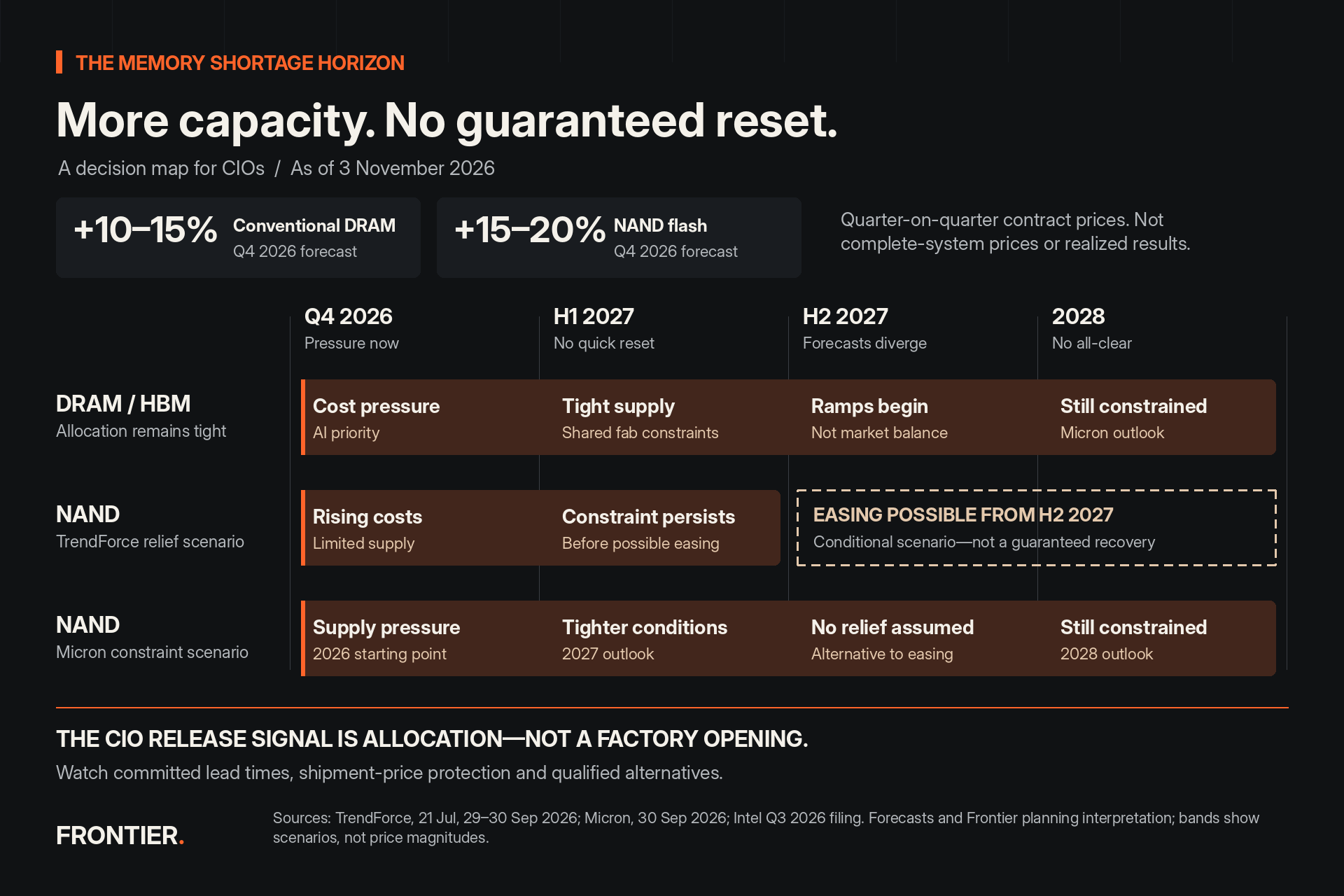
Now through the first half of 2027: plan for pressure, not a quick reset. Intel’s warning and TrendForce’s Q4 pricing outlook argue against assuming softer PC demand will rapidly restore buying power. Price inflation may moderate without prices falling, and availability may remain poor even where spot prices soften.511
The second half of 2027: NAND has a possible relief window, not a guarantee. TrendForce’s July NAND outlook forecast easing constraints as process improvements and additional output overtook demand growth. That is a segment-specific scenario, not a forecast that server DRAM or HBM becomes plentiful.13
2028 is a capacity milestone, not an all-clear. Micron’s September 30 prepared remarks anticipate tighter memory-and-storage conditions in calendar 2027 and 2028 than in 2026, with both DRAM and NAND still supply-constrained. Its roadmap includes initial Idaho DRAM output in mid-2027 and Singapore NAND output in the second half of 2028; meaningful production takes additional quarters. It does not identify a date when DRAM supply and demand return to balance.15
These forecasts disagree about NAND’s relief window. Do not average them into false certainty. Our planning judgment is to budget for persistent constraint through 2027, treat later NAND easing as an upside scenario, and retain a downside case through 2028. An AI-demand slowdown or faster output ramp could bring relief sooner; stronger demand or ramp delays could push it out.
There is a further complication: new capacity need not be freely available capacity. Micron disclosed 26 multiyear strategic customer agreements and $32 billion in customer financial commitments, mostly cash deposits. Supply assurance is being bought well before delivery.15
A factory opening is therefore not the CIO’s release signal. Better signals are shorter committed lead times, shipment-price protection, qualified alternate configurations and evidence that allocation is available to your account—not merely somewhere in the industry.
Three decisions CIOs should make now
1. Buy an enforceable delivery commitment, not a theatrical discount
Within the next procurement cycle, require competing bids to separate net delivered price, quote expiry, repricing rights, allocated components and shipment dates. Compare the same supported configuration and service terms. A larger discount against a raised list price is not a saving.
Where a quote expires before your approval process finishes, establish a CFO-approved fast lane with capped commitments rather than routinely accepting open-ended repricing. For eligible HPE deals, explicitly test the sub-$1-million protection against competing offers; verify geography and contract applicability rather than assuming a universal entitlement. For every vendor, tie deposits and acceptance to named delivery milestones and remedies for delay. A price guarantee without allocation protects the budget, not the project.8
2. Make installed memory a managed capacity reserve
Run a 30-day working-set and memory-pressure assessment across the workloads behind the next refresh: measure peak resident demand, paging, latency and concurrency—not CPU utilization as a proxy. Reclaim overprovisioned virtual-machine memory and retire duplicate services before cutting endpoint specifications indiscriminately.
For AI, trial context limits, cache reuse and model quantization against explicit quality, latency and safety tests. Adopt them only when the workload passes those tests; storage offload is not a latency-free substitute for RAM. Preserve critical headroom and rollback paths. Defer a refresh only where performance, security support and failure risk remain acceptable. The objective is more useful work per installed gigabyte, not the appearance of efficiency created by slower employees or unreliable agents.
3. Stage the 2027–28 portfolio—and defend placement choice
Fund essential replacements and production AI workloads in tranches. Release a capacity tranche only when the supplier can align memory, processors, networking, power and cooling with an accountable deployment date. Do not finance an accelerator collection while the rest of the system remains speculative.
Keep local, private-cloud and hosted-inference alternatives qualified for workloads where substitution is practical. Compare cost per successful business task, data constraints, latency and outage tolerance—not just advertised token prices or Altman’s utilization argument. Reopen deferred purchases when supplier-specific lead times and protected quotes improve, not because a calendar says 2028. This preserves the option to benefit from a recovery without betting the operating model on one.
Dell’s backlog is the opportunity. Micron’s allocation position is the constraint. The CIO’s job is to connect the two without becoming the shock absorber for everybody else’s economics.
[^dell-terms][^lenovo-terms][^intel-q3][^lenovo-express][^hpe-terms][^intel-remarks][^intel-reuters][^trendforce-hbm][^trendforce-nand][^altman][^micron-outlook]