CrowdStrike Moves Security Inside Anthropic’s Claude Cowork, Establishing the Agent Runtime as a New Control Boundary
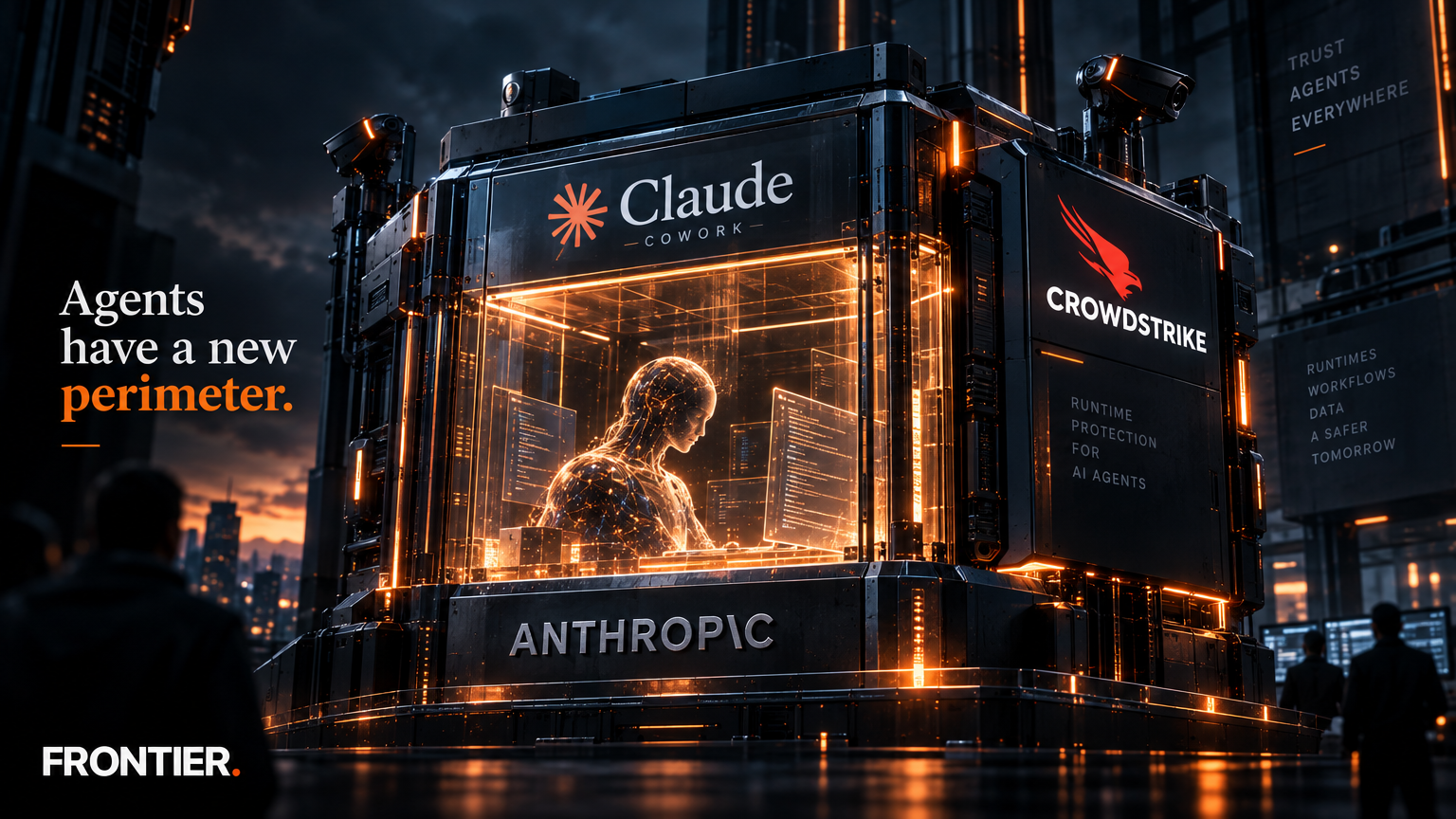
CrowdStrike has integrated Falcon Guardian with Anthropic’s Claude Cowork local virtual machine, signaling a larger shift from protecting only employee devices to monitoring the isolated runtimes where enterprise AI agents actually execute.
Take the argument with you.
Read the publication-ready report. Generated from the canonical News article.
What changed
CrowdStrike announced on November 3, 2026, that Falcon Guardian protection can operate inside Anthropic’s Claude Cowork local virtual machine rather than relying exclusively on an endpoint sensor installed on the host device.1 Anthropic’s own documentation confirms that organizations using Team and Enterprise plans can run approved endpoint detection and response sensors inside Cowork’s local VM, with CrowdStrike identified as one of the supported vendors.2
The placement of the sensor is the material development. Cowork runs agent activity in an isolated virtual machine, creating a separate execution environment from the employee’s host operating system. CrowdStrike says placing its sensor inside that VM exposes process execution, package activity and network behavior that a host-only endpoint sensor cannot directly observe.3 Independent security reporting corroborates the introduction of in-VM EDR monitoring, CrowdStrike’s inclusion and the capability’s beta status.4
The disclosed scope is narrower than CrowdStrike’s language about securing agents throughout their lifecycle might suggest. Anthropic describes the EDR capability as a beta and limits the documented coverage to local Cowork VMs. It does not cover Cowork sessions hosted on Anthropic’s servers.2 CrowdStrike separately says its integration is in beta on macOS and that Windows support was expected later in November 2026.3 A second independent security publication also reported the beta capability and CrowdStrike’s participation among approved EDR vendors.5
Those boundaries matter. The verified disclosures establish added runtime visibility and detection for one local execution model; they do not independently demonstrate complete lifecycle protection, equivalent controls across local and cloud-hosted sessions, or a measured increase in enterprise adoption. CrowdStrike’s claim that the integration will extend adoption is therefore a projected business outcome rather than a reported customer result.1 StreetInsider separately reported the CrowdStrike-Anthropic announcement, but its account largely reflects the vendor’s product description rather than independent evidence of operational outcomes.6
The news is consequently more important as an architectural signal than as proof of a finished security model. Anthropic is allowing approved security software to enter the agent’s execution environment, while CrowdStrike is extending endpoint-style telemetry into that environment. This creates a distinct security layer between protection of the user’s device and governance of the AI service itself.
Why it matters
The CIO decision model for enterprise AI now has to treat the location of security controls as a first-order architectural question. Asking whether an employee laptop already has EDR is no longer sufficient when an AI agent performs work inside an isolated VM. The relevant questions become: Where does the agent execute? Can the security team observe activity inside that runtime? Which deployment modes receive that visibility? Is the control generally available across the organization’s operating systems, or is it still a platform-specific beta?
This changes evaluation from a product-level comparison into a coverage-boundary assessment. Anthropic’s documentation draws an explicit line between local Cowork VMs, where approved EDR sensors can run, and sessions hosted on Anthropic’s servers, which the documented capability does not cover.2 CrowdStrike’s technical disclosure adds another boundary because its support was initially described as beta on macOS, with Windows availability expected later.3 A company could therefore approve the same AI product for two users or workflows while receiving materially different runtime telemetry depending on operating system and execution location.
The analytical implication is that an enterprise AI approval can no longer be represented by a single yes-or-no security decision. CIOs need a control map for each combination of agent, runtime, hosting model and endpoint platform. A local session with an in-VM sensor is not operationally equivalent to a cloud-hosted session outside that sensor’s documented scope. Nor should a beta integration be assumed to satisfy the same production requirements as a mature control without evidence from the organization’s own environment.
This also reframes the role of existing endpoint investments. CrowdStrike’s stated rationale is that a host sensor cannot directly observe all process, package and network activity occurring within Cowork’s isolated VM.3 That is a vendor claim about visibility, but it is consistent with the disclosed decision to place the sensor inside the VM and with independent reporting on the new monitoring design.4 The defensible conclusion is not that host EDR has become irrelevant. It is that host protection and runtime protection address different observation points and should not be treated as substitutes.
Procurement and architecture teams must therefore test security assertions against deployment-specific evidence. Phrases such as “agent protection” or “lifecycle security” can obscure whether a control covers local execution, provider-hosted execution or both. In this case, the available sources support runtime monitoring within local Cowork VMs, while Anthropic explicitly excludes server-hosted Cowork sessions from that documented EDR coverage.2 CIOs should require vendors to express coverage in equally concrete terms.
The larger structural shift is that agent runtime security is emerging as a separate enterprise requirement. As agents operate in isolated environments, the enterprise control plane must reach into those environments or establish another verifiable source of telemetry and detection. That requirement persists regardless of whether CrowdStrike’s particular integration moves from beta to broad production use. The durable CIO question is no longer simply whether an AI platform is secure, but whether every approved execution path has an observable and supportable security boundary.
Frontier take
The agent runtime—not the employee device—is becoming the decisive control boundary for enterprise AI.
CrowdStrike’s integration with Claude Cowork is an early, concrete expression of that shift because the sensor is placed where the agent’s local activity executes. The significance is not that one partnership has completed the enterprise agent-security stack. The verified record does not support that conclusion: the capability is a beta, CrowdStrike disclosed an initial macOS limitation, and Anthropic says the in-VM EDR model does not cover Cowork sessions hosted on its servers.23 The significance is that host-only controls are being supplemented by controls inside the agent environment itself.
This should reorganize enterprise AI governance around execution paths rather than product names. A single AI application may span local VMs and provider-hosted sessions, with different security controls in each location. If governance records only that “Claude Cowork is approved,” it can conceal the documented difference between a local VM capable of running an approved sensor and a hosted session outside that capability’s scope.2 Approval should instead attach to a defined configuration: runtime location, operating system, available telemetry, control maturity and permitted workflow.
The integration also establishes a higher evidentiary standard for vendor claims. CrowdStrike describes Falcon Guardian as protecting agents throughout their lifecycle and enabling adoption.1 What the retrieved disclosures substantiate is more specific: additional process, package and network visibility inside local Cowork VMs, delivered through a beta integration.3 CIOs should value that concrete improvement without converting it into evidence of end-to-end protection or proven adoption outcomes.
The defensible strategic assertion is therefore that runtime observability must become an explicit gate for consequential agent deployments. That does not mean every runtime must use conventional EDR. It means the enterprise must be able to identify what executes, where it executes and which control supplies telemetry and detection at that location. Where the answer changes by hosting mode or operating system, the permitted use should change with it.
CrowdStrike and Anthropic have made the boundary visible. CIOs now need to make it governable. The near-term task is not to declare agent security solved, but to prevent product-wide approvals from outrunning the narrower, configuration-specific coverage that vendors can actually document.
Three moves for CIOs
-
— Replace product approvals with runtime-specific authorization Create an authorization record for each agent deployment that identifies the execution location, host operating system, available in-runtime telemetry and workflows permitted under that configuration. Treat local and provider-hosted sessions as separate control cases even when they belong to the same AI product. For Claude Cowork, record the documented distinction between local VMs that can run approved EDR sensors and sessions hosted on Anthropic’s servers.2
- Decision trigger: Require a separate authorization whenever an agent can move between local and hosted execution, or whenever the available security sensor changes by operating system, plan or runtime location.
- Why now: The CrowdStrike integration demonstrates that control coverage can vary within one product. A product-level approval would hide the local-versus-hosted boundary and the disclosed beta and platform limitations.3
-
— Make runtime telemetry a production-readiness gate Before allowing an agent to handle consequential workflows, require evidence that the security team can observe and investigate relevant activity inside the environment where the agent executes. Validate the control in the enterprise’s own approved configuration rather than accepting a lifecycle-security claim as proof of coverage. Where in-runtime monitoring remains beta, constrain use until the organization has defined acceptable reliability and investigation procedures.
- Decision trigger: Pause or narrow deployment when a host sensor is the only documented observation point but the agent runs inside an isolated VM, or when the proposed runtime falls outside the vendor’s stated coverage.
- Why now: CrowdStrike says its in-VM sensor reveals process, package and network behavior that host-only protection cannot directly observe, while the documented integration remains beta.3 The combination creates a reason to test the new visibility without treating it as production-complete.
-
— Contract for explicit coverage boundaries, not broad agent-security language Add a deployment-mode coverage schedule to AI and security evaluations. Require vendors to state which local, hosted and operating-system configurations are supported; whether controls are beta or production-ready; and which configurations are excluded. Tie expansion of approved use to documented changes in that schedule rather than to generalized claims about secure adoption or lifecycle protection.
- Decision trigger: Invoke the requirement whenever a vendor claims end-to-end, lifecycle or enterprise-grade agent protection but its technical documentation identifies exclusions, staged platform support or beta status.
- Why now: The CrowdStrike announcement uses broad lifecycle and adoption language, while Anthropic and CrowdStrike’s technical materials establish narrower local-VM, beta and platform-specific conditions.123 Formalizing those distinctions now will keep AI rollout decisions aligned with verifiable controls.
Sources
- CrowdStrike press release: CrowdStrike Extends Anthropic’s Claude Cowork Enterprise AI Adoption with Falcon Guardian Protection 1
- Anthropic/Claude Help Center: Run your EDR sensor in Claude Cowork 2
- CrowdStrike technical blog: CrowdStrike Secures AI Agents Inside Claude Cowork 3
- Cyber Security News: Anthropic Enables EDR Monitoring in Claude Cowork 4
- GBHackers: Anthropic Enables EDR Security Monitoring for Claude Cowork AI Agents 5
- StreetInsider: CrowdStrike brings Falcon Guardian security into Anthropic’s Claude Cowork 6
[^crowdstrike-release][^anthropic-edr-docs][^crowdstrike-technical-blog][^cybersecuritynews-report][^gbhackers-report][^streetinsider-report]