Copado acquires Valo.ai as enterprise governance moves from release gates toward runtime control
Copado has acquired Valo.ai to add operational and security intelligence for live Salesforce environments, signaling a broader shift toward one control architecture spanning software delivery and production oversight—even though integrated remediation remains on the roadmap.
Take the argument with you.
Read the publication-ready report. Generated from the canonical News article.
What changed
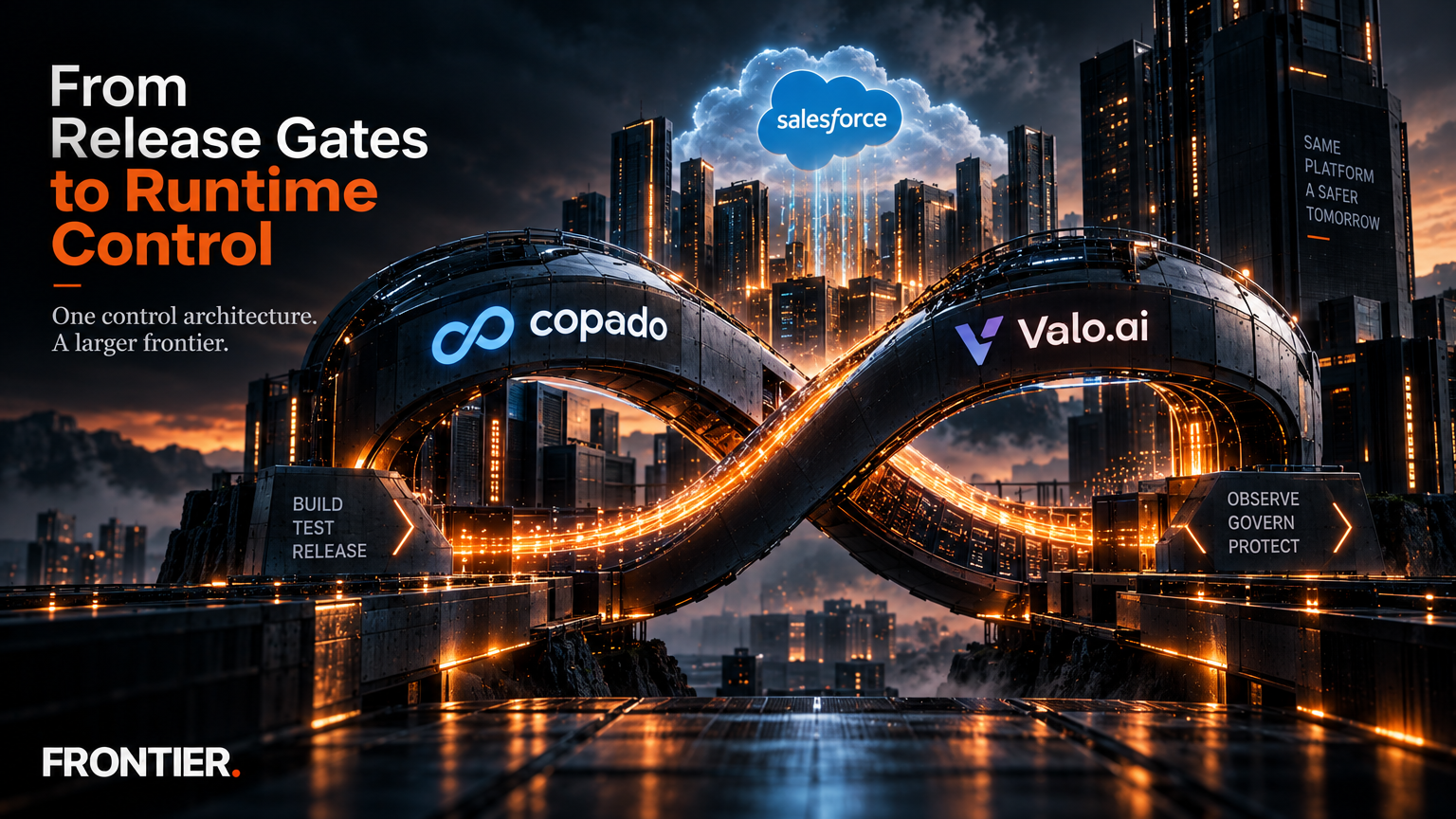
Copado announced on November 4, 2026 that it had acquired Valo.ai, a provider of operational and security intelligence for live Salesforce environments.123 Financial terms were not disclosed.2
Valo.ai analyzes live environments for connected applications, dormant integrations, excessive permissions and unused accounts, giving customers visibility into operational and security conditions that persist after software has been released.123 That runtime focus complements Copado's existing emphasis on development, testing and release governance. Copado describes the transaction as an expansion of governance from release processes into the ongoing operation of enterprise applications.14
The distinction between the transaction's immediate effect and its strategic objective is important. Valo.ai will remain available as a standalone product, with continued service and support for existing customers.123 Copado plans to integrate Valo.ai findings into development, testing, remediation and release workflows through a phased roadmap, but those integrated capabilities were not fully available at the announcement.123 Copado had also not announced a timetable for the rollout as of November 4.12
The current product reality is therefore an acquired runtime-visibility capability operating alongside Copado's release-governance portfolio. The proposed end state is a more continuous system in which production findings can inform governed changes, tests, remediation and subsequent releases. Treating that end state as already delivered would overstate the available integration. The defensible interpretation is that Copado has acquired the intelligence layer needed to pursue release-to-runtime governance, while the workflow connections required for closed-loop control remain prospective.123
This is more than a portfolio extension, but less than a completed control plane. The acquisition changes Copado's strategic scope immediately; it does not immediately erase the operational boundary between runtime observation and governed remediation. CIOs evaluating the deal should preserve that distinction in architecture reviews, procurement documents and deployment plans.
Why it matters
The CIO decision model has traditionally allowed release governance and production oversight to be evaluated as related but separable concerns. Development and platform teams could assess testing, deployment and change controls, while security and operations teams assessed permissions, integrations, accounts and live-system exposure. Copado's acquisition of Valo.ai points toward a different model: the enterprise application lifecycle becomes one continuous governance problem, from proposed change through release and then into the behavior and configuration of the live environment.
That shift changes the unit of evaluation. CIOs should no longer ask only whether a tool improves releases or whether another tool provides runtime visibility. They should ask whether the combined architecture can convert production evidence into an accountable, testable and governed change. Valo.ai can identify conditions such as dormant integrations, excessive permissions and unused accounts in Salesforce environments.123 The planned Copado integration is intended to connect findings of that kind with development, testing, remediation and release workflows.123 The strategic value lies in that connection, not merely in placing two product categories in one portfolio.
This also introduces a more demanding capability test. Visibility, workflow integration and closed-loop remediation are three different states. Visibility means identifying a condition in a live environment. Workflow integration means routing that condition into an owned development, security or operational process. Closed-loop remediation means that a resulting change can be authorized, tested, released and verified against the original runtime finding. Based on the announced product state, the first is available through Valo.ai, while the deeper integration required for the second and third remains subject to Copado's phased roadmap.123
The analytical implication is that vendor consolidation and control integration cannot be treated as synonyms. An acquisition can establish common ownership and strategic direction without immediately establishing common data models, workflow semantics, evidence trails or remediation controls. Copado's decision to continue offering Valo.ai as a standalone product reinforces the need to assess the current operating model independently from the proposed destination.123
For CIOs, this creates a two-horizon decision. The near-term decision is whether Valo.ai's present runtime intelligence solves a sufficiently important visibility problem on its own. The longer-term decision is whether Copado's planned integration can become the control layer connecting runtime evidence to governed software delivery. Those decisions should have separate requirements, economics and acceptance criteria because the company had not provided a rollout timetable for the integrated capabilities at announcement.12
The architecture question also becomes organizational. A release-to-runtime control model crosses development, security, operations and application ownership. If each group applies a different severity model or remediation process, consolidated tooling alone will not produce continuous governance. CIOs therefore need a shared policy for deciding which runtime findings require access removal, configuration change, code change, testing or formal release. This is an analytical requirement arising from the proposed convergence, not a capability Copado has demonstrated as fully delivered.
Frontier take
The decisive enterprise control point is moving from the release gate to the full release-to-runtime loop. Copado's acquisition of Valo.ai matters because it acknowledges that governed delivery is incomplete when live-system permissions, integrations and accounts remain outside the same decision architecture. But the acquisition should be evaluated as an architectural commitment, not evidence that the loop is already closed.
That assertion rests on a clear separation of available and planned capability. Valo.ai already provides visibility into operational and security conditions in live Salesforce environments.123 Copado already has a strategic position in development, testing and release governance, and it says the transaction will extend that focus into application operations.14 Yet the integration of runtime findings with development, testing, remediation and release workflows is phased roadmap work with no announced rollout timetable at the time of the acquisition.123
The resulting thesis is not that every lifecycle tool must become a security platform, or that runtime visibility should be absorbed uncritically into release management. It is that CIOs will increasingly need one governance architecture capable of preserving evidence and accountability as a risk moves from production detection to remediation and verified release. Products can remain modular, but the control model cannot remain fragmented if the objective is continuous oversight.
This reframes competitive evaluation around proof of control continuity. A credible platform should be able to show how a runtime finding is classified, assigned, translated into an approved change, tested, released and verified. Until Copado delivers and demonstrates those connections, customers should value Valo.ai for its current standalone intelligence and assign separate, conditional value to the integration roadmap. That approach neither discounts the acquisition nor grants credit for capabilities that have not arrived.
The enduring change is the convergence of application lifecycle governance and runtime intelligence into a continuous control layer for enterprise systems. Copado and Valo.ai provide a concrete example of that direction, but they also expose the central procurement risk: strategic coherence can arrive before operational integration. CIOs that separate those two conditions will be better positioned to adopt useful visibility now without allowing an undated roadmap to determine their future control architecture.
Three moves for CIOs
-
— Create separate capability ledgers for delivered control and roadmap control Require the evaluation team to maintain two scored ledgers. The first should cover capabilities available in the standalone Valo.ai product, including the specific runtime findings it can surface. The second should cover each proposed connection to Copado development, testing, remediation and release workflows. Give roadmap items no production-control credit until they have documented availability, acceptance tests and accountable owners. Structure commercial commitments so that payment or expansion tied to integrated governance follows verified delivery rather than the acquisition narrative.
- Decision trigger: Apply this model whenever a purchase, renewal or expansion depends on Valo.ai findings entering Copado workflows, or whenever the business case assumes fewer manual handoffs between runtime detection and governed release.
- Why now: Valo.ai remains available as a standalone product, while deeper workflow integration is planned in phases and had no announced rollout timetable at the acquisition date.123 A two-ledger model lets the organization use present visibility without treating prospective remediation as an existing control.
-
— Define the runtime-to-release decision contract before integrating tools Have application, security, operations and delivery leaders define a shared decision contract for runtime findings. For each category—such as dormant integration, excessive permission or unused account—specify severity, evidence requirements, accountable owner, approved remediation path, testing obligation and post-release verification. Then require any Copado-Valo.ai integration to implement that contract rather than allowing the product workflow to become the policy by default.
- Decision trigger: Initiate the contract when runtime findings can require code, configuration, identity or integration changes owned by more than one team, or before a pilot begins routing Valo.ai findings into Copado-managed delivery processes.
- Why now: The acquired product surfaces conditions across access, integrations, permissions and accounts, while Copado's intended destination spans development, testing, remediation and release.123 Defining the decision contract now prevents organizational ambiguity from being embedded in the future integration and operationalizes one governance architecture across lifecycle boundaries.
-
— Gate platform consolidation on a demonstrated closed-loop control Run a production-representative pilot using one bounded class of runtime finding. Require the combined process to detect the condition, preserve evidence, assign ownership, generate or initiate an approved remediation, execute required tests, release the change and verify that the original condition is resolved. Measure each handoff and retain existing controls until the full chain passes. Do not retire separate monitoring or workflow systems merely because Copado owns both product lines.
- Decision trigger: Use this gate before decommissioning an existing runtime-oversight tool, centralizing governance spend with Copado or representing the combined platform as a compensating control in an internal review.
- Why now: The transaction creates common strategic ownership, but the researched sources describe integrated remediation as a phased roadmap rather than a fully available capability.123 A closed-loop pilot tests the precise value on which the broader thesis depends and prevents portfolio consolidation from being mistaken for control continuity.
Sources
- Copado — Copado Acquires Valo.ai to Extend AI-Powered Governance from Release to Runtime 1
- Copado + Valo — Governance from Release to Runtime 4
- citybiz — Copado Acquires Valo.ai to Expand AI-Powered Governance Across Salesforce Environments 2
- Unite.AI — Copado Buys Valo.ai for Salesforce Security Observability 3