Cisco Connects Mythos Red Teaming and Splunk Agent Economics, Setting a Higher Bar for AI Governance
Cisco is adding Anthropic’s Claude Mythos to AI Defense and extending Splunk Agent Observability to correlate agent costs with quality and business impact—a material step toward an integrated control layer for enterprise AI agents.
Take the argument with you.
Read the publication-ready report. Generated from the canonical News article.
What changed
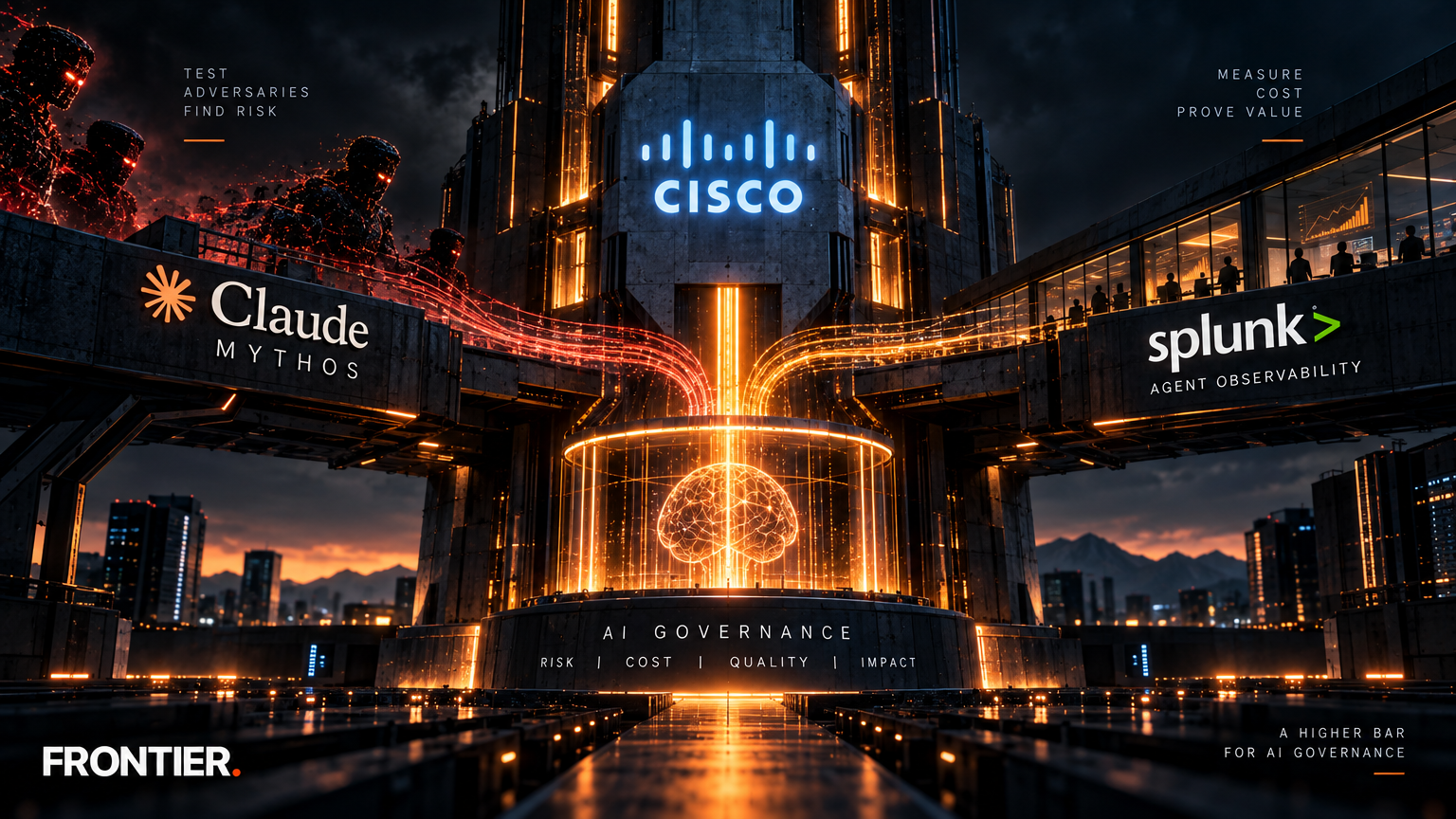
On November 10, 2026, Cisco announced that it plans to add Anthropic’s Claude Mythos to Cisco AI Defense for adaptive red-team testing of AI applications and agents. In the same announcement, Cisco detailed enhancements to Splunk Agent Observability intended to connect agent operating costs with evaluations of output quality and business impact, using usage data from Amazon Bedrock and Amazon CloudWatch.1 Independent reporting corroborated both sides of the announcement: the Mythos integration in AI Defense and the use of AWS telemetry to provide a more comprehensive view of agent spending and returns.23
The product boundaries matter. The security-testing capability is being added to Cisco AI Defense, not directly to Splunk. According to independent reporting, Cisco’s red-teaming tools will call Mythos to test customer models, agents and applications; customers will not receive direct access to the underlying Mythos model through the integration.4 Splunk’s role is different: its Agent Observability capabilities are being expanded to relate resource consumption to evaluations of agent outputs and business results.5 Treating both capabilities as a single Splunk launch would obscure the architecture Cisco actually described.
The November event was also not the original launch of Tokenomics. Cisco first disclosed the underlying token-spend tracking capability on September 15, 2026, during Splunk .conf26.6 The verified November 10 event is therefore a material update: Cisco connected the earlier cost-monitoring concept to Amazon Bedrock and CloudWatch telemetry, output evaluations and business-impact measurement, while also outlining AWS Marketplace distribution plans and additional evaluation capabilities.15
Cisco says the enhanced Tokenomics capability will enter private preview in December 2026 and become generally available through AWS Marketplace in early 2027.1 Those dates are vendor plans rather than completed availability milestones and should be evaluated accordingly. Cisco also says its Eval-G1 models can perform evaluations and guardrails at up to 98% lower cost than a commercial large language model and 2.5 times faster than traditional LLM-based evaluators.1 Those performance figures are vendor claims, not independently validated benchmarks in the supplied evidence.
The key news event is therefore a coordinated expansion across two Cisco control surfaces: planned Mythos-backed adversarial testing in AI Defense and a broader economic and performance view in Splunk Agent Observability. The analytical significance is that security testing, cloud-resource telemetry, output evaluation and business-impact measurement are beginning to converge into a common governance model, even though Cisco has not presented them as one monolithic product.
Why it matters
The conventional AI infrastructure decision begins with model capability and often ends with token price. Cisco’s announcement exposes why that framework is inadequate for enterprise agents. An agent can consume an acceptable number of tokens while producing weak outputs, failing adversarial tests or contributing little measurable business value. Conversely, a more expensive execution may be justified if it produces materially better outcomes within an acceptable risk boundary. Cost without quality, risk and impact is not an operating metric; it is only an expense record.
For CIOs, the decision unit consequently shifts from the model or token to the governed agent workflow. The relevant questions become whether the organization can test the behavior of an agent before and during deployment, observe what resources it consumes, evaluate what it produces and connect those results to an intended business outcome. Cisco’s planned Mythos integration addresses the testing side of that equation, while the Splunk enhancements address the relationship among usage, quality and impact.15 The supplied evidence does not establish that Cisco has already delivered a complete, unified control plane. It does, however, show the components moving toward the same decision context.
That changes procurement. A security tool should no longer be assessed only on whether it can detect or generate adversarial behavior. CIOs should also ask whether its findings can affect deployment, routing or spending decisions. Similarly, an observability platform should not receive credit merely for displaying token consumption. It should help decision-makers determine whether that consumption produced an acceptable result and whether the result remained within the organization’s risk tolerance. This is an analytical inference from the announced capabilities, not a claim that the integrations automatically deliver those decisions.
The distinction also changes accountability. If security results remain isolated from operational telemetry, one team can approve an agent’s behavior while another optimizes its cost with no common measure of acceptable performance. If output evaluations are disconnected from business impact, teams can improve technical scores without demonstrating that the agent is accomplishing its intended purpose. Bringing these measures into a shared operating model gives CIOs a basis for deciding when an agent should scale, be constrained, be redesigned or be retired.
The timeline calls for disciplined evaluation rather than immediate standardization. Cisco describes the enhanced Tokenomics capability as entering private preview in December 2026, with general availability planned through AWS Marketplace in early 2027.1 CIOs should therefore distinguish announced direction from production readiness. The appropriate near-term decision is not whether to declare a winner in agent governance. It is whether current pilots and procurement processes can generate the evidence needed to compare platforms on security, cost, quality and impact once the planned capabilities become testable.
The CIO scorecard must consequently expand. Model accuracy or capability remains relevant, and token consumption remains useful, but neither is sufficient. The durable evaluation model is multidimensional: adversarial resilience, runtime economics, output quality and business contribution. Independent coverage of the announcement confirms that Cisco is pairing the Mythos security integration with expanded monitoring of agent spending and returns, reinforcing that this is a broader operating-model change rather than an isolated feature release.23
Frontier take
The decisive enterprise AI control point will not be the model gateway or the token dashboard; it will be the evidence layer that can determine whether an agent’s cost is justified by its quality, business contribution and tested risk.
Cisco’s announcement is important because it points toward that evidence layer from two directions. AI Defense is slated to use Claude Mythos for adaptive red-team testing, while Splunk Agent Observability is being extended to pair AWS-derived usage information with evaluations and business-impact measures.15 The products remain distinct, and the supplied evidence does not prove seamless policy orchestration between them. The strategic signal is nevertheless clear: agent security and agent economics are becoming interdependent governance concerns.
That interdependence should shape architecture choices now. A cheap agent that repeatedly fails evaluation or adversarial testing is not efficient. A secure and technically capable agent that cannot demonstrate business impact is not automatically worth scaling. An agent that creates value but lacks observable risk boundaries may remain unsuitable for broader deployment. These are analytical conclusions derived from the combined control dimensions, not reported Cisco claims.
The practical objective is a durable control plane that preserves evidence across the agent lifecycle: what was tested, which risks were found, what resources were consumed, how outputs were scored and what business result followed. Vendor-specific features can contribute to that control plane, but CIOs should avoid allowing any one dashboard or proprietary metric to become the sole definition of success. The November disclosure extends Tokenomics beyond the token-spend tracking Cisco announced in September, but planned previews, marketplace availability and vendor performance claims still require validation.61
The winning governance model will therefore be outcome-gated rather than consumption-led. CIOs should authorize scale only when security, quality, cost and impact evidence can be reviewed together. Cisco has not proved that this operating model is complete, but its coordinated AI Defense and Splunk moves make the direction difficult to ignore.
Three moves for CIOs
-
— Replace token budgets with evidence-based agent operating envelopes For each material agent workflow, define one operating envelope that combines a cost ceiling, minimum output-quality threshold, required business-impact measure and acceptable adversarial-test result. Require the owner to review all four dimensions together before increasing traffic, autonomy or spending. Use the same structure when evaluating Cisco AI Defense, Splunk Agent Observability or alternatives; do not accept a token dashboard or security score as a standalone approval artifact.
- Decision trigger: Apply the operating envelope when an agent enters a production pilot, when its usage or autonomy is proposed to increase, or when a platform claims it can correlate resource consumption with quality and business outcomes. Pause expansion if any required measure is unavailable or cannot be linked to the same workflow.
- Why now: Cisco’s November update explicitly pairs planned Mythos-backed testing with expanded cost, evaluation and impact visibility, while the enhanced Tokenomics capability is still moving through planned preview and availability stages.15 Defining the decision model before platform adoption prevents vendor metrics from becoming the organization’s governance policy by default.
-
— Make adversarial findings change runtime and investment decisions Design a closed-loop review in which red-team results can alter an agent’s deployment status, permitted use cases, operating budget or evaluation frequency. Map each material security finding to an explicit response: constrain the workflow, require remediation, increase monitoring, or block scale. Test whether security evidence from a service such as Cisco AI Defense can be associated with the same agent identity and evaluation record used for cost and outcome analysis.
- Decision trigger: Initiate the review when an adaptive red-team test identifies a failure relevant to the agent’s intended use, when the agent or application changes materially, or when a vendor integration introduces a new testing model such as Claude Mythos. Do not expand autonomy until the finding has a documented disposition.
- Why now: Cisco plans to use Mythos through AI Defense to test customer models, applications and agents, while customers will not receive direct access to the model through that integration.4 That arrangement makes the quality and portability of the resulting evidence more important than access to the underlying model. CIOs need assurance that test findings drive operational decisions rather than remaining isolated security reports.
-
— Run a cross-platform proof of evidence before committing to an agent control plane Create a representative evaluation set spanning at least one agent workflow and require candidate platforms to show how they associate cloud usage, output evaluations, business-impact measures and adversarial-test results. Preserve the raw decision evidence and document any proprietary identifiers, scores or dependencies that prevent comparison. Treat Cisco’s cost and speed claims for Eval-G1 as hypotheses to be tested against the organization’s own workload, not as planning assumptions.
- Decision trigger: Run the proof when the enhanced Tokenomics capability becomes available for customer testing, before an AWS Marketplace purchase or renewal, or whenever a vendor claims that its observability product measures agent ROI. Escalate for architecture review if security and economic evidence cannot be reconciled at the workflow level.
- Why now: Cisco says private preview is planned for December 2026 and general availability through AWS Marketplace for early 2027; it also reports substantial Eval-G1 cost and speed advantages.1 The interval between announcement and broader availability gives CIOs time to define a neutral evidence model and validation protocol before commercial packaging turns a promising integration into a default architectural commitment.
Sources
- Cisco: Frontier AI Red Teaming and Agent Observability announcement 1
- Splunk by Cisco: Agent ROI, Tokenomics and real-time evaluations 5
- Cisco September 15, 2026 disclosure originally announcing Tokenomics 6
- CRN: Cisco puts Anthropic Claude Mythos behind AI Defense red teaming 2
- The Register: Mythos integration in Cisco and IBM security products 4
- ETCISO: Cisco expands AI-agent security and observability 3
[^cisco-november-release][^crn-reporting][^etciso-reporting][^register-reporting][^splunk-agent-roi-blog][^cisco-september-release]