Cisco and OpenAI Launch Shirudo to Govern the Patch Gap at Runtime
Cisco and OpenAI have released a pre-production Linux security runtime that applies signed eBPF mitigations without stopping protected services, pointing toward a new infrastructure layer between vulnerability discovery and permanent patching.
Take the argument with you.
Read the publication-ready report. Generated from the canonical News article.
What changed
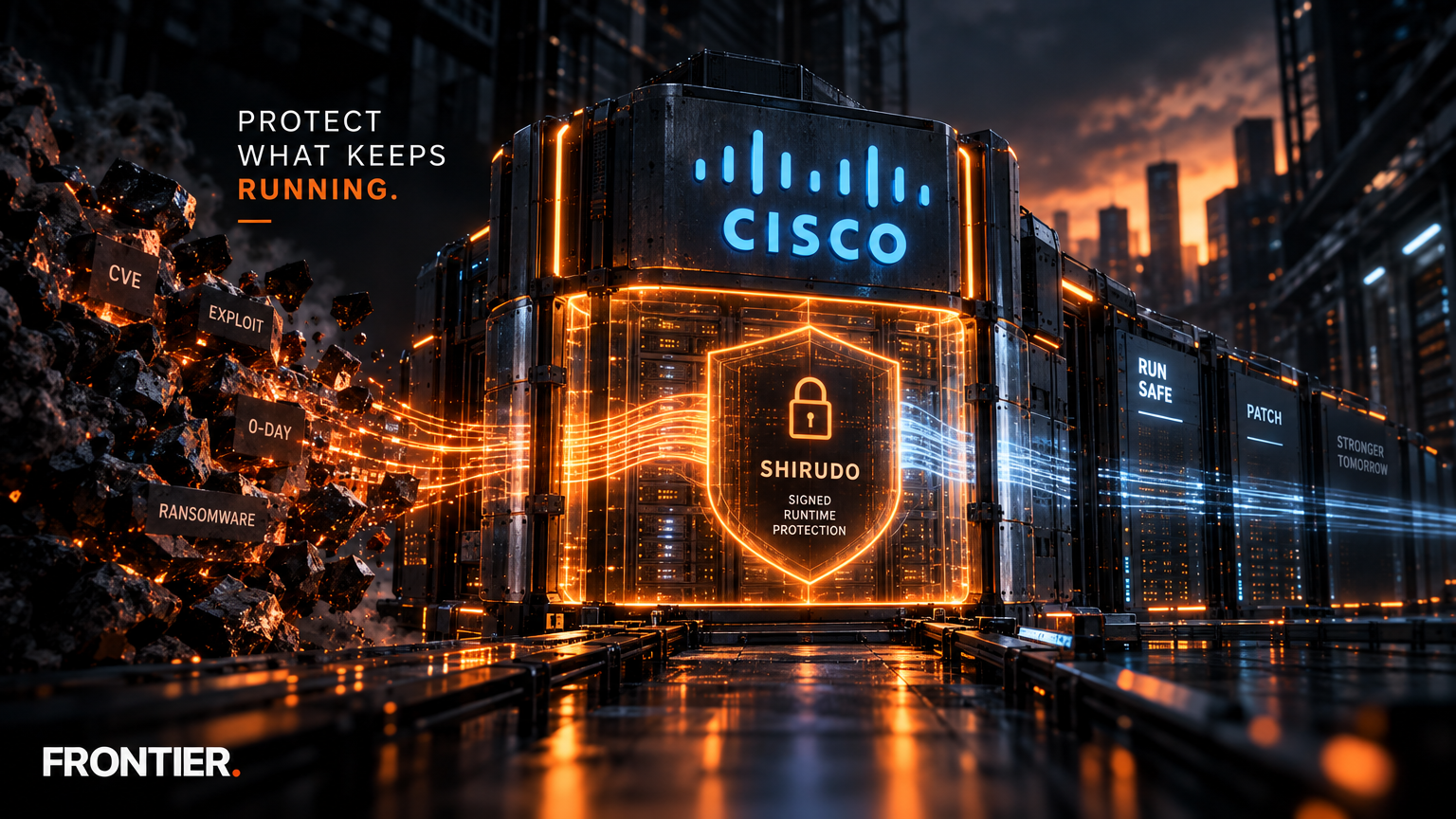
Cisco and OpenAI launched Shirudo on November 23, 2026, and published its source code as an open-source project. Shirudo is a pre-release Linux security runtime designed to protect running systems with temporary controls while operators test and deploy permanent patches.12 Despite the announcement’s emphasis on safeguarding agentic AI, the disclosed technology addresses a broader and more concrete infrastructure problem: how to reduce exposure on vulnerable Linux workloads when an immediate patch or restart is not practical.
Shirudo uses eBPF programs, signed micropatches and Trusted Platform Module-backed evidence to apply and verify temporary protections on live systems.3 The project calls those protections “shields.” The intended operating model separates generation from authorization: a shield can be created for a vulnerability, but an operator must approve and cryptographically sign it before deployment. The Hacker News reported that approved shields can be applied without stopping the protected service, while The Register described the mechanism as an eBPF-based compensating control for the interval before conventional remediation.45
The public repository identifies Shirudo as a BPF-based Linux security platform. Its main code is available under the BSD 2-Clause license, while BPF programs are dual-licensed under BSD and GPL terms.3 This makes the implementation inspectable and gives infrastructure teams a basis for evaluating the trust model rather than relying only on a vendor description.
The current release is not a generally available production security layer. The repository explicitly labels Shirudo pre-release and says protected targets require a Linux kernel with Shirudo’s signed-loader application binary interface and associated kernel patches, as well as TPM 2.0.3 Those prerequisites materially narrow its immediate use. Most enterprises cannot insert it into existing Linux estates as an ordinary agent or configuration update; they would first need to validate a modified kernel path, hardware compatibility and the operational process for signing and revoking shields.
OpenAI says a Codex-generated shield blocked a Java4Shell exploit attempt against a running Elasticsearch service without a restart.2 Cisco separately says Shirudo detected and blocked attempts involving Java4Shell and a PHP vulnerability.1 These are vendor-reported demonstrations, not independent performance or security validation. They establish the intended workflow, but they do not yet establish production reliability, workload compatibility or protection across a representative enterprise Linux fleet.
Why it matters
Shirudo introduces a third option into a vulnerability-management process that often forces infrastructure teams to choose between rapid patching and continued exposure. Immediate patching can require service interruption, compatibility testing or coordinated change windows. Waiting preserves operational stability but leaves the vulnerable component running. A signed runtime mitigation could narrow that interval without pretending that the underlying defect has been removed.
For CIOs, the relevant purchasing and architecture question is therefore not whether Shirudo should replace patch management. It should not. The question is whether Linux platforms should eventually include a governed runtime-defense layer alongside vulnerability scanning, configuration management and permanent remediation. Shirudo’s design suggests what such a layer would require: controls that can operate on running workloads, explicit operator authorization, cryptographic provenance and evidence from the target system that the control was accepted.3
That model changes what enterprises should demand from security and infrastructure suppliers. A temporary mitigation should not arrive as an opaque rule that silently alters production behavior. Buyers need to know who or what generated it, who approved it, which systems accepted it, what behavior it blocks, when it expires and how it will be removed after permanent remediation. Shirudo’s signed shields and hardware-backed evidence address parts of that governance problem, although the pre-release implementation does not prove that the complete lifecycle will work at enterprise scale.
The architecture also creates a distinct trust decision around AI-generated defenses. OpenAI’s demonstration used Codex to generate a shield, but the project does not equate generation with permission to deploy.2 That separation is important. Enterprises can evaluate automated control generation without allowing a model to modify kernel-level behavior autonomously. Human or policy-based approval, cryptographic signing and deployment evidence can remain mandatory even if AI reduces the time required to draft a mitigation.
CIOs should also distinguish infrastructure protection for AI systems from protection of AI models or agents themselves. Shirudo operates at the Linux runtime level. It may protect servers and workloads that support agentic applications, but the disclosed capability does not comprehensively secure model behavior, tool permissions, prompts or agent decisions.3 Treating it as an agent-security platform would misstate both the product’s present scope and the work still required elsewhere in the AI control stack.
The practical tradeoff is complexity. A runtime mitigation layer could reduce the period during which a known vulnerability remains unaddressed, but it adds kernel dependencies, signing infrastructure, approval workflows and another class of controls that operators must monitor and eventually retire. Shirudo’s requirement for a patched kernel and TPM 2.0 makes that tradeoff especially visible.3 Enterprises must decide whether the reduction in temporary exposure justifies maintaining this additional machinery for selected workloads.
The strongest near-term candidates are likely to be environments where service continuity constrains patch timing and where the organization can tightly govern the underlying Linux platform. That is an analytical inference from Shirudo’s architecture, not a demonstrated deployment result. CIOs should fund controlled evaluation rather than broad adoption until testing establishes failure behavior, workload compatibility and the integrity of the signing and rollback process.
Frontier take
Signed runtime mitigation should become a formal stage in vulnerability management, but only when it is governed as temporary infrastructure change rather than treated as an AI-generated substitute for patching.
Shirudo matters because it turns compensating controls into a potentially verifiable operating layer. Its combination of eBPF enforcement, signed shields and TPM-backed evidence offers a concrete model for protecting a running system while a permanent fix moves through testing and deployment.3 The architectural idea extends beyond this pre-release project: vulnerability response can include an authorized, measurable containment phase between discovery and remediation.
That phase needs hard boundaries. Every shield should map to a specific vulnerability or exposure, carry an accountable approval, produce target-level deployment evidence and have a retirement condition tied to permanent remediation. Without those controls, temporary defenses can become invisible technical debt. A mitigation that remains after the underlying software changes may no longer provide the intended protection and could complicate troubleshooting. This is why the governance system matters as much as the mechanism that blocks an exploit.
CIOs should resist two opposite errors. The first is dismissing runtime mitigation because Shirudo is not ready for general production use. The project’s pre-release status, modified-kernel dependency and unvalidated vendor demonstrations justify caution, not indifference.3 The second is allowing the urgency around agentic AI to obscure the technology’s actual role. Shirudo is presently a Linux vulnerability-control project with potential relevance to AI infrastructure, not a complete defense system for autonomous agents.
The appropriate enterprise response is to test the operating model before selecting a product. Security and platform teams should establish whether they can authorize, distribute, observe and retire temporary kernel-level controls without weakening existing patch obligations. That evaluation should include conventional incident and change-management personnel, because a runtime shield affects production behavior even when it avoids a restart.
Cisco and OpenAI have supplied an inspectable reference point, while independent reporting confirms the release, its eBPF approach and the availability of the source code.54 What remains unproven is whether Shirudo itself can satisfy enterprise requirements across diverse fleets. CIOs should therefore treat the project as an architectural signal and an evaluation target—not as evidence that the patch gap has already been solved.
Three moves for CIOs
-
— Create a separate authorization path for temporary runtime defenses Define a control class for signed runtime mitigations that is distinct from both emergency patches and ordinary detection rules. Require each mitigation to identify its vulnerability, generator, approver, signing authority, target population, expiration condition and permanent-remediation owner. Preserve the rule that AI may propose a control but cannot authorize its production deployment.
- Decision trigger: Activate the path when a critical Linux exposure cannot be permanently remediated within the organization’s approved risk window because testing, uptime or dependency constraints block an immediate patch.
- Why now: Shirudo separates shield generation from operator approval and uses signed controls with target-side evidence.3 Establishing that governance model before adopting a specific implementation lets the enterprise evaluate runtime mitigation without granting an AI system or security supplier unilateral authority over kernel-level production behavior.
-
— Test the evidence chain, not just exploit blocking Run a contained evaluation on non-production Linux systems that measures whether the organization can verify who signed a shield, which targets loaded it, what happened when loading failed, how the shield was revoked and whether permanent patching automatically initiated its retirement. Include kernel compatibility and TPM requirements in the test plan.
- Decision trigger: Begin testing when a platform supplier offers signed eBPF mitigation or when infrastructure teams consider adopting the Shirudo kernel path on a controlled fleet.
- Why now: The published code is pre-release and requires a signed-loader ABI, kernel patches and TPM 2.0, while the reported exploit-blocking results remain vendor claims.32 A successful demonstration is insufficient unless the enterprise can prove deployment state, failure handling and removal.
-
— Make runtime mitigation support a Linux platform selection criterion Add governed temporary-defense capabilities to future Linux platform, managed-service and security-tool evaluations. Ask suppliers whether controls can be cryptographically authorized, applied without service interruption, independently observed, constrained to named workloads and retired when permanent fixes arrive. Keep conventional patch service levels in the contract.
- Decision trigger: Apply the criterion during the next Linux platform refresh, managed infrastructure procurement or negotiation over vulnerability-remediation commitments for workloads whose availability limits restart windows.
- Why now: Shirudo shows that runtime controls can be designed as a layer between discovery and patching, while its current prerequisites show why the capability must be evaluated as part of the platform rather than assumed to work as a drop-in security agent.43 Procurement can encourage support for verifiable mitigation without allowing temporary controls to replace permanent remediation.
Sources
[^cisco-newsroom][^openai-announcement][^shirudo-github][^the-hacker-news][^the-register]