BlueFlag expands AI agent governance as software controls move beyond human developers
BlueFlag Security has extended its governance platform across agent discovery, code approvals, application dependencies, spending and remediation, reflecting a broader shift from governing developer access to governing every human and AI participant in software delivery.
Take the argument with you.
Read the publication-ready report. Generated from the canonical News article.
What changed
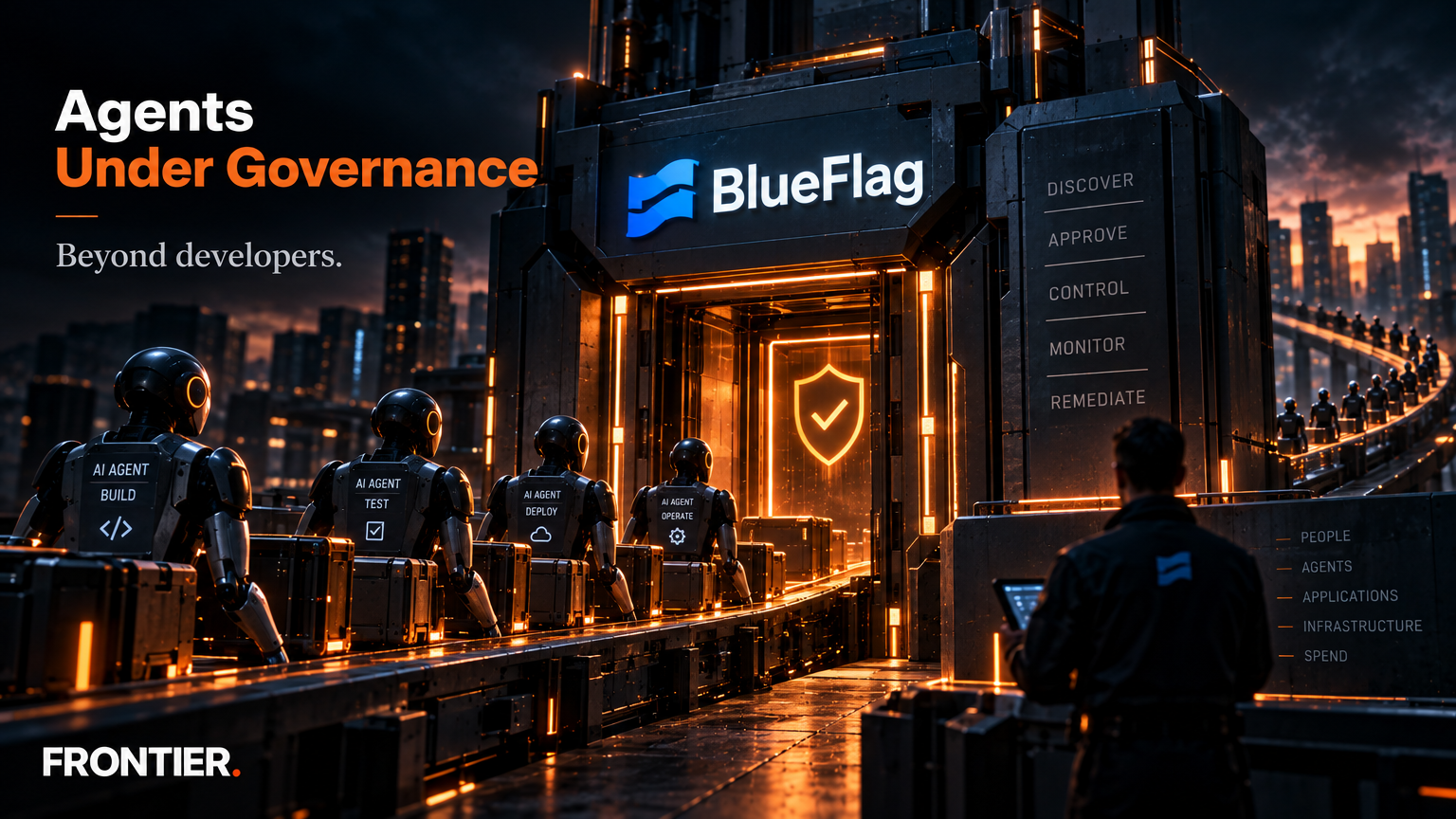
BlueFlag Security expanded its AI Agent Governance offering on November 4, 2026, adding or enhancing six areas that span agent discovery, endpoint visibility, human-review checks, application inventory, cost measurement and automated remediation.1 The event was an expansion rather than a first launch: BlueFlag introduced its original governance capability on March 23, with behavioral baselines, anomaly detection, overprivilege scoring and audit trails for coding assistants and autonomous agents.2
The new scope starts with identifying agents through code and build activity. BlueFlag says its platform can classify an agent, connect its activity to particular developers and repositories, and distinguish approved from unapproved use. It also says customers can use data from CrowdStrike and SentinelOne endpoint detection and response products to identify AI tools running locally on developer machines.1 Those functions address a visibility gap created when employees install or invoke assistants outside centrally procured development platforms, although the available reporting does not independently test BlueFlag's detection coverage or classification accuracy.
The expansion also reaches further into the delivery process. BlueFlag says the platform can identify pull requests and deployments approved by AI without human review, inventory applications that contain AI components or dependencies, and compare AI spending with development output. Its AccessGuard and DriftGuard functions can address identity and pipeline risks after detection, according to the company.1 Help Net Security highlighted the identity problem behind the update: agents may operate through developer credentials or their own identities, making both attribution paths relevant to access control and investigation.3
BlueFlag stated that all six capability areas were generally available, connected through APIs and read-only by default. Automated fixes require a customer to opt in.14 That separation matters because discovery and enforcement carry different operational risks: observing an agent does not alter a delivery pipeline, while revoking access or changing a control can interrupt work. Availability, efficacy and remediation performance remain vendor claims rather than independently tested findings.
The company also reported that 83% of organizations in its measured dataset had unapproved AI coding agents, 56% had autonomous agents using separate identities and 22% had experienced an autonomous agent merging code without human involvement.14 These figures come from BlueFlag customer telemetry and were not independently audited in the retrieved reporting. They indicate what BlueFlag says it sees among measured customers, not established prevalence across enterprises.
Why it matters
The immediate CIO choice is no longer simply whether developers may use an AI assistant. It is whether the enterprise can identify an agent wherever it participates in software delivery, connect its actions to an accountable identity and apply controls according to what the agent can do. A tool that suggests code inside an editor presents a different exposure from an agent that can approve a pull request, merge code, deploy an application or alter pipeline settings. Treating both as one software category produces controls that are either too weak for autonomous activity or unnecessarily restrictive for low-authority assistance.
BlueFlag's expansion illustrates the required breadth. Repository logs can show code and approval activity, but they may not reveal locally installed tools. Endpoint telemetry can expose local execution, but it does not by itself establish which repository, application or deployment an agent affected. Identity records can show credentials, yet an agent may use a developer's account or a separate machine identity. Application inventories can identify AI dependencies without proving that a human reviewed the resulting code. The analytical implication is that CIOs need linked evidence across endpoints, identities, repositories, build systems and deployment controls rather than a procurement list labeled “approved AI.”13
That creates a build, buy and integration decision. An enterprise may assemble visibility from existing endpoint, identity and software-delivery systems, or buy a governance layer that correlates those records. The correct choice depends on whether current systems can answer four operational questions: which agent acted, under whose authority, on which software asset and with what human oversight. If those answers require a manual investigation across separate consoles, broad agent adoption can outpace the control function. A purchased layer may reduce that correlation work, but CIOs should require evidence that it discovers the tools and workflows actually used in their environment rather than assuming broad coverage from a feature list.
Human review also needs a more precise definition. A nominal approval step has little value if an AI agent generated a change and another agent approved it through an authorized identity. BlueFlag's claimed ability to flag AI-approved pull requests and deployments surfaces this distinction.1 CIOs therefore must decide which actions require a named human reviewer and what evidence the delivery system must retain. The threshold should follow consequence: code generation may remain permissible under standard review, while security-control changes, production deployments or agent-granted access may require stronger separation of duties.
Remediation presents a second tradeoff. Read-only governance can establish an inventory and produce evidence without changing production workflows. Automated enforcement can shorten the interval between detecting an overprivileged identity or pipeline drift and correcting it, but it also gives the governance system authority to disrupt software delivery. BlueFlag's decision to make its capabilities read-only by default and require customers to opt into automated fixes acknowledges that boundary, even though the safety and effectiveness of those fixes have not been independently established.14 CIOs should evaluate observation and remediation as separate purchases and permissions, not accept write access merely because it is bundled with discovery.
Cost measurement adds another decision. Comparing AI expenditure with development output could help determine where licenses or agent workloads merit expansion, but output metrics can encourage the wrong behavior if they count activity without accounting for review, defects or operational risk. BlueFlag says its update provides this comparison; the retrieved sources do not establish a validated relationship between the measured spending and business outcomes.1 CIOs should use such data to locate adoption patterns and investigate variance, not as an automatic score for individual developers or teams.
Frontier take
AI agents should receive governance according to their authority in the delivery lifecycle, not according to the product category or vendor name attached to them. That is the central significance of BlueFlag's expansion. The product now spans discovery, identity, approvals, application dependencies, economics and remediation because no single repository permission or endpoint policy can represent everything an agent may do.1
This approach changes the unit of control. Traditional developer governance starts with a person, grants that person access and records actions under the person's identity. Agentic delivery can split those elements apart: a human may initiate an agent, the agent may operate under another identity, and its work may pass through automated approval or deployment stages. BlueFlag's original March offering already addressed coding assistants, autonomous agents, behavioral anomalies and overprivilege; the November update extends that model across more of the lifecycle.21 The strategic direction is therefore broader than shadow-AI detection. It is the construction of an accountability chain for nonhuman participation in software production.
CIOs should not wait for a perfect enterprise-wide agent taxonomy before imposing controls. They can classify agents by observable authority: suggest, modify, approve, merge, deploy, administer or remediate. Each additional authority should require stronger identity separation, evidence retention and human oversight. This avoids a blanket ban while preventing an assistant from becoming an autonomous production actor through incremental permission grants that no single review captures.
BlueFlag is one vendor proposing this lifecycle layer, and its product claims still require validation in each customer's environment. Detection rates, false positives, integration depth and the operational effects of automated remediation are not established by the announcement or independent reporting. The defensible procurement position is therefore outcome-based: require a governance product or internally built control plane to reconstruct an agent's path from endpoint and identity through code, approval and deployment. If it cannot produce that chain reliably, it is an inventory tool rather than an agent-governance system.
Three moves for CIOs
-
— Build the agent register from observed activity, not license records Create a reconciled register that links detected agents to developer endpoints, identities, repositories, build activity and application dependencies. Compare procurement records with endpoint and delivery-system evidence, then assign an owner and approval status to every observed agent. Test any vendor against representative local tools and repositories before treating its inventory as authoritative.
- Decision trigger: Start when any development group permits AI-generated code, or when endpoint or repository evidence identifies an assistant that is absent from the approved software catalog. Escalate to mandatory registration when an agent can modify a repository or invoke a build.
- Why now: BlueFlag's update reflects the gap between purchased tools and agents visible through endpoint, code and build activity.1 An inventory based only on contracts cannot capture unapproved installations or explain which software assets an agent touched. Establishing the evidence chain first gives later approval and remediation controls a dependable object to govern.
-
— Set review requirements by agent authority Classify agent permissions as suggestion, modification, approval, merge, deployment, administration or remediation. Require a named human decision-maker for high-consequence transitions, and retain evidence showing whether that person reviewed the actual change rather than merely approving an automated workflow. Prevent the same agent, or two agents acting without human intervention, from both producing and approving a protected change.
- Decision trigger: Apply stronger controls as soon as an agent can approve or merge code, deploy to an operational environment, change access, alter pipeline policy or act through a separate identity. Suspend that authority if the organization cannot distinguish human from agent approval in its audit record.
- Why now: BlueFlag says it can flag AI-approved pull requests and deployments that lacked human review, while its telemetry indicates that some measured customers have seen autonomous merges.14 The percentages are not independently audited, but the underlying control question is immediate: an approval stage cannot provide human oversight when an agent can satisfy it.
-
— Separate governance visibility from remediation authority Deploy agent-governance capabilities in read-only mode first and measure discovery coverage, attribution quality and false positives. Grant write or remediation access only for narrowly defined conditions, with a named service owner, rollback procedure and delivery-impact limit. Use spending-to-output comparisons as investigation signals rather than automatic team rankings or budget decisions.
- Decision trigger: Require a separate authorization review whenever a governance platform requests permission to revoke identities, alter pipeline configuration or remediate drift. Enable automation only after repeated observations show that the same condition can be identified accurately and corrected without unacceptable interruption.
- Why now: BlueFlag makes the expanded functions read-only by default and requires an opt-in for automated fixes, exposing a useful boundary between seeing risk and acting on production systems.14 Preserving that boundary lets CIOs gain lifecycle visibility without prematurely giving a new control layer the power to disrupt software delivery.
Sources
- BlueFlag Security — Expands Agentic AI Governance Throughout the SDLC 1
- BlueFlag Security — March 2026 launch of AI Agent Governance 2
- SiliconANGLE — BlueFlag expands governance to unapproved coding agents 4
- Help Net Security — BlueFlag adds controls for agents using developer identities 3
- SecurityBrief — Later coverage of BlueFlag governance tools 5
[^blueflag-nov4][^blueflag-mar23][^siliconangle-nov4][^securitybrief-nov17]