AWS TorchNeuron Opens PyTorch to Trainium. NVIDIA’s Hardest Lock-In Survives.
AWS has removed an important obstacle to moving PyTorch workloads onto Trainium2 and Trainium3, but CUDA-specific kernels, beta compatibility gaps, and operational economics still decide whether CIOs can really switch.
Take the argument with you.
Read the publication-ready report. Generated from the canonical News article.
What changed
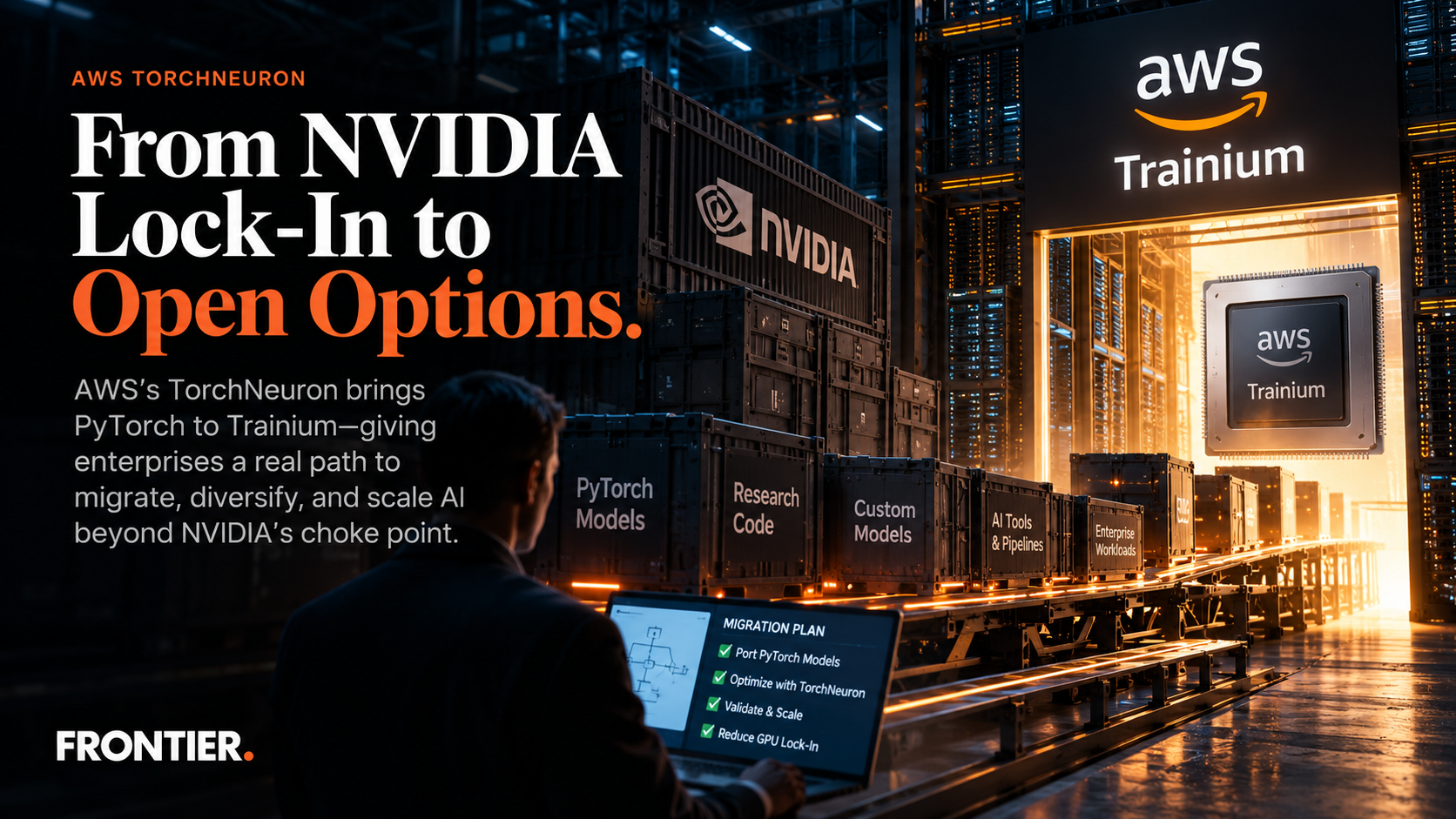
AWS has made a strategically meaningful move against NVIDIA's strongest competitive advantage: not the GPU itself but the software investment surrounding it. TorchNeuron, introduced October 19 and entering public beta October 20, registers AWS Trainium2 and Trainium3 as native devices in PyTorch. Developers whose models already use supported, device-agnostic PyTorch operations can often change device placement from cuda to neuron and run familiar training and inference workflows without rewriting their model definition. This is a practical advance, not simply a cloud chip marketing campaign.123
The mechanism matters. TorchNeuron uses PyTorch's official PrivateUse1 extension and accelerator APIs; it supports eager execution for debugging, torch.compile for optimized graphs, and distributed interfaces including FSDP, DTensor, and tensor parallelism. Hugging Face has added native Trainium integration into Transformers and Diffusers, reducing the amount of AWS-specific scaffolding needed in common workflows. The backend is being released under Apache 2.0. AWS still owns the underlying Trainium silicon, Neuron compiler/runtime, and cloud capacity.245
This is additional AI accelerator capacity, not new GPU capacity. Trainium is AWS's purpose-built machine-learning accelerator rather than an NVIDIA-compatible GPU. That distinction matters because PyTorch is a high-level programming framework, while CUDA, cuDNN, CUDA graphs, NCCL dependencies, and hand-tuned kernels form a lower-level NVIDIA-specific execution ecosystem. TorchNeuron can remove a considerable part of framework-level migration work. It does not translate arbitrary compiled CUDA programs or guarantee equivalent performance on a different architecture.56
AWS has named Cartesia and Deepgram among early users. Cartesia says it ran a standard voice inference pipeline with limited PyTorch code changes while still developing Neuron Kernel Interface (NKI) kernels for performance-critical layers. Deepgram reports roughly 60% more input-audio seconds per dollar on Trainium than its existing GPU baselines after a multi-month engagement with AWS. Both are meaningful directional evidence, but Deepgram's figure is a customer benchmark reproduced in the vendor-authored technical launch, not an independently verified general price/performance advantage.2
Why it matters
The hypothesis that workloads are trapped on NVIDIA is partly right, but the lock-in must be decomposed. A model defined with torch.nn, standard operators, and portable optimizer code was never inherently a CUDA-only intellectual asset. The expensive part is usually what accumulated underneath and around it: bespoke Triton or CUDA kernels, optimized attention, inference serving stacks, distributed communication assumptions, precision choices, profiler integrations, build images, testing, and the hard-won behavior of a particular GPU fleet. A team that mistakes common model syntax for complete hardware portability will discover the difference in production.
AWS's own release notes supply the most consequential qualification to the announcement. In an August PyTorch upstream suite run, roughly 154,000 outcomes were recorded and about 69,000 were skipped. Around 30,000 skips reflect normal PyTorch eligibility checks, but roughly 39,000 were deliberate Neuron exclusions; approximately 22,000 related to operators without native lowering. The beta also excludes or restricts sparse tensors, forward-mode autograd, some quantization and attention features, and dynamic or symbolic shapes. These numbers are not an overall workload failure rate. They are, however, direct evidence that the phrase “no rewrite” cannot be treated as an enterprise compatibility guarantee.23
There are also two execution modes with very different economics. Eager mode is useful for interactive development, but the technical announcement says separate operations can incur compilation, device launches, and intermediate high-bandwidth-memory traffic. The production-performance path is torch.compile, where graph capture, lowering, and compiler support matter. Adaptive eager remains experimental. Consequently a successful notebook run is not the same as acceptable model-training throughput or production serving latency. Model correctness needs checking against a reference GPU output, including precision tolerance and actual distribution of sequence lengths, shapes, and batch sizes.2
A useful readiness split emerges:
| Existing workload | Migration prospect | CIO-level gate |
|---|---|---|
| Standard PyTorch training or supported inference | Promising | Actual operator coverage, quality equivalence, and compiled performance |
| Hugging Face Transformer or Diffusers pipeline | Improving rapidly | Exact model, kernel, library, and serving-version compatibility |
| Distributed training with FSDP or tensor parallelism | Plausible | NeuronCore topology, collective performance, checkpoint/resume behavior |
| Custom CUDA/Triton kernels or CUDA-specific collectives | Significant porting risk | Rewrite or replace critical kernels, then independently benchmark |
| Sparse, dynamic-shape, or unsupported quantized workloads | Beta blocker or redesign | Feature support must be demonstrated, not promised |
These categories are grounded in AWS's own support disclosures rather than a claim that every application in a category will behave identically.25
The counterargument to exaggerated NVIDIA lock-in is that TorchNeuron is part of a broader hardware-abstraction race. AMD's ROCm brings supported PyTorch code to Instinct accelerators and provides HIP tooling for some CUDA source migration, although AMD explicitly cautions that CUDA APIs and libraries are not interchangeable. Google Cloud likewise describes TorchTPU as a PyTorch-native execution path for its TPUs. Thus AWS did not invent accelerator portability. It has made its own silicon a materially more accessible contender for PyTorch-centered teams.789
For CIOs the second-order effect is commercial leverage. When only one accelerator family passes an organization's production tests, procurement has little effective freedom regardless of the number of chips advertised. A second qualified backend allows workload placement decisions to reflect capacity, region, resilience, energy and unit economics rather than engineering impossibility. It can reduce exposure to NVIDIA shortages, but only where AWS can supply suitable Trainium instances and where the new runtime actually passes the firm's acceptance criteria. “Available capacity” is therefore a contract and operating question, not a fact established by the launch.
The trap is trading one lock-in for another. Open-source TorchNeuron increases portability at the PyTorch surface, but highly optimized NKI kernels, Neuron compiler versions, EC2 instance topology, EFA networking and AWS service integration can make the next migration just as expensive. This resembles a broader pattern we described when AWS expanded its agent infrastructure: the interface becomes easier to adopt while the platform owner seeks control of the runtime and its economics. Here the battleground is model execution rather than agent orchestration.102
Finally, distinguish comparative evidence from vendor extrapolation. AWS says its continuous Hugging Face sweep touches 100,000 models representing 99.9% of observed model downloads, using reduced representative configurations. That is useful test coverage, not proof that 99.9% of customer production deployments work or perform competitively. Similarly Deepgram's 60% advantage may be real for the measured audio pipeline, yet says little about an unrelated retrieval-augmented generation model, a large diffusion pipeline, or a heavily customized attention implementation. Cloud price sheets alone are equally misleading without utilization, compilation, latency, engineer time, and cloud commitment terms.26
Frontier take
AWS has opened the PyTorch door. NVIDIA's last-mile moat is still made of kernels, operating practice, and proof. That is both the opportunity and the limitation. By making the standard framework route much more accessible, AWS can turn some previously captive workloads into contestable infrastructure purchases. But CIOs should resist calling the migration complete until their production-critical graph, libraries, custom operators, checkpoints, security controls, and deployment economics all survive the move.
Selective placement, not a wholesale NVIDIA exodus, is the point. Keep unsupported workloads on GPUs; move validated demand to Trainium where capacity and fully loaded costs justify it. That is resilience—not indecision.
Performance portability has layers: model definition, compilation, kernels, memory, collectives, and recovery. Each lower layer can demand engineering, as Cartesia's NKI tuning demonstrates. Minimal model changes do not mean minimal effort to reach production performance.24
Even with compatibility, the economic bet remains unproven for most enterprises. The correct return measure is quality-adjusted work per fully loaded dollar, across the deployed model's duty cycle, plus a realistic migration and maintenance amortization. Procurement should consider available reserved capacity, on-demand elasticity, queueing time, committed-spend discounts, observability, incident response and the cost of preserving a second backend. The Reuters and TechCrunch reporting confirms the competitive significance of the release, not a universal Trainium win over NVIDIA.69
The Frontier thesis is simple: the coming accelerator price war will be won at the compatibility boundary, but the bill will be decided below it. TorchNeuron turns NVIDIA dependence from an unquestioned assumption into a testable claim. CIOs should use that opening decisively—but not confuse a public-beta API bridge with proven production portability.
Three moves for CIOs
-
— Map the CUDA dependency, not merely the PyTorch repository Direct platform engineering and MLOps leaders to inventory every significant training and serving workload, mapping framework versions, custom CUDA/Triton kernels, CUDA graphs, NCCL calls, attention/quantization libraries, distribution patterns, model shapes, and serving runtimes. Classify each as green (mostly standard supported PyTorch), amber (specific Neuron kernel or configuration work), or red (unsupported operation or major redesign). Build a repeatable automated compatibility suite from production shapes and checkpoints, not toy notebooks. Document the baseline cost of maintaining all CUDA-dependent components.
- Decision trigger: Move a workload to an AWS Trainium pilot only after its actual operator graph, model quality, inference outputs, and dependency versions are covered; hard-block unsupported dynamic/sparse paths or unbudgeted kernel porting.
- Why now: AWS's own public beta skips tens of thousands of PyTorch test outcomes, including about 22,000 lacking native operator lowering. The availability of
model.to('neuron')is a starting test, not an architecture approval.23
-
— Run an independent, full-cost Trainium-versus-GPU trial Select two or three representative workloads—for example a high-volume voice or LLM serving task, one fine-tuning job, and one CUDA-heavy application. Benchmark matched accuracy or loss, tokens or audio-seconds per second, p95 latency, batch and context distributions, compiler warm-up, memory utilization, uptime, failure recovery, and $/correct completed workload under real reservation terms. Include engineering migration hours and future Neuron-specific tuning, then publish the results internally with explicit go/no-go gates and the ability to fall back to GPUs.
- Decision trigger: Scale only where a 60–90-day pilot clears a preagreed total-cost and service-level hurdle (for example 20% lower fully loaded unit cost without measurable quality or latency regression); do not treat vendor or single-customer percentages as your ROI.
- Why now: Deepgram's roughly 60% higher audio-seconds-per-dollar finding is encouraging but tied to its own baseline and AWS-assisted port. CIOs need an apples-to-apples test for their actual models, operating constraints, and cloud contracts.26
-
— Turn a second accelerator into negotiated optionality, not new lock-in Keep model definitions, dataset access, evaluation fixtures, and deployment manifests as device-agnostic as practical; isolate CUDA and Neuron kernels behind narrow interfaces with tested fallback. Require procurement to obtain Trainium regional capacity, outage recovery options, quota guarantees and pricing commitments before migration. Compare at least one other non-NVIDIA backend where practical, document exit costs from NKI or specialized cloud integrations, and require quarterly reassessment as PyTorch, Neuron, ROCm and TPU backends mature.
- Decision trigger: Treat any migration that requires irrecoverable AWS-specific code, unsupported critical features, or unavailable failover capacity as a strategic vendor-concentration decision that needs explicit CIO approval.
- Why now: TorchNeuron weakens lock-in at the framework layer while the Trainium runtime remains AWS-specific. AMD and Google are advancing their own PyTorch routes, so sourcing leverage comes from maintaining multiple proven execution choices, not pledging allegiance to the newest chip.789
Sources
- Amazon, TorchNeuron announcement, October 2026 1
- PyTorch project, native TorchNeuron technical announcement and test methodology 2
- AWS Neuron, TorchNeuron component release notes 3
- AWS Neuron, TorchNeuron native PyTorch documentation 5
- Hugging Face, TorchNeuron native support across model libraries 4
- Reuters, Amazon takes aim at NVIDIA with PyTorch compatibility 6
- TechCrunch, TorchNeuron and the battle for NVIDIA developers 9
- AMD, ROCm software, CUDA source-porting limitations 7
- Google Cloud, PyTorch-native TorchTPU stack 8
- Frontier Research, AWS Just Filled In the Agent Stack 10
[^aws-launch][^pytorch-technical][^aws-beta][^huggingface][^aws-guide][^amd-rocm][^google-torchtpu][^techcrunch][^frontier-aws]