AWS Brings OpenAI Daybreak Red to GovCloud, Making Governance the Gate to High-Risk AI
OpenAI’s specialized GPT-5.6 Cyber model is now available to eligible Amazon Bedrock customers in AWS GovCloud (US-East), marking a larger shift toward deploying dual-use AI through approval-gated cloud infrastructure where identity, monitoring, operator access and retention terms become architectural controls.
Take the argument with you.
Read the publication-ready report. Generated from the canonical News article.
What changed
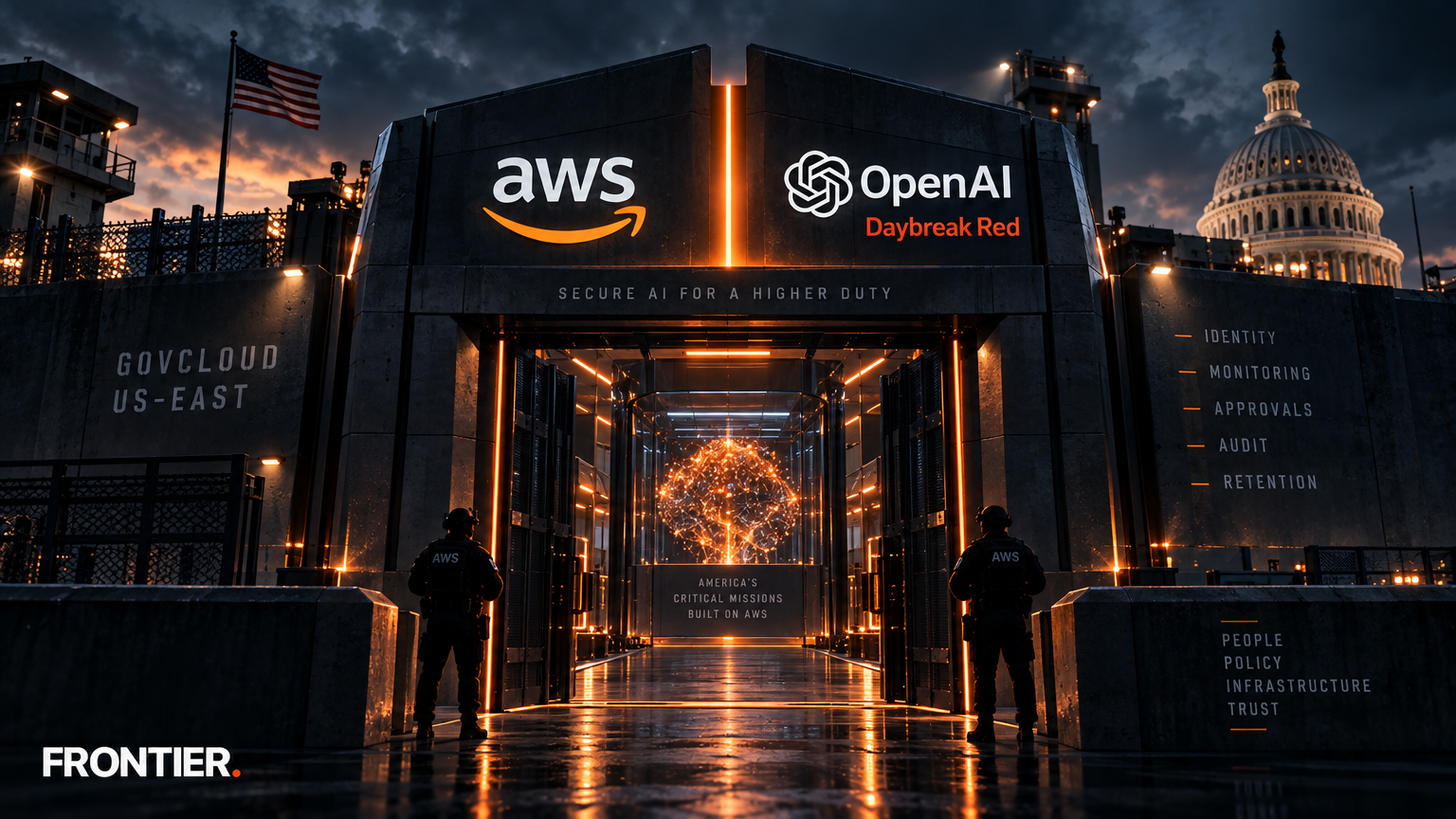
AWS announced on October 30, 2026, that OpenAI’s Daybreak Red is available to eligible customers through Amazon Bedrock in AWS GovCloud (US-East), extending an offering also available in US East (Ohio).1 Independent reporting published the same day corroborated the GovCloud expansion.2
Daybreak Red uses OpenAI’s specialized GPT-5.6 Cyber model. OpenAI describes it as a system for authorized vulnerability research, exploit validation or reproduction, penetration testing, red teaming and mitigation development.3 The model identifier within Amazon Bedrock is openai.gpt-5.6-cyber.4 Independent reporting has also corroborated the model’s intended defensive uses, reduced-refusal positioning and restricted availability.56
This is not an ordinary catalog addition. Access requires approval for OpenAI’s Daybreak program, may require additional model-specific review and must then be provisioned through the customer’s AWS account team. OpenAI explicitly says that purchasing AWS services does not itself guarantee access.4 The practical product is therefore a combination of model capability, provider eligibility decisions and cloud provisioning—not an API that any Bedrock customer can activate on demand.
AWS says Daybreak Red runs on Bedrock’s next-generation inference engine, with zero-operator access enforced at the chip. AWS also says inference data is not used to train models and that customers do not need to share their Daybreak Red data with OpenAI.1 Those are attributed vendor claims, not independently audited findings in the supplied research, and CIOs should treat them accordingly during assurance reviews.
The data-handling language also requires careful separation of distinct controls. OpenAI states that Daybreak approval and data-retention settings are separate matters.4 An earlier AWS technical disclosure said traffic flagged by classifiers could be retained by AWS for up to 30 days unless other arrangements applied.7 It would therefore be an analytical error to translate the announcement’s training and data-sharing statements into an assumption of automatic Zero Data Retention. The relevant terms must be established for the customer’s specific account, traffic path and approved configuration.
The event is significant because it places a powerful, dual-use cyber model inside a cloud environment designed for government workloads while preserving an explicit access gate. The model has not simply moved closer to sensitive workloads; governance has moved into the delivery mechanism itself.
Why it matters
CIOs have traditionally been able to separate model selection from deployment governance: a technology team chose a model, while security, legal and risk functions added controls around its use. Daybreak Red points toward a different decision model for the highest-risk AI capabilities. Eligibility, identity verification, provisioning, monitoring, infrastructure isolation and retention conditions are becoming constitutive parts of the service rather than policy overlays applied after procurement.
That changes the first procurement question. The question is no longer only whether a model performs well enough for vulnerability research or red-team workflows. It is whether the enterprise can obtain, maintain and evidence authorization to use the capability within an acceptable deployment architecture. OpenAI’s approval process and AWS’s separate provisioning step mean commercial availability, technical availability and organizational authorization are distinct states.4 A CIO could have an AWS relationship and a viable use case yet still lack permission to activate the model.
The second change is that infrastructure assurances must be decomposed rather than accepted as a single promise. AWS’s claims about chip-enforced zero-operator access, non-use of inference data for training and no requirement to share Daybreak Red data with OpenAI address different risks.1 They do not, by themselves, settle retention periods, classifier-triggered handling, logging, incident access or every circumstance in which data may persist. The supplied documentation indicates that Daybreak approval does not automatically determine retention settings, while AWS has previously described possible retention of classifier-flagged traffic.47 CIOs therefore need control-by-control evidence instead of relying on a general statement that the service is private or secure.
The third change concerns operating ownership. A model designed for exploit reproduction and penetration testing is intentionally capable of producing outputs that ordinary enterprise AI controls may be designed to suppress. OpenAI positions Daybreak Red as offering verified defenders greater room to perform authorized cyber work, and independent reporting confirms the approval-gated and reduced-refusal design.356 That creates a need to bind model access to a defined defensive mandate, named operators and monitored environments. The analytical inference is that conventional enterprise chatbot governance is insufficient: the control objective is not merely to prevent harmful prompts, but to ensure that powerful outputs occur only within authorized investigations.
The fourth change is economic and architectural. For controlled AI, a nominally available model can have little enterprise value until approval, account provisioning and data terms align. CIOs must evaluate the complete path to usable capability, including the organizational effort required to secure approval and preserve it. This is not a claim that performance has become irrelevant. It is an assessment that performance is now only one threshold in a multi-gate deployment decision.
For government agencies and regulated organizations already using AWS environments, GovCloud availability may reduce one infrastructure-placement obstacle. It does not remove the need to verify workload eligibility, authorization boundaries or data handling. The strategic consequence is that cloud architecture and AI governance are converging: provider controls increasingly determine which advanced capabilities can operate, for whom and under what conditions.
Frontier take
The decisive advantage in high-risk enterprise AI will belong to organizations that can operate a governed capability path—not simply organizations that can acquire the strongest model.
Daybreak Red makes that assertion defensible because its practical availability depends on a chain of controls. OpenAI determines eligibility and may require model-specific approval; AWS then provisions access through the customer’s account team.4 The model runs through Bedrock infrastructure, while AWS makes specific claims about operator access, training use and data sharing.1 Each element changes whether the capability can be used safely and lawfully. Model access is the output of that chain, not its starting point.
This structure also changes how CIOs should interpret concentration risk. Using a governed cloud service can consolidate infrastructure and access controls, but it creates dependencies on multiple providers’ approval processes, technical enforcement and documented data practices. That is not inherently a reason to reject the service. It is a reason to map which provider owns each control and what happens if an approval, configuration or assurance changes. OpenAI’s statement that AWS purchasing alone does not guarantee access demonstrates that contractual cloud access and operational model entitlement are already separate.4
The strongest enterprise architecture will therefore treat advanced cyber AI as a privileged security system. Its operating envelope should specify authorized missions, approved identities, permitted data classes, regions, logging expectations, retention terms and suspension conditions. That approach is consistent with the model’s stated focus on authorized vulnerability and exploit work rather than unrestricted general use.3 It also gives CIOs a basis for comparing future high-risk models even when vendors package their controls differently.
CIOs should resist two opposite errors. The first is dismissing an approval-gated service as merely difficult procurement. The friction is part of the product design because it determines who can access a dual-use capability. The second is assuming that provider gating transfers accountability away from the enterprise. Provider approval does not establish that every internal project, dataset or operator is authorized.
The broader structural shift is from policy-governed model use to infrastructure-governed capability deployment. Daybreak Red’s GovCloud expansion is an early, concrete example: specialized capability, identity and eligibility checks, provider provisioning, infrastructure controls and explicit data terms are being assembled into one delivery system. CIOs should organize their decisions around that system rather than around model benchmarks alone.
Three moves for CIOs
-
— Build a capability-authorization graph before starting procurement Map every dependency between the proposed cyber mission and usable model access: OpenAI eligibility, any model-specific approval, AWS account provisioning, approved identities, target region, workload authorization, monitoring ownership and retention configuration. Assign an executive owner and required evidence to each node. Treat the model as deployable only when the complete graph is satisfied, rather than when a commercial agreement is signed.
- Decision trigger: Require this graph whenever a model is approval-gated, designed for exploit reproduction or red teaming, or cannot be activated solely through the organization’s existing cloud entitlement. For Daybreak Red, the immediate trigger is OpenAI’s explicit requirement for approval followed by AWS provisioning.4
- Why now: The GovCloud announcement demonstrates that regional availability does not equal customer entitlement.12 Building the graph now prevents teams from treating cloud procurement, provider approval and internal authorization as one decision. It also exposes which dependency could delay, suspend or invalidate the deployment.
-
— Make retention behavior—not privacy language—the production release gate Require a written control matrix covering training use, model-provider sharing, operator access, classifier-triggered retention, log persistence and deletion. Validate the terms for the specific account and traffic path, and obtain an explicit exception decision if the organization cannot establish the required retention posture. Do not infer Zero Data Retention from statements that data is not used for training or need not be shared with OpenAI.
- Decision trigger: Block production use when live vulnerabilities, exploit artifacts, government data or other sensitive material will enter the service and the organization cannot document retention for normal and classifier-flagged traffic. Reopen the gate whenever provider terms, model approval or Bedrock configuration changes.
- Why now: AWS makes specific claims about training, sharing and chip-enforced operator access, but OpenAI separates Daybreak approval from retention settings.14 AWS has also previously disclosed possible retention of classifier-flagged traffic for up to 30 days unless other arrangements apply.7 The distinction is material before sensitive cyber evidence enters the system.
-
— License missions internally, not just users Create an internal capability license that binds each approved operator to defined defensive missions, systems, data classes and time windows. Connect activation to a named investigation or red-team authorization, monitor usage against that mandate and define automatic suspension conditions. Provider approval should be treated as a prerequisite, not as a substitute for enterprise authorization.
- Decision trigger: Apply mission-level licensing when a model offers reduced refusals for authorized cyber work or is used for exploit validation, reproduction, penetration testing or red teaming. Escalate to a fresh approval when work moves from synthetic exercises to live systems, crosses an organizational boundary or introduces a new data class.
- Why now: Daybreak Red is expressly designed to give verified defenders more latitude for advanced cyber tasks, while access remains restricted.356 That combination makes identity-only access control too coarse. Mission licensing operationalizes the same thesis as the provider architecture: powerful capability should become available only when authorization and deployment context align.
Sources
- AWS What's New: Daybreak Red in AWS GovCloud (US-East) 1
- AWS and OpenAI technical launch blog for Daybreak on Bedrock 7
- OpenAI Daybreak trusted-access overview 4
- OpenAI disclosure introducing Daybreak Red and GPT-5.6 Cyber 3
- Axios reporting on GPT-5.6 Cyber and Daybreak Red 5
- TechRadar reporting on the Daybreak Red expansion 6
- Automater reporting on OpenAI services and Daybreak Red in AWS GovCloud 2
[^aws-whats-new-daybreak][^automater-govcloud][^openai-daybreak-expansion][^openai-daybreak-help][^axios-daybreak][^techradar-daybreak][^aws-bedrock-daybreak-blog]