AMD’s EPYC 9006 Availability Makes the Host CPU a First-Class AI Infrastructure Decision
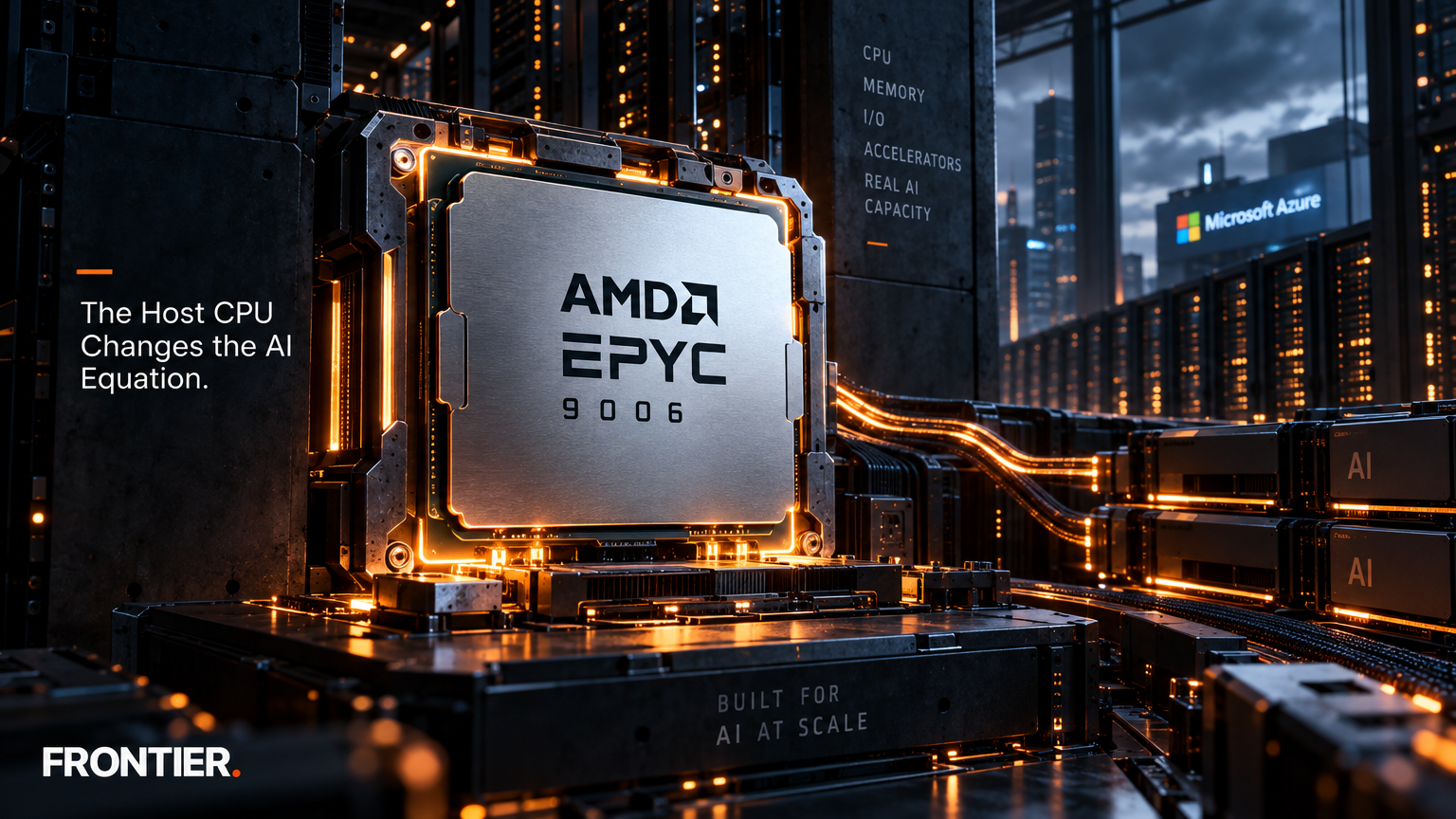
AMD made its 6th Gen EPYC 9006 SP7 processors generally available on November 10, 2026, as Microsoft opened an Azure implementation for preview. The milestone reflects a larger shift toward heterogeneous AI systems whose economics depend on balancing accelerators with CPU density, memory bandwidth, I/O and actual deployment readiness.
Take the argument with you.
Read the publication-ready report. Generated from the canonical News article.
What changed
On November 10, 2026, AMD announced general availability of its 6th Gen EPYC 9006 SP7 processor family and said systems using the processors were shipping from leading server vendors.1 This was a commercialization milestone rather than the original product launch: AMD had introduced the broader 6th Gen EPYC portfolio at its Advancing AI event on July 23, 2026.2
The SP7 family scales to 256 cores and 512 threads per socket and introduces PCIe Gen 6 alongside increased memory bandwidth, according to AMD and independent technical coverage.134 Those specifications matter in context because AI servers must move data among processors, memory, storage, networks and accelerators. The availability announcement therefore concerns more than CPU throughput: it puts a new host architecture into purchasable systems that enterprises can begin evaluating as an integrated platform.
Microsoft separately opened registration on November 10 for a preview of Azure HDv2 virtual machines built with 6th Gen AMD EPYC processors.5 Preview status is an important qualification. Microsoft had exposed the platform to prospective users, but the cited announcement did not establish general availability. CIOs should consequently distinguish the availability of AMD’s processors and partner systems from the maturity of each cloud implementation.
The references to Meta, Microsoft and Oracle do not represent three customer wins secured on November 10. AMD and Meta had already identified Meta as a lead customer for the Venice generation in a February 24 joint disclosure filed with the SEC.6 AMD announced in October that upcoming Oracle Cloud Infrastructure Compute E7 instances would use 6th Gen EPYC processors, but the cited disclosure described a future service rather than an already generally available OCI instance.7 Microsoft’s HDv2 preview was the cloud development that coincided with AMD’s general-availability announcement.5
The confirmed event is therefore narrower and more significant than a generic launch story. AMD moved EPYC 9006 SP7 into general availability, while cloud adoption remained distributed across lead-customer use, preview access and planned services. That uneven progression gives CIOs a more useful signal than a single roster of prominent names: processor readiness does not automatically make every server configuration or cloud service equally deployable.
Why it matters
The CIO decision model for AI infrastructure has often centered on accelerator selection and availability. The inference from AMD’s milestone is that this model is incomplete. As servers become heterogeneous systems, accelerator capacity can only be evaluated in relation to the host CPU, memory subsystem and I/O fabric that supply data, coordinate work and support the applications surrounding accelerated computation.
EPYC 9006 makes that dependency harder to leave as a secondary specification. Its core density, memory bandwidth and PCIe Gen 6 support create new platform options, but specifications alone do not establish enterprise value.14 Independent testing from ServeTheHome provides evidence that can supplement AMD’s claims, while Tom’s Hardware correctly presents several comparative figures as claims rather than universally reproduced results.38 CIOs should preserve that distinction: vendor benchmark results are evidence to investigate, not substitutes for workload-equivalent validation.
The procurement unit must consequently expand from the accelerator or virtual-machine SKU to the complete workload path. A credible evaluation should consider CPU utilization, memory pressure, I/O demand, accelerator feeding, software behavior and service availability together. This is an analytical conclusion drawn from the disclosed platform characteristics and rollout stages, not a vendor-reported guarantee of better outcomes. A system with more accelerator capacity may still be a poor choice if the surrounding architecture is mismatched to the workload. Conversely, a stronger host layer may improve effective capacity without requiring every application to consume additional accelerators.
Deployment status must also become part of architecture scoring. AMD’s processors were generally available on November 10, but Microsoft HDv2 was in preview, Oracle’s E7 instances were upcoming, and Meta’s lead-customer relationship predated the event.1576 These are materially different forms of evidence. General availability supports procurement planning; preview access supports testing; a roadmap announcement supports option analysis; and a named lead customer offers directional validation without proving suitability for another enterprise.
CIOs therefore need two connected scorecards. The first should measure system balance across CPU, memory, I/O and accelerators. The second should measure commercial readiness across on-premises systems and specific cloud services. This changes the decision from “Which accelerator do we want?” to “Which deployable architecture produces the required workload result within our operating, lifecycle and evidence constraints?”
That reframing also reduces the risk of allowing a prominent customer name to stand in for due diligence. Meta’s role, Microsoft’s preview and Oracle’s plan each indicate ecosystem engagement, but they do not establish equivalent deployment maturity or transferable economics. The durable decision signal is the combination of architecture, validated workload behavior and availability—not the breadth of a launch-day logo slide.
Frontier take
The host CPU is now a control point for AI infrastructure economics, and CIOs that continue treating it as an interchangeable component will make incomplete capacity decisions.
This assertion does not depend on accepting AMD’s comparative performance or performance-per-dollar claims. It follows from the structure of the systems being procured. AMD’s shipping platform combines high core density, expanded memory capabilities and PCIe Gen 6, while the associated cloud offerings are arriving at different stages.157 The architecture and the route to consumption must therefore be assessed together.
AMD’s November milestone is strategically significant because it converts the host layer from a future specification into an available design choice. Yet availability should initiate comparison, not end it. ServeTheHome’s independent testing supplies useful external evidence, but enterprise teams still need results tied to their own workload mix and equivalent system configurations.3 Claims reported by AMD or repeated in technical coverage should remain attributed unless independently reproduced under comparable conditions.18
The practical consequence is a new sequencing rule for infrastructure governance: establish the workload’s balance requirements before committing to accelerator quantities, cloud instance families or refresh timing. That sequence prevents accelerator demand from becoming the sole proxy for AI capacity. It also creates a common evaluation framework for owned infrastructure, previews and planned cloud services, despite their different commercial states.
AMD, Microsoft, Meta and Oracle are relevant here for different reasons, not as a single cohort of newly secured customers. AMD has made the processor family available; Microsoft has exposed a preview; Meta was previously identified as a lead customer; and AMD has described Oracle instances that were still upcoming in the cited announcement.1567 Treating those signals as equivalent would obscure the decision CIOs actually face.
The ultimate shift here is the elevation of general-purpose compute into AI portfolio governance. CPU architecture, memory, I/O, deployment maturity and independent workload evidence should now sit beside accelerator selection in investment reviews. The enterprises that adopt this model will be evaluating effective systems rather than isolated components.
Three moves for CIOs
-
— Set a host-balance gate before approving accelerator capacity Require every AI infrastructure proposal to document the workload’s CPU demand, memory pressure, I/O path and accelerator utilization as one system profile. Run shortlisted configurations under equivalent workload conditions, and separate independently observed results from vendor-supplied comparisons. EPYC 9006’s density, memory and PCIe characteristics justify evaluation, but they do not by themselves prove a better enterprise outcome.138
- Decision trigger: Apply the gate whenever a proposed accelerator purchase, reservation or cloud commitment exceeds the organization’s normal infrastructure approval threshold, or whenever testing shows sustained accelerator underutilization alongside CPU, memory or I/O contention.
- Why now: AMD has moved the host platform into general availability, making comparative system tests actionable rather than hypothetical.1 Delaying host-layer analysis until after accelerator commitments would lock the enterprise into quantities and configurations selected under an incomplete capacity model.
-
— Separate architecture qualification from service-maturity approval Maintain two approval tracks: one for the technical architecture and another for the specific delivery vehicle. Record whether each option is generally available, in preview or only announced, and prohibit a processor-level availability claim from being used as evidence that a corresponding cloud service is production-ready.
- Decision trigger: Require separate approval whenever the preferred architecture is available through one channel but remains in preview or on the roadmap in another. For this cycle, Microsoft HDv2’s preview and AMD’s description of upcoming Oracle E7 instances meet that trigger.57
- Why now: The EPYC rollout demonstrates that silicon, server and cloud-service readiness can advance on different schedules. A maturity ledger lets CIOs test emerging architectures without allowing preview access, a planned instance or a named customer relationship to be mistaken for deployable production capacity.
-
— Tie refresh decisions to workload bottlenecks, not processor generations Rebuild server-refresh criteria around measured constraints in CPU headroom, memory movement and I/O rather than product-generation cadence. Establish a baseline on the current estate, test an EPYC 9006 configuration with the same workload, and approve migration only when the full-system result satisfies predefined capacity, operational and evidence thresholds.
- Decision trigger: Open a refresh review when workload telemetry identifies the host layer as a recurring constraint, when accelerator resources remain underused because surrounding compute cannot sustain them, or when a generally available platform can be tested under equivalent conditions.
- Why now: The availability of systems based on a platform reaching 256 cores per socket with PCIe Gen 6 creates a concrete point for reassessing host constraints.14 The recommendation is not to refresh automatically; it is to use the new option to determine whether host architecture—not accelerator scarcity—is limiting effective AI capacity.
Sources
- AMD announces general availability of 6th Gen EPYC SP7 processors 1
- AMD Advancing AI 2026 original 6th Gen EPYC launch disclosure 2
- Microsoft announces Azure HDv2 preview using 6th Gen AMD EPYC 5
- AMD SEC-filed joint disclosure naming Meta as a lead 6th Gen EPYC customer 6
- AMD disclosure concerning planned OCI Compute E7 instances 7
- ServeTheHome EPYC 9006 launch review and independent benchmarks 3
- The Next Platform reporting on EPYC 9006 Venice 4
- Tom's Hardware technical reporting on the EPYC 9996 and wider Venice portfolio 8
[^amd-ga-2026-11-10][^amd-original-launch-2026-07-23][^sth-review-2026-11-10][^next-platform-2026-11-10][^microsoft-hdv2-preview-2026-11-10][^amd-meta-8k-2026-02-24][^amd-oracle-2026-10-27][^toms-hardware-2026-11]