Amazon Unifies AWS Marketplace and Business Shopping—But Not Procurement Control
AWS has joined software, AI and physical-goods discovery in a single storefront, but its two checkout paths expose a deeper contest over who controls enterprise purchasing decisions.
Take the argument with you.
Read the publication-ready report. Generated from the canonical News article.
What changed
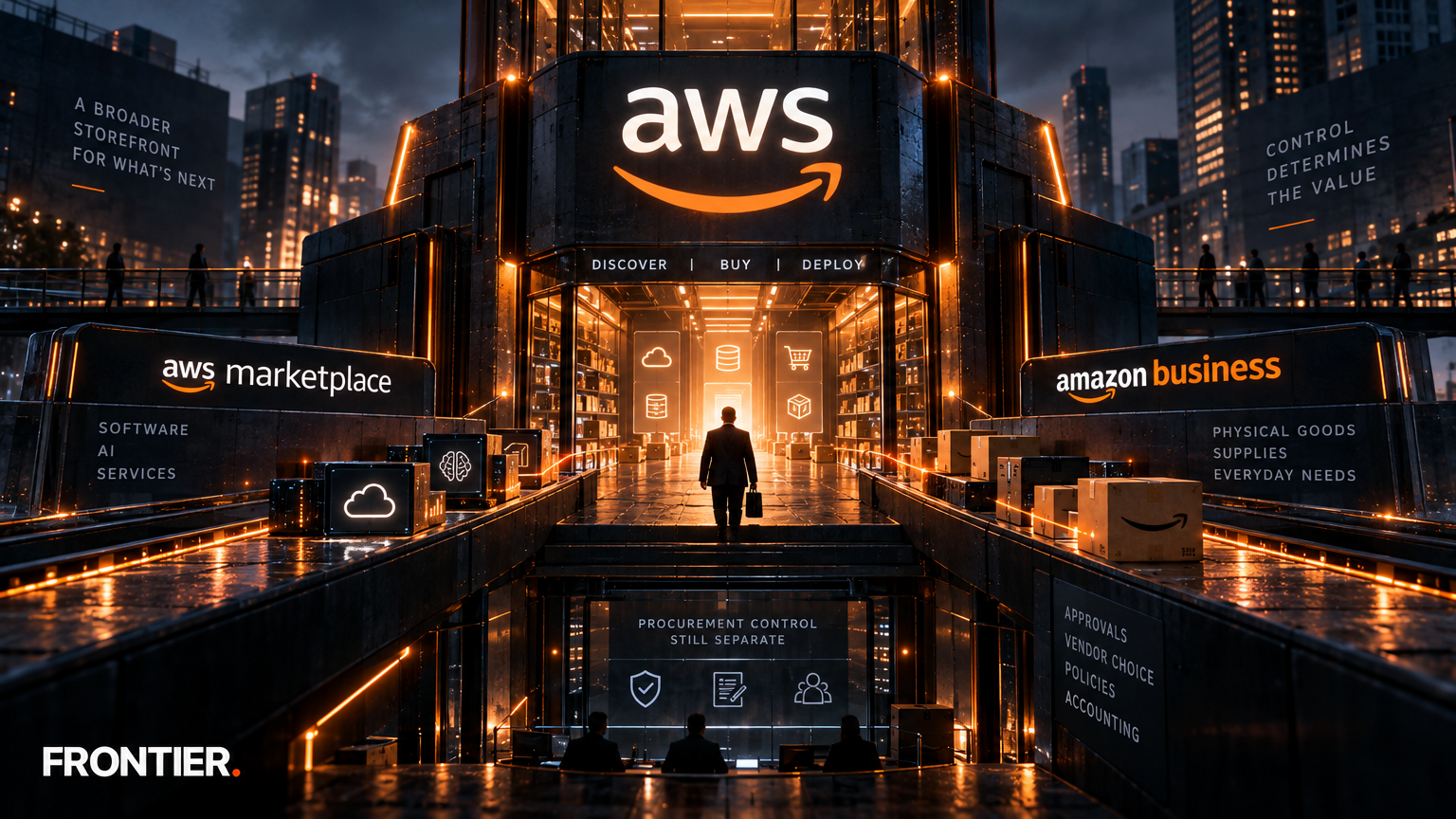
On October 28, 2026, Amazon Web Services announced a connector between AWS Marketplace Storefront and Amazon Business. A customer can present software, data and AI products from AWS Marketplace alongside physical goods from Amazon Business in a curated storefront. Administrators connect an Amazon Business account to the storefront, import permitted products and configure a governance experience around both catalogs.1 On its face, this sounds like a convenience release. It is more interesting as a test of who owns the enterprise's next purchasing interface.
The distinction that matters is the transaction boundary. An AWS Marketplace purchase can be completed within the storefront and appears on the customer's AWS invoice. An Amazon Business purchase moves through single sign-on to an authenticated Amazon Business cart. AWS describes one browsing front door, not one combined settlement ledger, one universal contract or a replacement for procure-to-pay systems.1 The connector is available where AWS Marketplace operates to qualified Storefront customers with the necessary account and API access; that is availability, not proof of broad deployment or measured buyer savings, yet.
The underlying Storefront was already generally available in June. Its original proposition was a branded, curated software catalog for partners and resellers, with private-offer workflows and AWS Marketplace billing.2 October extends that distribution surface across a category boundary, from digital infrastructure and enterprise software toward physical supplies. The incremental code may be modest; the possible commercial ambition is not.
But governance has to be understood at the layer where it actually operates. AWS documentation describes storefront buyer groups, purchase-request approval policies, catalog segments and visibility filters. Critically, it says a segment hides products in the storefront view but does not change their availability in AWS Marketplace or prevent access through direct product URLs.3 In its documented Buy With AWS workflow, a buyer's request may still lead to seller-created private offers and subsequent AWS Marketplace acceptance.4 A curated catalog is therefore not, by itself, an enforceable enterprise purchasing boundary.
Why it matters
The underlying enterprise problem is not an absence of shopping catalogs. It is fragmented responsibility for spend, vendor risk, contracts, credentials, approvals and renewal obligations across technology and operational purchasing. Cloud software might be charged to an AWS account under a private offer; the same employee's hardware order can follow an Amazon Business cart and a finance team's established purchase-order process. Finance must reconcile the actual liabilities; IT must govern software and data access; procurement must verify authorization and commercial terms. A common search box does not eliminate those duties.
The timing matters because technology purchasing categories are converging faster than their governance. The Linux Foundation's 2026 State of FinOps survey, covering 1,192 respondents, reported that 98% manage AI spend and 90% manage or expect to manage SaaS spending, while licensing and private infrastructure are increasingly part of the same cost-management conversation.5 That survey does not evaluate Amazon's new connector. It independently establishes why leaders need cross-category cost attribution and decision rights, rather than another channel-specific dashboard.
There is a very large strategic prize in becoming the default purchasing entry point. AWS Marketplace already supports negotiated private offers with custom pricing, license agreements and payment schedules; accepted offers become agreements with commercial obligations.6 The October 28 connector brings that purchasing route alongside a separate physical-goods shopping path. Convenience may influence where a buyer looks before architecture and supplier-risk review, but Amazon has not reported independently measured adoption or savings for this new connector.1 This is a risk to test, not a demonstrated procurement failure.
Competitors have recognized the same lever. Independent reporting on Anthropic's Claude Marketplace described a limited-preview platform through which customers could direct existing AI commitments toward third-party tools.7 This is not an apples-to-apples comparison with physical goods. It shows a broader market shift: vendors increasingly seek to control the path by which enterprises discover, approve, and pay for adjacent products.
Amazon also already participates in the opposite architectural pattern: bringing its catalog into a customer's existing procurement system. Amazon Business documents integrations with Coupa, SAP Ariba, Ivalua, GEP and other procure-to-pay providers, including Punchout and integrated search; in a conventional Punchout workflow, a cart returns to the customer's procurement system for approval.8 That architecture leaves the buyer's system as the approval hub. The new AWS-hosted storefront starts at Amazon's surface and hands physical goods into a separate Amazon Business cart. Which direction a CIO chooses affects where policy is defined, which system records the request, and how exceptions are escalated.
Four failure modes deserve particular scrutiny. First, approval asymmetry: one storefront policy may appear uniform while the two purchase paths execute under different back-end controls. Second, reconciliation drift: consolidated discovery can mask separate invoices, purchase orders, tax treatment and spend categories. Third, supplier steering: curated results and spend-commitment incentives can favor marketplace choices that are not optimal for portability or long-term total cost. Fourth, visibility leakage: storefront catalog restrictions are not equivalent to restrictions on the underlying marketplace. The last issue is explicitly documented by AWS; the others are governance risks to test, not demonstrated failures of this newly released connector.31
Why are conventional answers insufficient? A procurement-suite approval process may approve the order without evaluating software architecture, data processing or AI-model exposure. A FinOps dashboard may report cloud invoices but omit Amazon Business line items and supplier renewal liabilities. A marketplace catalog policy may narrow what a buyer sees without stopping a purchase from another route. Solving the entire problem requires joined policy identifiers, purchase-order and invoice reconciliation, vendor-risk attestations, identity mapping, and exception handling across systems—not just SSO.
Frontier take
Our thesis: Amazon is testing control of the corporate purchasing front door before it has unified the purchasing control plane. The difference between those two achievements is where CIO leverage resides. The buying experience is becoming a distribution moat. The defensible operating model is the one that can prove a purchase was authorized, economically rational, secure, contractually understood and attributable across every system it crosses.
This should not be reduced to an anti-Amazon argument. A well-governed storefront can reduce duplicate searching, align approved suppliers with buyer groups and make procurement less painful. For many organizations, especially those already using AWS Marketplace and Amazon Business, that improvement is valuable. But the stated architecture is still a federated journey: AWS Marketplace completes one set of transactions, while Amazon Business cart handoff completes another.1 A front door is a user-experience control point; an enterprise approval system is a legal, financial and technical control point. They should not be confused.
What makes this news more consequential than a connector release is its direction of travel. The storefront supplier may increasingly influence which software, AI services and physical products buyers encounter at the moment they have an approved budget. A cloud commitment can become a buying preference, procurement telemetry can become a competitive asset, and the storefront can become a channel for expansion into adjacent business categories. Those are plausible second-order outcomes, not announced capabilities or proven market-share gains. The independent FinOps evidence explains why cross-category oversight is urgent; the AWS announcement shows where commercial influence could increase.51
The counterweight is an open architecture for commercial governance. CIOs and procurement leaders should keep a canonical approval record in a buyer-controlled system, retain independent vendor comparisons and integrate invoices from all settlement paths into common spending data. They should measure whether the new interface reduces actual cycle time and errors rather than only clicks. Amazon's own Punchout integrations demonstrate that buyer-controlled procure-to-pay remains a supported route; the new storefront should earn its place against that baseline, not quietly displace it.8
The strategic question is therefore not whether Amazon can put two catalogs on one page. It can, and it has. It is whether enterprises will let the company that sells and distributes products also become the primary arbiter of what they are allowed to buy. A disciplined CIO can enjoy the convenience without surrendering that decision.
Three moves for CIOs
-
— Prove the policy at the transaction boundary Run a controlled pilot with one AWS Marketplace software purchase and one Amazon Business physical-goods order. Map the storefront's group approval to the final accepting identity, contract, purchase order, cost center and audit event in each checkout path; test a disallowed item reached by a direct product URL as well as through the curated catalog.
- Decision trigger: Expand only when a denied or unapproved purchase cannot silently bypass the enterprise's required approval process in either channel.
- Why now: AWS explicitly documents that storefront catalog segments filter visibility rather than underlying product availability.3 The launch's handoff to a separate Amazon Business cart makes an end-to-end control test essential.1
-
— Retain an independent procurement system of record Choose a buyer-controlled source of truth for spend authorization and supplier risk, and integrate AWS invoices, Amazon Business orders, tax and shipping, renewals and purchase-order references into it. Keep IT architecture and security approval separate from a buyer's ability to initiate checkout.
- Decision trigger: Require a reconciliation demonstration, including exceptions and reversals, before placing multi-department or regulated spend behind the new storefront.
- Why now: The connector joins discovery but AWS explicitly describes different transaction destinations for software and physical products.1 Existing Punchout arrangements provide a comparison point for maintaining buyer-controlled approvals.8
-
— Audit the economic influence of the storefront For every significant software or AI procurement, compare the marketplace offer with at least one directly negotiated or alternate-channel option. Document cloud-commitment eligibility, total contract value, usage lock-in, cancellation or renewal terms, and the actual effect on the committed-spend balance.
- Decision trigger: Use the storefront as the preferred route only where an independently reviewed comparison shows equal or better lifecycle economics and acceptable portability.
- Why now: AWS private-offer contracts and a consolidated buying interface can influence purchasing choices even though commercial controls remain separate.61 The growing breadth of FinOps responsibility makes these cross-channel trade-offs a CIO-level accountability.5
Sources
- AWS, AWS Marketplace and Amazon Business unified storefront announcement, October 28, 2026 1
- AWS, Marketplace Storefront general availability, June 16, 2026 2
- AWS Marketplace Storefront, buyer groups, policy and catalog governance documentation 3
- AWS Marketplace Storefront, Buy With AWS purchase workflow documentation 4
- Amazon Business, integrations with enterprise procure-to-pay systems 8
- AWS Marketplace, preparing private offers and buyer obligations 6
- Linux Foundation, 2026 State of FinOps survey, February 19, 2026 5
- TechRadar, independent coverage of Anthropic's enterprise marketplace, March 2026 7
[^aws-announcement][^storefront-ga][^aws-governance][^finops-2026][^aws-private-offers][^claude-marketplace][^amazon-punchout]