2026 AI Token Routers: The Market Map You Can Interrogate
59 offerings and projects, eight strategic categories, verified identities, and an explorable dataset with downloadable evidence.
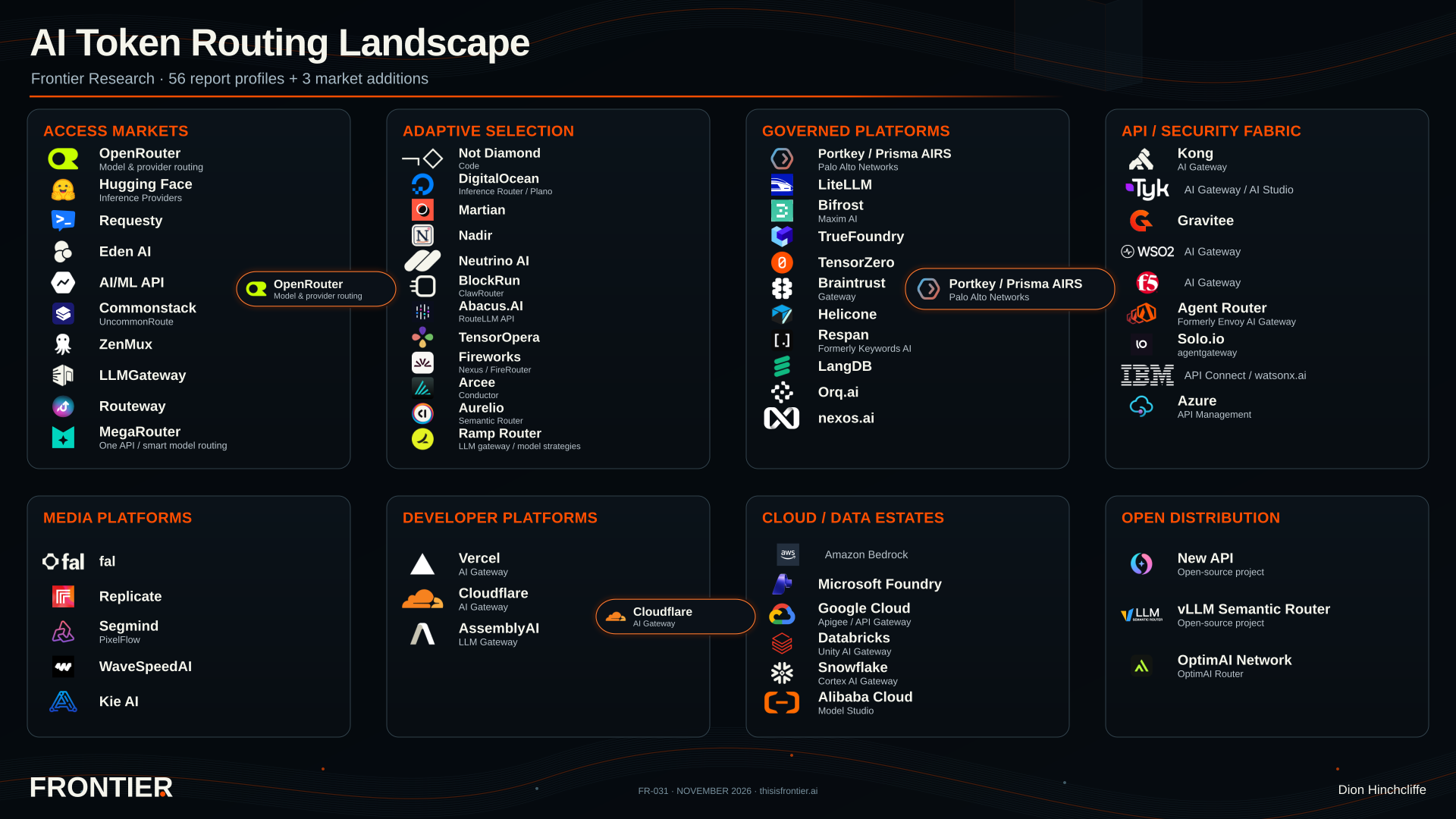
Research you can actually explore.
Interact with the source-backed market landscape, inspect individual company and project records, check logo provenance, and take the underlying data with you.
Edition 2026.11.04-r1 · Qualitative differentiation, not market share or independent security certification. Accounts, categories, logos and evidence are versioned with the dataset. Open the complete interactive view for source details.
2026 AI Token Routers: The Market Map You Can InterrogateThe AI model market is expanding faster than most enterprises can safely integrate it. The strategic question is no longer simply which model wins? It is who controls the routing decision between models, providers, credentials, regions and outcomes.
This Frontier Data Field turns the market into something you can interrogate rather than merely read: 59 AI routing offerings and projects organized into eight differentiation categories, with official brand evidence and portable structured data. It builds on the original 56-profile Frontier report, adding three separately verified November 2026 offerings. 1
What the market map reveals
Access marketplaces make model exploration faster; adaptive selectors optimize task/model choices; governed platforms, API/security fabric, and cloud/data estates draw different boundaries around authority. Developer, media and open-distribution platforms show how far beyond text chat the routing problem is spreading.
Yet a broad model catalog is not enterprise governance. A gateway can simplify integration while becoming a new point of failure, concentrated telemetry, policy drift and supplier lock-in. OpenRouter's automatic route selection illustrates one part of the capability; it does not, by itself, settle enterprise policy, outcome verification or portability. 2
MegaRouter, Ramp Router and OptimAI Router are identified as additions after the original research cutoff—not as if they appeared in FR-031. Their documented capabilities and maturity differ. 3 4 5
Three decisions for CIOs
-
Open the experimentation lane; constrain the production lane. Allow supervised model comparisons across task types, but enforce explicit approved providers, data boundaries, credentials, regions and permitted fallback behavior for operational workloads.
-
Optimize cost per accepted outcome—not the cheapest call. Demand task-based tests for quality, retry rates, latency, failure recovery, auditability and total validated work. A cheaper request that fails twice can be the more expensive route.
-
Keep routing authority inside the enterprise. Own the policies, route eligibility, outcome tests and rollback paths. Preserve portable evaluation records and an emergency direct path around the gateway.
Explore and download
Use Explore the interactive landscape above to inspect any of the 59 offerings, follow verified evidence and filter by category. The JSON-LD and CSV buttons export the same canonical records the explorer reads, including source and category annotations.
Important limits: This is a qualitative catalog, not a ranking by traffic, spend, performance or market share, nor a security certification. The 59 records are offerings and projects, not 59 independent companies. Source and logo identities are checked; vendor performance claims are not independently validated.
The complete architectural and economic argument is in Rent the Models. Own the Rules. 1
[^frontier-report][^openrouter-docs][^megarouter][^ramp-router][^optimai-router]