Yes, It’s The End of Software as We Know It
Satya Nadella’s infinite SaaS factory is a clever defense of Microsoft’s software empire. It may also be the blueprint for dismantling it.
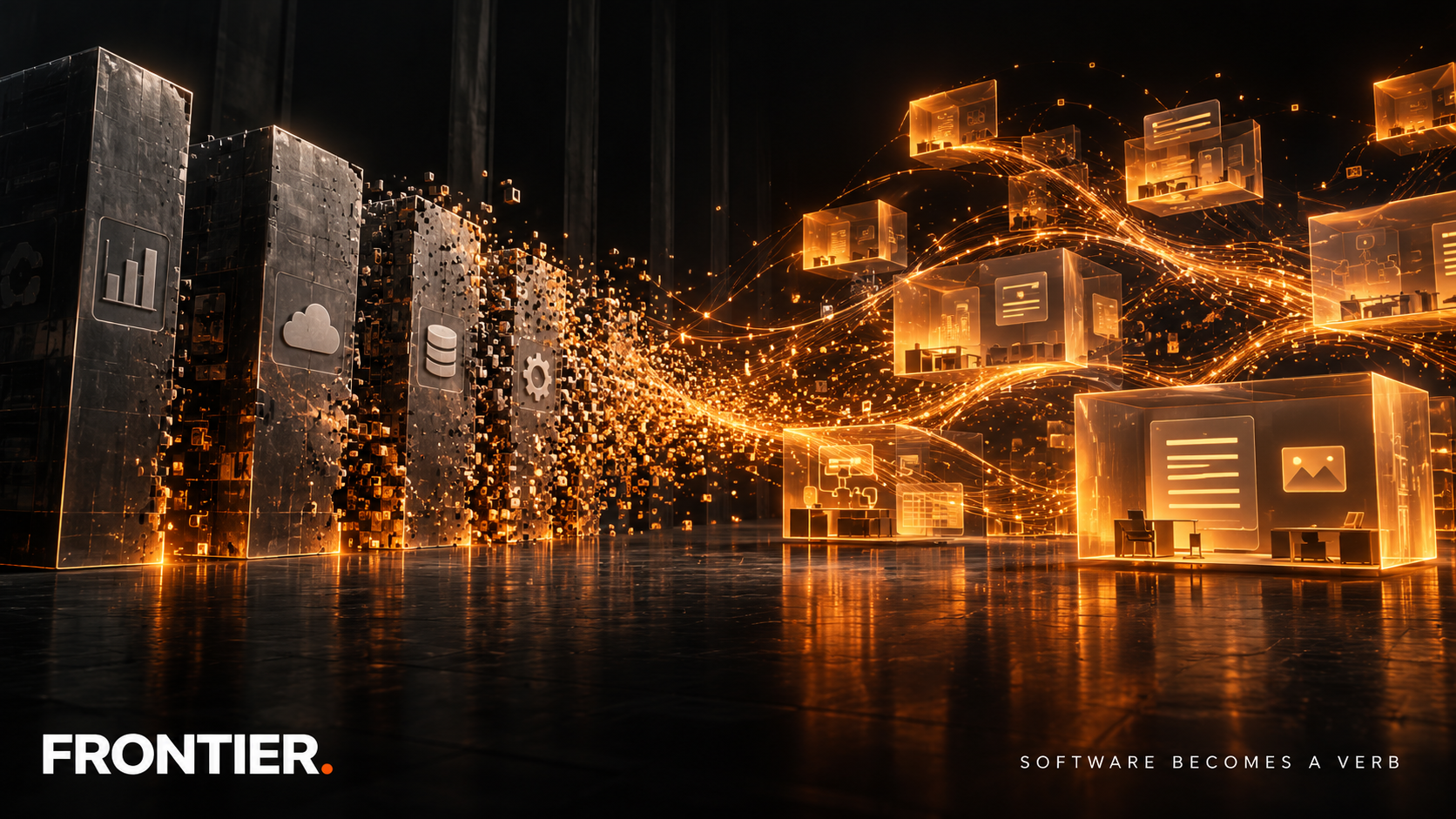
Today, October 8, Microsoft CEO Satya Nadella laid out a vision he calls the “Infinite SaaS Factory.”1 It is one of the more consequential statements about the future of enterprise software from an incumbent technology leader, not because of what it promises AI agents can do, but because of what it concedes about the applications those agents may eventually replace. Nadella is effectively arguing that software should organize itself around work, rather than forcing work to organize itself around software. That is both a compelling strategy for defending Microsoft’s enormous application franchise and a potential blueprint for dismantling its traditional economics.
The implications are staggering. For decades, enterprise software has been a scarce, expensive, relatively rigid artifact. Organizations purchased applications, configured them, integrated them, trained people to use them, and then spent years adapting their operations to what they had bought. Now imagine reversing that relationship. Instead of organizations adapting themselves to software, software continuously adapts itself to organizations. Instead of buying applications with thousands of features, enterprises assemble precisely the capabilities needed for a particular task, user, or moment. Instead of maintaining a vast portfolio of fixed interfaces, workflows, and customizations, organizations increasingly generate and regenerate them. Software becomes less a product than an executable expression of intent.
Microsoft’s brilliant defense of a disappearing boundary
Nadella’s argument begins with an observation that enterprise workers will recognize immediately: much of modern work consists of working around software. People reconstruct context across applications, move information between systems, remember which interface controls which step, and translate business intent into whatever sequence of actions each product happens to require.
Microsoft’s answer is to put Copilot in front of that complexity as a multimodel operating environment for work. Work IQ supplies business and workplace intelligence in the flow of work.2 Dynamics 365 is being recast around agentic ERP capabilities that expose business processes and operational logic to agents rather than forcing every interaction through a traditional application surface.3 Dataverse and the broader Microsoft business-app stack supply state, data, permissions, and business context. Copilot Managed Runtime gives generated code and agent execution a governed place to run.4
That is a formidable transition strategy. An agent that can draft a sales email is useful. An agent that understands contract terms, pricing rules, customer history, inventory constraints, approval authority, regulatory obligations, and the actual state of the transaction is operationally valuable. The accumulated machinery of enterprise applications still matters, even if their interfaces matter less.
But there is an unmistakable commercial calculation. Microsoft needs its enormous application franchise to remain economically relevant as more work moves to agents. Making the capabilities of those applications available as trusted context, skills, data, and execution services is a powerful way to preserve that value.
The contradiction is that this same architecture weakens the application boundary. Once business functions become accessible, composable, and independently executable, the application itself becomes negotiable. The same architecture that makes existing SaaS applications valuable to agents also makes it possible to replace those applications incrementally. There is no guarantee the applications that built the bridge will be the ones that ultimately cross it.
Every major software vendor is fighting for the same future
Microsoft is hardly alone. Salesforce is positioning Agentforce and its enterprise AI harness around trusted customer context, governed agents, and operational workflows.5 SAP is tying Joule to business data, knowledge graphs, deterministic logic, and the transactional machinery required for an autonomous enterprise.6 ServiceNow is emphasizing its role as a system of action that exposes governed work across systems.7 Workday is building an Agent System of Record intended to make AI agents governable participants in the workforce alongside people.8
The implementations differ, and vendor roadmaps are not proof that every promised architecture is complete. Permissions, interoperability, reliability, semantics, governance, and economics remain uneven. But the strategic convergence is remarkable.
Each incumbent faces the same problem. It must make its software more open, composable, and agent-accessible while preserving economic power in trusted state, context, governance, and execution. The software vendor that controls trusted business context, governed execution, and the agent’s path to action may retain considerable economic power even after users stop opening its applications.
The battle is no longer simply for the application. It is for the right to define how work gets executed.
The real disruption: Infinite execution
The phrase “infinite SaaS factory” captures an important possibility, but it understates the transformation. The more radical concept is infinite execution.
Not literally infinite compute, energy, or financial capacity. Those remain constrained, and autonomous execution introduces its own costs. Rather, it is the progressive removal of the traditional constraints on producing software capabilities.
Consider a supplier-onboarding process for European subsidiaries. Today it may require procurement-software configuration, custom forms, integrations, development requests, testing, deployment, and training. In an agentic environment, an authorized employee could describe the desired process: validate tax data, check sanctions lists, enforce regional policy, route approvals, escalate exceptions, and produce evidence for audit. The environment can increasingly assemble the functionality, interfaces, data connections, policies, tests, and execution path needed to carry it out.
The same capability might appear to one employee as conversation, to another as a spreadsheet or dashboard, to another as a mobile experience, and to a machine as an automated event with no visible interface at all. The underlying data, policies, identities, permissions, and transaction systems persist while the experience and execution path are generated around the objective.
This is the shift from software as an artifact to software as a continuously generated capability. The future application is the outcome, not the container.
The economics of software scarcity are breaking
Traditional SaaS economics depend on packaging scarce capabilities into reusable products and selling them repeatedly. Interfaces, workflows, integrations, reports, forms, and standardized application logic were expensive enough to produce that bundling them into durable products made enormous economic sense.
Agents begin to alter that equation. As tailored interfaces, workflow logic, orchestration, integrations, reports, personal workflows, and portions of application logic become cheap to generate or compose, customers can increasingly create the capability they need instead of buying another module. Agents may perform work without a human ever occupying the licensed seat that historically justified much of SaaS pricing.
That does not make everything inside an enterprise application cheap or replaceable. Durable value migrates toward business semantics, institutional knowledge, authoritative records, permissions, policies, transaction integrity, specialized networks, accountability, auditability, and governed execution.
Software becomes less a product than an executable expression of intent. The economic center of gravity moves away from owning a fixed collection of screens and toward reliably turning intent into action.
The great system-of-record argument is only half right
The strongest defense of incumbent software is that systems of record remain indispensable. That is true. Enterprises will continue to need authoritative representations of customers, employees, products, transactions, contracts, entitlements, inventory, and financial obligations.
But a system of record is a responsibility, not an eternal entitlement granted to a particular software product.
Nadella himself acknowledges that some organizations will extend existing systems while others will replace them. Once trusted state, business semantics, transaction integrity, permissions, and governance can be preserved independently, more of the surrounding application becomes replaceable. The system of record survives. The traditional application surrounding it may not.
CIOs should not underestimate the difficulty of that replacement. Mature enterprise applications encode decades of implicit business behavior: exception handling, reconciliation, regulatory interpretation, security assumptions, concurrency controls, dependencies, and undocumented edge cases. An agent can generate a plausible replacement interface in minutes. Reproducing the operational guarantees of a mature financial system is another matter entirely.
That is why the near-term architecture will be hybrid. Agents will increasingly orchestrate trusted deterministic services while selected application functions, workflows, and modules are replaced around them. Microsoft’s bridge strategy is powerful precisely because it supports that transition. But bridges can carry traffic in both directions.
When software becomes abundant, governance becomes the scarce resource
There is a paradox at the center of this transition: as software becomes easier to create, it becomes harder to control.
A company capable of generating thousands of applications, workflows, integrations, and agent execution paths cannot govern them as if each were a stable software release moving through a traditional change board. Replacing application sprawl with uncontrolled agent sprawl would be a remarkably expensive form of progress.
Governance therefore has to become executable too.
Machine-readable policies. Scoped delegation. Verifiable identities. Transaction limits. Automated testing. Continuous monitoring. Immutable audit evidence. Reversible actions where possible. Explicit human intervention where necessary.
The critical question is not whether an agent can produce a convincing action. It is whether the system can prove that the action faithfully represents authorized business intent. Deterministic software remains essential where correctness, speed, repeatability, and cost require it. Intelligence should be used where judgment creates value, without turning every consequential transaction into an improvisation by a language model or routing every decision through a human bottleneck.
The market may be right today and wrong about tomorrow
There is no contradiction in believing that incumbent SaaS vendors may benefit enormously from the first phase of agentic computing while also believing that agentic computing threatens important parts of their long-term economics.
The first generation of agents will use existing applications. They need the data, integrations, workflows, security models, and transaction systems already there. That can make incumbent platforms more valuable in the near term.
The second generation will increasingly bypass their interfaces.
The third may begin replacing selected functions, workflows, and modules.
Later generations could make the distinction between application and execution environment increasingly artificial.
That is a scenario, not a timetable or an established outcome. The pace will depend on reliability, economics, regulation, interoperability, the ability to extract business semantics from proprietary platforms, and whether generated systems can reproduce the operational guarantees enterprises actually require. But it is strategically dangerous to confuse near-term incumbent advantage with permanent application boundaries.
What CIOs should do now
The wrong response is to launch a wholesale replacement program. The equally wrong response is to assume that buying every incumbent vendor’s agentic add-on constitutes an enterprise AI strategy. Three moves matter most.
First, separate business capabilities from application boundaries. Inventory authoritative data, business rules, APIs, permissions, semantic models, and transaction dependencies. Identify where critical business meaning is trapped inside proprietary products. Treat portability of business context and execution rights as architectural objectives. The goal is not immediate replacement; it is the freedom to replace selectively when economics and reliability justify it.
Second, build an enterprise execution architecture, not another collection of AI pilots. Establish common patterns for agent identity, delegation, policy enforcement, testing, observability, cost accounting, rollback, and human escalation, with deterministic services behind consequential transactions. Measure successful business outcomes rather than agent activity or tokens consumed. If agents cannot be governed as reliably as applications, scale will simply multiply risk.
Third, renegotiate the economic relationship with software vendors. Ask what seat-based pricing means when agents perform the work, whether business logic and data can be invoked independently of the application interface, who owns generated customizations, how portable business semantics are, and whether consumption charges simply create a new form of lock-in. Test selective replacement at the periphery while preserving critical records and controls. Optionality is much cheaper to build before a vendor becomes the sole execution gateway.
The end of software scarcity
For much of computing history, the defining problem was that software was difficult to create. The industry built enormous fortunes by manufacturing reusable functionality, while enterprises built enormous organizations around acquiring, integrating, customizing, and operating it.
Agentic systems now offer a plausible route to reversing that arrangement. Producing software may cease to be the primary constraint. The harder problem becomes determining what should happen, supplying trustworthy context, enforcing authority, proving correctness, controlling economics, and turning intent into reliable outcomes.
Nadella deserves credit for looking beyond the chatbot attached to yesterday’s applications. But the deeper significance of the Infinite SaaS Factory is that it makes the application itself less fundamental. Microsoft, Salesforce, SAP, ServiceNow, and Workday may retain enormous power by controlling trusted context, state, governance, and execution—or they may discover that making those capabilities composable accelerates the unbundling of their own products.
Either way, the competitive battleground has moved.
Software will not disappear. It will become abundant enough that owning software is no longer the point. Owning the ability to turn intent into trustworthy outcomes will be.
Sources and further reading
- Satya Nadella, “The Infinite SaaS Factory” (October 8, 2026: https://x.com/satyanadella/status/2108213283144810958).
- Microsoft: Work IQ — business and workplace intelligence in the flow of work
- Microsoft: Build the future of agentic ERP with new Dynamics 365 capabilities
- Microsoft Copilot Studio: managed hosting and execution for Copilot-created code
- Salesforce: The Trusted Enterprise AI Harness
- Salesforce: The Agentic Enterprise
- SAP: The Autonomous Enterprise in Action
- SAP: The Next Era of Business AI
- ServiceNow: System of Action for AI Agents
- Workday: Agent System of Record
- Reuters: Software stocks and AI disruption
[^nadella-infinite-saas][^microsoft-work-iq][^microsoft-agentic-erp][^microsoft-runtime][^salesforce-harness][^sap-autonomous][^servicenow-action][^workday-asor]