After the 2026 Election, AI Enters the Age of Operating Accountability
A nonpartisan technology assessment of ten policy shifts, ten incoming leaders and the CIO operating model needed to compete in a potential $1.5–$3 trillion AI market by 2030.

My take on the momentous political events in the U.S. in the last 24 hours: The next major competitive advantage in artificial intelligence is now the ability to keep deploying it as the rules around it change.
The November 3 U.S. elections have substantially altered the institutions that will negotiate and determine those rules. Democrats have won control of both chambers of Congress, while a substantial set of incoming governors brings new approaches to AI infrastructure, consumer protection and economic participation. The presidency remains Republican. This is a complex shift in the distribution of policymaking authority, and quite far from the arrival of a single national AI policy.12
What follows is a technology and enterprise strategy analysis, not an assessment of which party deserved to win, why voters voted, or whose political program is preferable. Below, I evaluate each of the AI proposals by their mechanisms, implementation constraints and consequences for building and using intelligent systems going forward. An election victory establishes authority to pursue an agenda, however, it does not establish that every proposal will work or become law (far from it.)
For AI companies and CIOs, the central implication is pretty straightforward: the United States is likely to become a more demanding environment in which to demonstrate that AI creates value, assigns costs transparently and leaves someone accountable when it acts. That environment remains highly investable. But successful participation will require more than access to capable models.
Our planning estimate puts worldwide annual end-customer spending on AI products, directly purchased compute, implementation services and enterprise-owned AI hardware at right around $1.5 trillion to $3.0 trillion in 2030. The assumptions and boundaries appear below. This is a sufficiently large opportunity that withdrawing from AI because governance is difficult would be strategically a non-starter for now. Deploying without the capacity to navigate governance would be equally shortsighted.
The major task of leaders of tech firms and IT departments is to earn, and retain, the ability to operate at scale.
What the election changes—and what it cannot change overnight
The freshly-elected incoming Congress can and will change committee agendas, investigative priorities, appropriations negotiations and the prospects for proposed legislation. Senate control also changes the environment for confirming appointments. Those are highly meaningful channels of influence even when a broad AI law cannot pass.
But congressional majorities do not automatically produce a federal regulatory settlement. Under current Senate practice, ending debate on most legislation ordinarily requires 60 votes; overriding a presidential veto requires two-thirds in both chambers. New congressional leadership does not directly control executive agencies, independently elected state attorneys general, utility commissions or courts.34
This matters because the most impactful changes to enterprise AI will almost certainly arrive through different institutions and on different schedules. Example: A utility tariff can alter infrastructure economics. A state law can require a new decision-review workflow. A procurement contract can require evidence that a model provider does not yet supply. A court order can change the availability of a model or a particular use. These mechanisms should not be collapsed into a prediction that “Congress will regulate AI.”
Nor should the election be treated as an AI-specific mandate. The results establish who won office, not how much any individual issue caused that victory.
The outgoing federal policy direction already includes child protection, infrastructure impacts, intellectual property, workforce preparation and innovation, alongside a preference for national standards and preemption of some state requirements. These subjects are therefore not newly appearing because of the election. The change is in the likely balance among them, the institutions pursuing them and the compromises needed to act.5
Frontier’s base case for the next two years is continued AI investment accompanied by more distributed accountability: selective federal agreements, active state policymaking, (hotly at times) contested boundaries of authority, and greater pressure for evidence from suppliers and deployers. We do not assume a comprehensive national AI code, a nationwide development pause, or an automatic reversal of executive policy.
The ten issues most likely to change an AI operating model
The chart asks a specific question: by November 3, 2028, how likely is a new or materially expanded binding U.S. requirement in each issue area to require an operating-model change for an enterprise exposed to that activity?
“Change” in this context means a revised deployment approval, product control, human-review process, supplier contract, infrastructure commitment or reporting obligation. It includes legislation, implementing rules, utility orders and court decisions. A campaign speech, hearing or unenacted bill does not affect this model. Thus, the following are category-level probabilities for affected enterprises, not the probability that every company will face each obligation.
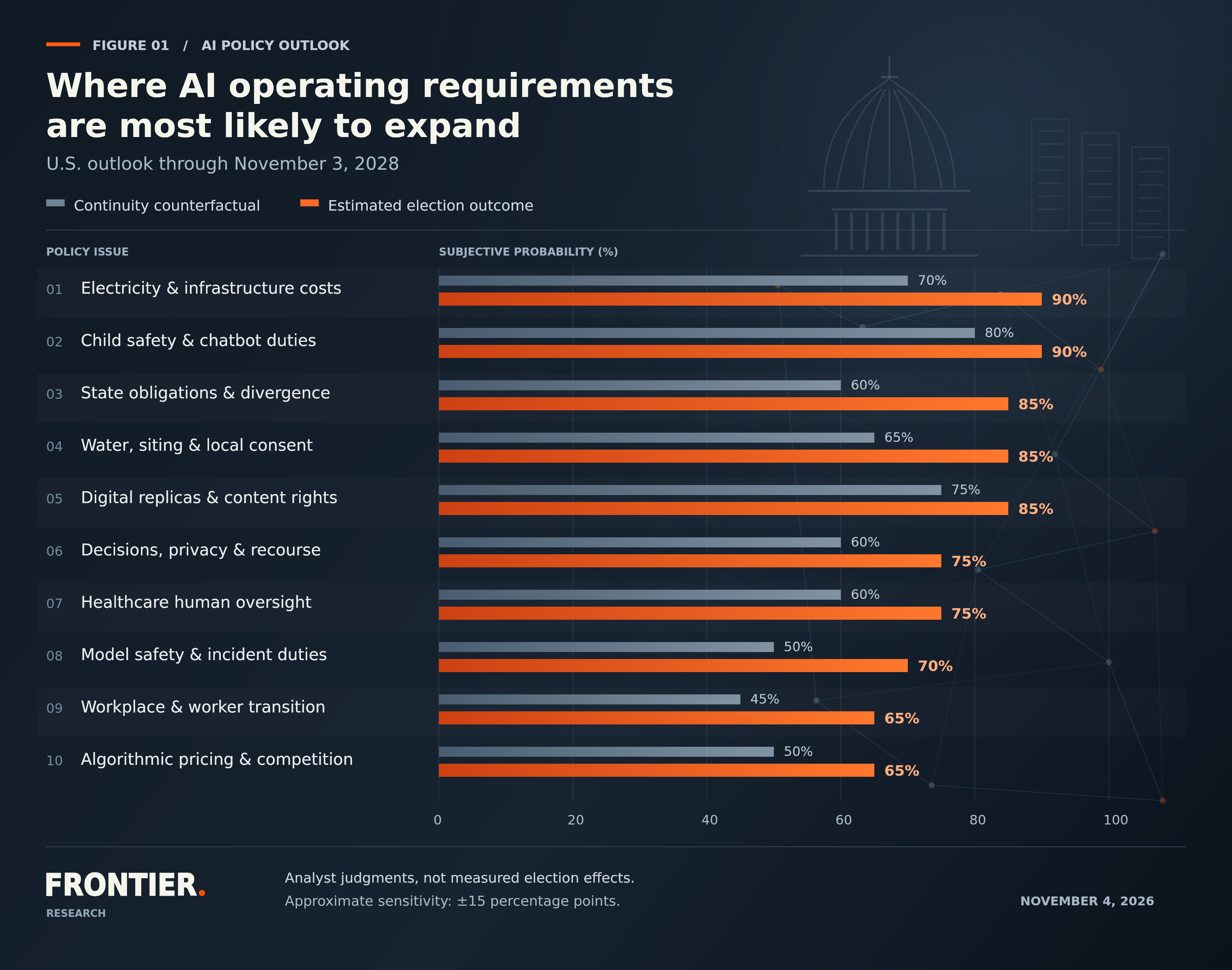
The gray bars show a counterfactual in which Republicans retained Congress and the key Republican-held state executive offices that changed hands. Orange shows the election outcome now reported. Both estimates are made today using the same underlying technology and policy evidence. The difference is a scenario comparison, not a measured causal effect of the election and not a pre-election forecast reconstructed as fact.
| Issue | Continuity scenario | Election-outcome scenario | Change |
|---|---|---|---|
| Data-center electricity and infrastructure cost allocation | 70% | 90% | +20 percentage points |
| Child safety and chatbot product duties | 80% | 90% | +10 points |
| State-specific obligations and jurisdictional divergence | 60% | 85% | +25 points |
| Data-center water, siting and local consent | 65% | 85% | +20 points |
| Digital replicas, impersonation and content rights | 75% | 85% | +10 points |
| Consequential decisions, privacy and recourse | 60% | 75% | +15 points |
| Healthcare coverage and clinical human oversight | 60% | 75% | +15 points |
| Advanced-model safety, incident reporting and liability | 50% | 70% | +20 points |
| Workplace management and worker-transition obligations | 45% | 65% | +20 points |
| Algorithmic pricing and competition controls | 50% | 65% | +15 points |
These are subjective Frontier planning judgments (ultimately based on our research judgement), rounded to five-point increments, not polling, statistical estimates or probabilities supplied by the cited sources. Treat each estimate as uncertain by approximately 15 percentage points, bounded by 0–100; that is a sensitivity allowance, not a confidence interval. Small differences between rows are not meaningful. The events overlap and the probabilities must not be added.
We assign the highest likelihood where concrete measures already exist, support spans parties and an implementation route does not depend on a comprehensive federal bargain. We increase the election-outcome estimate where incoming officials have explicit proposals and relevant authority. We temper it for presidential vetoes, Senate procedure, divided state government, litigation and administrative capacity. The chart is intended to structure investment decisions; it is not a claim that uncertainty can be eliminated.
1. Electricity and infrastructure cost allocation: an AI supply-chain issue. Incoming officials in both parties have many proposals to keep data-center expansion costs from shifting to households. Federal ratepayer legislation had already passed the House before the election, making this a continuation and potential strengthening of an existing direction.678
For operators, the practical questions are who finances interconnection, who guarantees minimum demand and who absorbs stranded infrastructure costs. For enterprise buyers, those questions can surface as capacity reservation fees, regional price differences and contract escalation clauses. Lower inference costs per task can coexist with higher costs for reliable, available capacity. CIOs should distinguish the two.
2. Child safety: product behavior becomes an operating requirement. The Cruz–Schatz CHATBOT Act advanced unanimously from Senate Commerce in August; it was a legislative proposal, not an enacted national requirement. New York separately enacted restrictions on unsafe companion-chatbot features for minors, with the sponsor reporting a June 1, 2027 effective date.910
The enterprise perimeter is wider than a consumer chatbot company. Education, entertainment, retail and family-facing services can expose minors to AI. Identity and age handling, default behavior, escalation and product testing need to work together. An age-assurance solution that unnecessarily accumulates sensitive identity data can introduce a second problem while addressing the first.
3. State authority: adaptability becomes an architectural requirement. The federal framework favors preemption of some state AI rules; the proposed GUARDRAILS Act seeks to undo the December 2025 executive order addressing state regulation. Neither position should be mistaken for a settled answer to every preemption question.511
For a multistate enterprise, the sensible response is a shared control baseline with configurable jurisdictional overlays. Determine coverage from the relevant law and transaction, not merely the location of a server. Notice language, retention, escalation and permitted uses should be configurable without rewriting the application. Election results do not themselves change the legal validity of an existing state requirement.
4. Water, siting and local consent: permission to build is part of capacity. Hinojosa, Benson and Sand have proposed varying combinations of local involvement, resource disclosure, changed tax treatment and development restrictions. These are different approaches, not a uniform nationwide moratorium.121314
Operators should distinguish announced megawatts from permitted, financed, connected capacity. Enterprises should ask suppliers what happens if a planned region opens late. Water efficiency also requires location-specific analysis: a cooling design can trade water consumption against electricity demand, and a single global sustainability label cannot resolve the local question.
5. Digital replicas and content rights: provenance becomes operational. Blackburn’s bipartisan NO FAKES work addresses unauthorized digital replicas of voice and likeness. That is separate from the copyright questions around training data and generated outputs examined by the Copyright Office.1516
Enterprises will need (sometimes hard to get) records of permission for voices, faces, creative assets and licensed datasets, along with revocation and removal processes. Model providers need defensible sourcing and contractual clarity. This category’s high likelihood reflects the range of active routes to new obligations; it does not predict that courts will rule uniformly for either AI developers or rights holders. Elections do not determine judicial outcomes.
6. Consequential decisions, privacy and recourse: the workflow matters as much as the model. Colorado’s revised automated-decision legislation specifies developer documentation duties for covered systems beginning January 1, 2027. It illustrates both the direction toward deployer-facing evidence and the need to track amended law rather than an outdated summary.17
Hiring, lending, housing and benefits systems will very likely require a traceable account of what information influenced a decision, how the system was used and how someone can contest the result. A model evaluation alone cannot establish that the surrounding process is appropriate. Human review is meaningful only if the reviewer has time, information, authority and a genuine ability to change the outcome.
7. Healthcare: automation must respect the decision boundary. The bipartisan Doctors Not AI Act proposes restrictions on AI use in health-plan claims review. Its introduction is evidence of legislative interest, not evidence that its proposed obligations already apply nationwide.18
Healthcare organizations should separate administrative assistance from consequential coverage or clinical judgments. The operational issue is not simply whether a human clicked “approve.” It is whether a qualified person independently reviewed the relevant facts, could override the recommendation and left an adequate record. Buyers should demand evaluation on their actual patient population and workflow.
8. Advanced-model safety and liability: suppliers will face stronger evidence requests. Cantwell’s October framework proposes enforceable standards, independent audits, continuous testing and incident reporting. A separate Cantwell–Rounds initiative emphasizes standards, testing capacity and defensive AI, demonstrating cross-party interest in parts of the safety agenda.1920
For model developers, this points toward more formal release evidence and incident processes. For enterprise buyers, it suggests negotiating access to evaluations, version histories, incident notices and material-change information. A provider’s general assurance about model safety does not replace controls over the tools, permissions and data an enterprise gives its agents.
9. Work and transition: two distinct obligations may develop. The No Robot Bosses proposals concern automated employment decisions and surveillance. Wyden’s October proposals address unemployment insurance, transition wages and potential data-center taxation. Protecting people from inappropriate workplace decisions is a different mechanism from financing support after displacement.2122
CIOs and CHROs should therefore maintain separate plans for managing people with AI and changing jobs through AI. Measure task redesign, redeployment, training completion and sustained productivity. Do not assume that every headcount change is attributable to AI, or that a productivity gain necessarily produces an equivalent reduction in employment.
10. Pricing and competition: inspect the data and objective function. Klobuchar’s algorithmic-collusion proposal addresses competition risks from pricing systems. The FTC’s surveillance-pricing work examines the use of personal data in individualized pricing. These are related but distinct issues.2324
A pricing application needs review of competitor-data inputs, sensitive customer attributes, optimization objectives and commercial effects. Ordinary demand-based pricing is not automatically collusion or unlawful personalization. Equally, outsourcing a pricing decision does not remove the buyer’s need to understand the system.
From our analysis, the most important omission from the top ten is a general tax on AI use. Taxing data-center operators, taxing tokens and financing worker transitions are materially different proposals. They deserve financial sensitivity analysis, but we do not make a broad new AI usage tax a base-case enterprise obligation. Comprehensive federal privacy legislation, election-media safeguards and AI competition policy also remain watch items; their relevant operating effects are partly captured in the categories above.
Ten incoming officeholders to watch
“New” here means newly elected to the office identified, not necessarily a first-time politician. These are ten of the most decision-relevant incoming officials with documented proposals and institutional leverage. The selection is not an endorsement, a prediction of personal effectiveness or a claim that an untested proposal has already proved successful. We assess the useful mechanism in each idea and the constraint on implementing it.
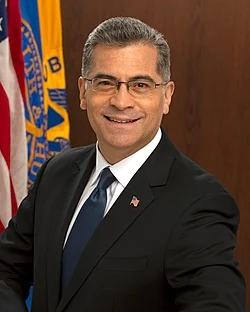 Xavier Becerra — California governor-elect, Democrat. His platform combines AI literacy through schools, libraries and community colleges with workforce support and safeguards for children and public safety. California’s institutional reach makes that combination consequential. The useful idea is to treat adoption capability and protection as parts of the same program. Watch budgets, agency appointments and specific bill language: the platform’s principles are broader than its implementation detail. Enterprise implication: anticipate demand for training partnerships and documented safeguards, not merely an additional model benchmark.2526
 Marsha Blackburn — Tennessee governor-elect, Republican. Her NO FAKES work supplies a concrete model for protecting voice and likeness while permitting AI development. Tennessee’s creative economy makes this a particularly relevant incoming executive perspective. The useful mechanism is an identifiable right, a permission boundary and a remedy. Moving to a governorship does not allow her to enact a federal bill; watch state implementation and coordination with federal sponsors. Enterprise implication: consent and provenance should be managed assets in media, marketing and customer experience.2715
 Amy Klobuchar — Minnesota governor-elect, Democrat. Her algorithmic-collusion proposal targets the use of nonpublic competitor information in pricing systems. The useful idea is to examine information flows and competitive conduct rather than presume that every algorithmic price is problematic. As governor, her tools become state legislation, appointments and administration; federal sponsorship does not transfer automatically. Enterprise implication: pricing vendors should be able to explain their data sources and safeguards before a purchasing organization entrusts them with commercial decisions.2823
 Gina Hinojosa — Texas governor-elect, Democrat. Her campaign proposed stronger local bargaining power over data centers, resource transparency, household utility protections and a temporary pause tied to legislative action. The useful mechanism is making infrastructure terms visible before communities and customers incur costs. Implementation depends on Texas law, the legislature and relevant regulators. Enterprise implication: reassess Texas capacity assumptions and project conditions, without assuming existing contracts or facilities are automatically invalidated by the election.212
 James Talarico — U.S. senator-elect, Texas, Democrat. His data-center plan includes federal minimum protections, infrastructure cost responsibility, local decision-making and closed-loop water systems. The useful idea is a clearer floor for development terms across competing jurisdictions. Some proposals, including changes to Texas tax exemptions, require state action rather than a senator’s unilateral authority. Enterprise implication: expect closer scrutiny of resource accounting; evaluate water proposals against engineering evidence and local conditions.212
 Byron Donalds — Florida governor-elect, Republican. His Protecting Ratepayers Act proposes requiring data centers to obtain power and water independently of public infrastructure. The useful principle is cost responsibility alongside continued development. The proposed mechanism is more stringent than simply paying an appropriate grid tariff, and its feasibility depends on reliability, siting and engineering. It is not a current blanket operating mandate. Enterprise implication: compare independent supply, dedicated infrastructure and regulated tariffs rather than assume that a pro-development position means inexpensive unrestricted access.297
 Jocelyn Benson — Michigan governor-elect, Democrat. Her September campaign announcement called for a data-center moratorium, ending tax breaks and protections against higher household electricity bills. The useful strategic question is what enforceable conditions permit development to resume or proceed. The duration, scope and legal route of any pause matter more than the label. Enterprise implication: treat proposed capacity separately from operational capacity and make regional substitution a procurement requirement.3013
 Rob Sand — Iowa governor-elect, Democrat. Sand’s plan includes full infrastructure cost recovery, integrated resource planning, resource-use disclosure, public hearings and workforce commitments. It is unusually specific about the information needed to evaluate a project. The useful idea is a measurable development bargain; promised employment and tax benefits can be compared with resource and infrastructure costs. Legislative agreement remains necessary for major parts. Enterprise implication: expect a stronger demand for auditable project economics, not just a high-level sustainability pledge.214
 Roy Cooper — U.S. senator-elect, North Carolina, Democrat. Cooper proposes full payment of data-center energy costs, encourages new supply and supports grid modernization and community involvement. The useful mechanism is connecting growth with additional infrastructure rather than treating electricity as an unlimited input. A senator can shape federal policy but does not set every state utility rate. Enterprise implication: capacity commitments should disclose the assumptions about new generation, grid upgrades and who pays if demand disappoints.28
 Aaron Ford — Nevada governor-elect, Democrat. Ford has proposed expanding consumer-protection representation at the state utility commission and imposing stronger conditions on data-center development. The useful idea is institutional: ratepayer protection needs regulatory capacity and expertise as well as a promise. Commission changes and new requirements depend on legislation and lawful administrative processes. Enterprise implication: watch commission appointments, rate proceedings and project-specific conditions alongside gubernatorial announcements.3132
Portrait credits: Gina Hinojosa — Jpardo210; James Talarico — Antonioaesparza, CC BY-SA 4.0, displayed cropped. Other portraits: public domain or CC0, via Wikimedia Commons.
This list tends to emphasize actionable mechanisms, not rhetorical intensity. It also does not replace monitoring of established congressional actors. Cantwell, Wyden, Schatz, Cruz and others already hold substantive AI portfolios. Incoming leadership assignments will matter a lot here next few months.
A separate boundary case is Michigan senator-elect Abdul El-Sayed’s proposal to prohibit artificial superintelligence and recursive self-improvement. It belongs in a low-likelihood, but high-impact scenario, not in a claim about a uniform Democratic agenda. Enterprises should monitor defined capability restrictions and emergency powers without treating the most expansive proposal as the expected national settlement.33
What this means for the AI industry’s business models
The likely effects differ across the stack.
For frontier-model developers, the growing commercial requirement is to supply evidence alongside intelligence. Customers will ask not just what a model can do, but which version was tested, under what conditions, what changed and what happens after an incident. The ability to support those answers consistently could become a source of differentiation.
For hyperscalers and data-center operators, infrastructure cost allocation and development timelines become more visible components of product economics. Greater disclosure and explicit cost recovery can raise near-term project costs while also improving the predictability of a project that has secured durable local agreement. The net effect depends on design and execution; “more rules” alone does not tell an investor whether a project becomes more or less viable.
For application vendors, the risk is selling workflow automation that cannot support the buyer’s obligations. An enterprise may need an appeal path, consent record or independent clinical review that the model supplier does not provide. Products that make those functions usable can gain adoption even if their underlying model is not the highest-scoring one.
For smaller suppliers, proportionate requirements matter. Expensive fixed compliance costs can favor incumbents; interoperable evidence standards and reusable assessments can reduce the burden. Buyers should ask whether their procurement rules improve outcomes or merely reward the vendor with the largest compliance department.
For enterprise users, the responsibility boundary becomes critical. Model providers control training and model releases; cloud operators control infrastructure; application vendors control product behavior; enterprises control many deployment choices, permissions and business decisions. Contracts can allocate duties and remedies, but cannot make the actual deployment disappear from the enterprise’s risk perimeter.
The strategic opportunity is therefore broader than compliance software. It includes efficient inference, verifiable agents, better identity systems, decision-review tooling, workforce enablement and infrastructure that can demonstrate a sound economic bargain.
Bounding the 2030 opportunity without counting the same dollar three times
As I mentioned above, Frontier’s planning range is $1.5 trillion–$3.0 trillion in worldwide annual end-customer AI spending in 2030, with a central scenario of approximately $2.25 trillion, expressed in nominal U.S. dollars. This is an original scenario estimate developed for this analysis, not an audited market measurement or a forecast borrowed from another analyst firm.
The boundary is purchasing by businesses, public institutions and consumers for AI functionality and directly operated AI capacity. We exclude the imputed value of productivity gains, company valuations, internal employee payroll and cumulative capital investment. We count cloud and model services only when purchased directly by the end customer; compute embedded in a purchased application is already part of that application’s price.
| Non-overlapping spending category | Lower scenario | Upper scenario | Principal assumption |
|---|---|---|---|
| AI applications and agent services | $650B | $1,250B | Paid human use plus separately purchased workflow automation |
| Directly purchased AI compute and model services | $450B | $900B | End-customer training and inference purchases; excludes application vendors’ inputs |
| External implementation, assurance and change services | $200B | $450B | Integration and operating change purchased from outside suppliers |
| Enterprise-owned AI hardware | $200B | $400B | End-user purchases for self-operated AI; excludes cloud-provider equipment |
| Total annual spending in 2030 | $1,500B | $3,000B | Scenario sum; midpoint $2,250B |
For applications, the lower case assumes about one billion paid user-equivalents at $300 annually, plus $350 billion in separately purchased workflow services. The upper case assumes 1.5 billion at $500 annually, plus $500 billion in workflow services. These are explicit adoption and expenditure assumptions, not observed current user counts. A user-equivalent normalizes spending; it is not a claim about unique people.
For direct compute and model services, illustrative demand of 50 million organizational workload-equivalents spending $9,000–$18,000 annually produces $450 billion–$900 billion. That unit spans small deployments and fractions of much larger ones; it is a modeling device, not a count of firms. External services assume roughly 18%–21% of application-plus-direct-compute spending. Enterprise-owned equipment assumes four million purchasing-equivalents at $50,000–$100,000 annually. These deliberately broad assumptions make the estimate inspectable and revisable.
Physical investment provides a scale check, not a number to add. The IEA’s 2026 review reports more than $400 billion of capital expenditure by the largest technology companies in 2025 and a projected further increase in 2026; that expenditure is not all AI. McKinsey’s estimate of $6.7 trillion in global data-center investment through 2030 is cumulative and also broader than an annual AI revenue measure.3435
The lower case assumes falling unit prices, slower workflow adoption and infrastructure constraints. The upper case requires extensive paid agent deployment, useful outcomes that sustain willingness to pay, and capacity arriving in time. Neither assumes that intelligence becomes unlimited or that every announced project is completed. A severe technological, financial or regulatory disruption could put spending outside the range.
The strategic conclusion is not that every AI investment will succeed. It is that the potential market is large enough to reward organizations that can turn capability into dependable, purchasable outcomes across changing rules.
The CIO agenda: build for permission, performance and change
The next two years require an operating model that lets responsible deployment move faster. That starts with a small set of shared controls and clear decision boundaries, rather than reviewing every experiment as if it were a medical device.
In the first 30 days, map AI to business consequences and authority. Build an inventory that records the business owner, affected people, jurisdictions, model and application suppliers, data categories, tool permissions and consequential decisions. Start with production systems and procurements already in flight. The CIO owns technical completeness; business executives own the decisions made with the systems; legal and risk teams map obligations.
Classify uses by what they can do, not only by whether they contain generative AI. A low-visibility hiring model can create greater exposure than a widely used writing assistant. The immediate output should be a prioritized list of systems requiring changes, with an accountable owner and a funded remedy.
Within 60 days, make supplier evidence part of the purchase. For consequential or agentic systems, require intended-use documentation, relevant evaluations, model-change notices, incident cooperation, data-use terms, subcontractor visibility and exportable records. Negotiate who supplies evidence, how quickly, and what happens if they cannot.
Separate legal protection from operational continuity. An indemnity may help allocate losses; it does not restore an unavailable workflow. Include fallback rights, transition assistance and the ability to export business state. Do not assume models are interchangeable: validate alternatives against the same business tests before promising portability.
Within 90 days, make policy changes deployable. Put jurisdictional rules, permitted tool actions, thresholds for escalation and retention schedules into maintained configuration where appropriate. Preserve a record linking each consequential action to its model version, policy version, relevant inputs and approvals, while minimizing sensitive data.
The test is concrete: can the enterprise change a review requirement for one jurisdiction without a months-long application rewrite? Can it stop a dangerous action without disabling every useful AI function? Can it identify who was affected and provide a remedy?
Make human review a designed service. Staff it, train it, measure it and give reviewers authority. Track appeal turnaround, reversals, unresolved cases and whether reviewers simply accept automated recommendations. For lower-risk uses, avoid unnecessary queues; for high-consequence decisions, do not confuse nominal oversight with effective control.
Budget the complete unit economics. The meaningful denominator is a successful business outcome, not a token. Include compute, integration, review, exception handling, governance, security, switching and infrastructure-related charges. Reassess a use case when these costs materially erode its advantage. A modest model with a reliable process can outperform a more capable model embedded in a brittle one.
Make workforce transition part of the deployment plan. Establish a joint CIO–CHRO baseline for tasks, skills, quality and staffing. Record redeployment opportunities and training outcomes before claiming savings. Use evidence to distinguish AI effects from demand changes and broader restructuring. This improves investment decisions whether or not new transition legislation passes.
Connect infrastructure commitments to credible delivery. Before a large capacity reservation, require evidence of power access, relevant permits, water strategy, interconnection milestones and contingency regions. Stress-test both a delay and a price increase. Geographic diversity should reduce correlated exposure, not create an unmanaged collection of jurisdictions.
The board should see a small, consequential dashboard: realized value per workflow; percentage of consequential systems with complete evidence; unresolved serious incidents; appeal performance; supplier and region concentration; time required to implement a policy change; and the cost and tested readiness of fallback arrangements.
Prepare for three paths, not one political forecast
Under a negotiated federal framework, the priority will be mapping existing controls to national requirements and determining which state obligations survive. The trigger is enacted text and authoritative implementation guidance, not a press announcement.
Under continued fragmentation—our base case—the priority is maintaining common controls with jurisdictional overlays, monitoring effective dates and preserving supplier flexibility. A stalled federal bill does not imply a stalled state or sector agenda.
Under a major AI incident followed by accelerated intervention, the priority is containment, evidence preservation, communication and continuity. More capable agents make permission boundaries and tested shutdown procedures valuable even before any new rule requires them.
Across all three paths, some investments remain useful: reliable inventories, clear ownership, proportionate evaluations, consent records, meaningful review, controlled agent permissions and tested alternatives. These investments preserve options rather than betting the enterprise on one legislative outcome.
The stake in AI’s future
In my final analysis, the election will not settle any arguments over AI. Instead, it changes who has authority to negotiate the conditions under which AI expands, but that “who” is very different than it might have been after yesterday.
Those conditions will concern all-too-familiar institutional responsibilities: who pays for infrastructure, who may use personal information, who owns creative assets, who reviews a consequential decision and who responds when a system fails. AI changes their scale and speed. It does not eliminate them.
The strongest AI companies will make those responsibilities easier for customers to fulfill. The strongest enterprises will turn them into repeatable operating capabilities while continuing to experiment, invest and deploy.
I believe the model above is how organizations can retain a stake in AI’s vast long-term large future: by becoming capable of delivering its benefits under real-world conditions, including conditions that change both very frequently and in major directions.
Methodology and timing: Analysis prepared November 4, 2026 using reported race calls, official legislative and policy materials, campaign proposals and identified reporting. Race calls are not final certifications. Committee assignments, state legislative outcomes and implementation details may change. Campaign sources establish stated positions, not the truth of campaign allegations or demonstrated policy effectiveness. Forecast probabilities and the market model are Frontier judgments with explicit assumptions; cited sources do not endorse those estimates. No competing analyst-firm forecasts are used.
[^state-results][^cloture][^federal-framework][^ratepayer-vote][^cooper][^preemption][^pricing][^surveillance-pricing][^california-result][^becerra][^tennessee-result][^minnesota-result][^florida-result][^michigan-result][^nevada-result][^compute]