SAP’s TechWolf Deal and NetApp Exploration Shift the AI Contest From Features to Architecture
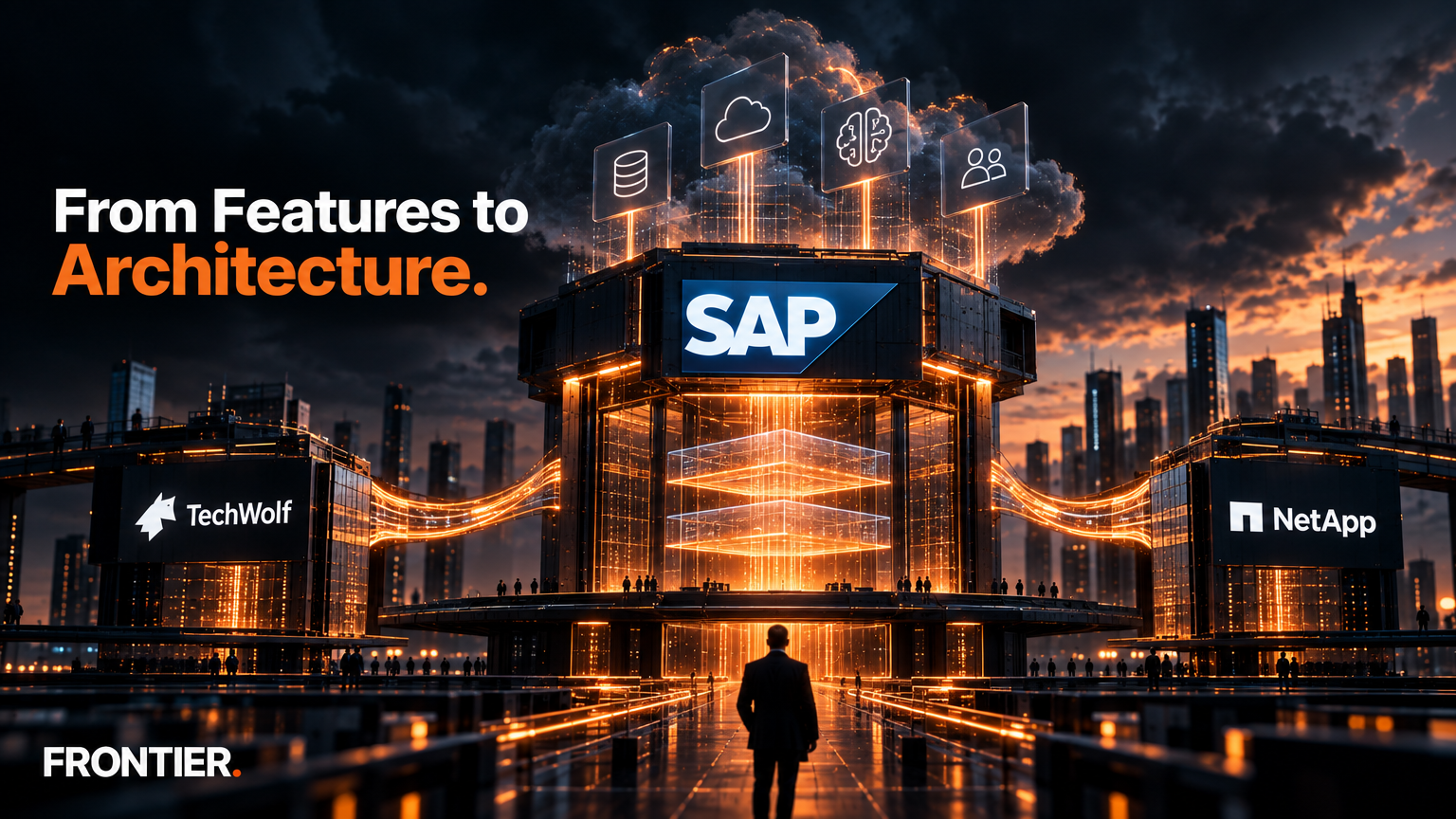
SAP has agreed to acquire TechWolf while exploring a cloud-native infrastructure integration with NetApp, extending a broader investment in cloud, data and AI. The larger shift is from buying discrete enterprise applications to selecting the architectural foundation through which data, infrastructure, AI and workforce intelligence will be governed.
What changed
SAP’s latest moves extend its AI strategy both upward into workforce intelligence and downward toward infrastructure. On October 6, 2026, SAP announced a definitive agreement to acquire TechWolf, a provider of AI-based workforce intelligence, subject to regulatory approval and other closing conditions.1 Reuters independently corroborated the agreement, reported that financial terms were not disclosed and said closing was expected in the fourth quarter of 2026.2
That agreement followed NetApp’s September 29 announcement that the two companies intend to explore deeper cloud-native integration between NetApp capabilities and SAP Cloud Infrastructure. The areas to be evaluated include object storage, but the announcement does not disclose a binding deployment contract, commercial terms or a delivery timetable.3 NetApp’s statements that a resulting integration could improve security, resilience, availability, performance and regulatory support should therefore be treated as forward-looking vendor claims, not demonstrated customer outcomes.3
These developments are part of a broader, documented expansion of SAP’s data and AI estate. SAP’s half-year regulatory disclosure records continued investment through partnerships and the completed acquisitions of Reltio, Dremio and Prior Labs.4 SAP CEO Christian Klein separately characterized AI products as a historic growth opportunity in a September interview; that is management’s strategic assessment rather than independent evidence of realized customer value.5
The financial and workforce context matters, but the record requires more precision than the original roundup supplied. SAP disclosed that it repurchased 590,000 shares from September 21 through September 25, taking the relevant tranche’s cumulative total to 8,895,886 shares.6 That figure became stale when SAP later reported another 50,000 shares purchased from September 28 through October 2, lifting the cumulative total to 8,945,886 shares.7 Reuters had previously reported that SAP announced a buyback program of up to €10 billion while pursuing accelerated cloud growth.8
The description of a job-security pact as simply “holding firm” is also incomplete. Handelsblatt reported that SAP management and the parent-company works council agreed to a framework running through the end of 2028 that includes alternative-role offers, retraining and preservation of salary levels for transferred employees.9 IG Metall, however, said the expiring employment-security agreement was not being renewed and that the replacement framework primarily governs reorganizations and severance without explicitly excluding operational dismissals.10 The defensible conclusion is that SAP has established transition protections, not preserved the previous employment-security arrangement unchanged.
SAP’s next scheduled financial checkpoint is its October 21, 2026 third-quarter results announcement, followed by an investor and analyst teleconference.11 Until SAP provides further detail, the TechWolf agreement is pending and the NetApp work remains exploratory.
Why it matters
For CIOs, the relevant decision is no longer whether SAP offers another useful AI feature. It is whether SAP can serve as the coherent architectural layer through which enterprise data, infrastructure services, AI models and workforce intelligence are assembled and governed. SAP’s completed data-platform acquisitions, proposed infrastructure integration and pending workforce-intelligence acquisition collectively support that interpretation, although they do not prove that the components already operate as one production-ready system.431
That distinction changes the evaluation model. A conventional feature comparison asks which application has the strongest functions today. An architectural evaluation asks where authoritative data will reside, which services mediate access to it, how policies propagate across layers, which components remain replaceable and whether announced integrations have enforceable delivery commitments. The analytical inference from SAP’s expansion is that these questions increasingly belong in the core platform decision rather than in separate application, data and infrastructure procurements.
CIOs should consequently separate strategic direction from deployable capability. The NetApp announcement establishes an intention to explore and evaluate integrations, including object storage; it does not establish generally available functionality, a committed date or measured service outcomes.3 Likewise, SAP has signed an agreement to acquire TechWolf, but the transaction remains subject to closing conditions.1 A roadmap can justify technical discovery, but it should not be treated as a production dependency until architecture, availability, support responsibilities and commercial obligations are documented.
The decision also becomes more consequential because integration can create both operating leverage and dependency. If application workflows, data products, storage controls and AI services are governed through one platform, enterprises may gain a more consistent architecture. That is an analytical possibility, not a reported outcome. The corresponding risk is that data access, AI execution and infrastructure choices become harder to separate during a later sourcing or modernization decision. CIOs therefore need to assess substitutability at each layer, rather than treating vendor consolidation as inherently equivalent to technical simplification.
Workforce intelligence adds another dimension. TechWolf would extend SAP’s AI position into evidence-based workforce and skills information if the acquisition closes.1 At the same time, reporting on SAP’s own workforce framework describes retraining and alternative-role mechanisms, while IG Metall emphasizes that the replacement does not reproduce the previous protection against operational dismissals.910 The CIO implication is not that SAP’s internal labor agreement predicts customer outcomes. It is that AI architecture and operating-model change must be evaluated together: a platform that informs role, skills or deployment decisions requires governance spanning technology, data stewardship, human resources and employee representation.
The investment case should therefore be based on demonstrated cross-layer outcomes rather than the number of AI announcements. Architecture fit, contractual maturity, data-control boundaries, operational accountability and workforce governance become first-order selection criteria. Individual features remain relevant, but they are no longer sufficient evidence for committing an enterprise operating model to the platform.
Frontier take
SAP’s strategic prize is not ownership of more AI features; it is becoming the control plane through which customers organize enterprise data, infrastructure and AI. That is the strongest defensible interpretation of the company’s documented direction across data acquisitions, the pending TechWolf transaction and the proposed NetApp integration.413
This assertion does not mean SAP has already delivered that control plane. The evidence instead shows the pieces moving toward convergence at different levels of maturity. Reltio, Dremio and Prior Labs are listed as completed acquisitions in SAP’s regulatory reporting.4 TechWolf is a definitive agreement subject to closing conditions.1 NetApp’s infrastructure work is an exploration without disclosed delivery commitments.3 CIOs should preserve those distinctions because strategic coherence on a vendor roadmap is not the same as operational coherence in a customer environment.
The architecture, rather than any one announcement, should organize the buying decision. A CIO considering SAP’s expanding platform should require a layer-by-layer account of systems of record, data movement, policy enforcement, identity dependencies, infrastructure interfaces, support ownership and exit paths. That analysis should identify which capabilities exist now, which depend on a completed acquisition, which remain proposed and which outcomes have been validated in production. Vendor statements about resilience, security or regulatory support should become testable acceptance criteria rather than assumed benefits.3
Capital allocation reinforces the seriousness of SAP’s strategic direction but does not validate customer economics. The company is simultaneously investing in cloud and AI assets and conducting a large share-repurchase program.48 Customers still need their own evidence that consolidation lowers operating complexity, improves control or accelerates delivery. SAP’s corporate confidence cannot substitute for an enterprise-specific business case.
The practical dividing line is architectural leverage. Enterprises that can use SAP as an extensible foundation while retaining observable interfaces, enforceable service commitments and credible substitution options may capture value from convergence. Enterprises that contract against roadmap language, blur exploratory work with available services or leave workforce governance until deployment risk turning integration into dependency. CIOs should buy the architecture that can be verified—not the narrative that merely connects its future components.
Three moves for CIOs
-
— Create a contractual maturity ledger for every cross-layer dependency Build a single architecture ledger that classifies each required SAP capability as generally available, contractually committed, acquisition-dependent or exploratory. For every dependency, record the responsible supplier, availability date, support boundary, acceptance test and fallback design. Keep proposed NetApp capabilities and TechWolf-dependent functions outside the committed production baseline until their status changes.
- Decision trigger: Require executive architecture review whenever a business case, migration wave or production launch depends on a capability without a binding delivery date, measurable acceptance criteria or named support owner.
- Why now: The NetApp work is explicitly exploratory, while the TechWolf transaction remains subject to closing conditions.31 Treating either as already delivered would convert roadmap uncertainty into enterprise execution risk.
-
— Measure control-plane concentration before approving platform consolidation Map which SAP components would control transactional records, analytical data, object storage, AI execution, identity-linked policy and administrative telemetry. For each layer, define an export mechanism, an alternative provider and the maximum acceptable cost and time for substitution. Use those results in commercial negotiations and architecture approval rather than relying on a generic multivendor policy.
- Decision trigger: Run the concentration test when one SAP program would place three or more of the application, data, infrastructure, AI or workforce-intelligence layers behind shared interfaces or commercial terms.
- Why now: SAP’s completed data acquisitions, proposed NetApp integration and pending TechWolf acquisition indicate convergence across formerly separate layers.431 The leverage and dependency created by that convergence must be evaluated before, not after, implementation.
-
— Make workforce governance an architecture gate, not a deployment workstream Establish a joint approval mechanism involving technology, data governance, HR, legal and relevant employee representatives for any SAP capability that uses skills, role or workforce data. Require documented data provenance, permitted decision uses, human-review points, retention rules and a process for challenging consequential outputs.
- Decision trigger: Activate the gate before workforce or skills information is used to recommend role changes, retraining, staffing, internal mobility or organizational restructuring.
- Why now: TechWolf would extend SAP into AI-based workforce intelligence if the transaction closes, while SAP’s own workforce framework emphasizes retraining and alternative roles amid disagreement over the extent of employment protection.1910 Architecture and organizational accountability are therefore converging.
Sources
- NetApp announcement concerning proposed SAP Cloud Infrastructure integration 3
- SAP Half-Year Report 2026 filed with the SEC 4
- SAP ninth 2026 share-buyback interim notification 6
- SAP tenth 2026 share-buyback interim notification 7
- Handelsblatt reporting on SAP's workforce framework through 2028 9
- IG Metall Heidelberg assessment of SAP's replacement reorganization framework 10
- dpa-AFX reporting on Christian Klein's AI growth statements 5
- Reuters reporting on SAP cloud growth and its announced buyback program 8
- SAP Investor Relations financial-results calendar 11
- SAP announcement of its agreement to acquire TechWolf 1
- Reuters reporting on SAP's TechWolf acquisition agreement 2
[^sap-techwolf][^reuters-techwolf][^sap-half-year-sec][^dpa-ai-interview][^sap-buyback-sep29][^sap-buyback-oct5][^reuters-jan29][^handelsblatt-oct1][^ig-metall-oct1][^sap-events]