NetApp’s Agentic AI Strategy Starts by Killing the Copy Tax
NetApp expanded AI Data Engine metadata discovery across its own and third-party storage and deepened its Commvault recovery integration, signaling a larger shift from copy-heavy AI pipelines toward governed data activation and resilience where enterprise data already resides.
What changed
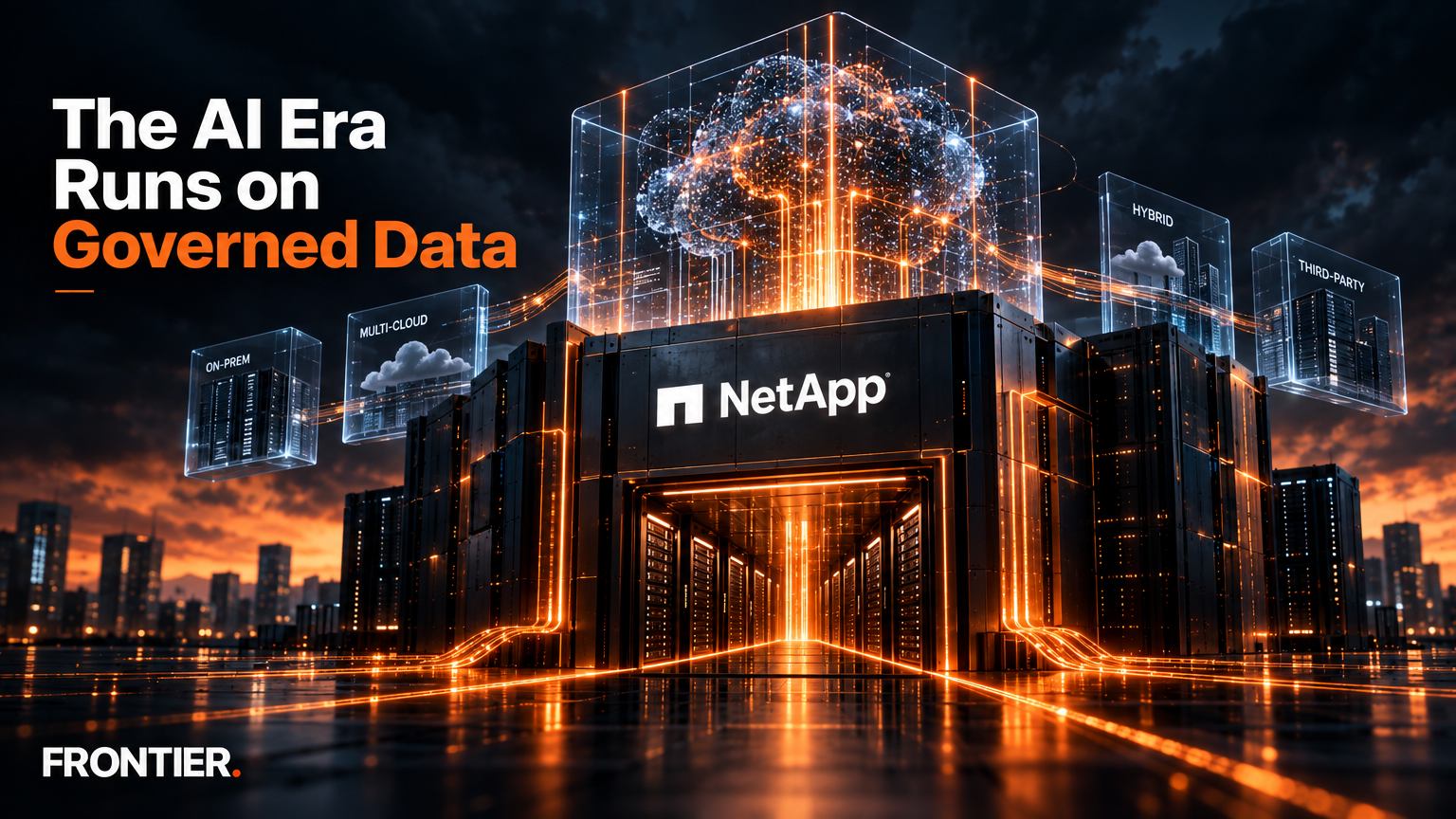
NetApp announced an expansion of AI Data Engine on September 29, 2026, extending metadata discovery across NetApp ONTAP and StorageGRID as well as non-NetApp repositories accessed through NFS, SMB and S3.1 Independent reporting from NetApp INSIGHT 2026 corroborated that the company is positioning the expanded engine around AI data preparation, governance, protection and recovery across hybrid environments.23
The immediate product change is broader discovery across heterogeneous storage. Rather than limiting AI data services to information held on a single NetApp platform, the announced architecture is intended to identify and prepare data across NetApp and third-party repositories.1 An independently hosted transcript of the event also describes the extension across ONTAP, StorageGRID and non-NetApp NFS, SMB and S3 environments.4 This matters because discovery is a prerequisite for deciding which enterprise data can be used by models or agents, under which permissions and with which recovery requirements.
NetApp characterizes the design as secure, in-place and “zero-copy,” with existing access controls preserved instead of requiring enterprises to move data into additional AI-specific pipelines.15 That is a supplier claim, not an independently demonstrated operating result. The reviewed materials do not provide independently verified customer benchmarks or production case studies establishing end-to-end zero-copy operation, governance outcomes or recovery performance at enterprise scale.231 CIOs should therefore treat zero-copy as an architectural objective to test, not a proven outcome to assume.
The announcement also connects AI data infrastructure more closely to cyber resilience. NetApp disclosed an expanded Commvault integration that links storage-layer ransomware signals with automated response, recovery and clean-recovery workflows.1 Commvault separately described a deeper integration between the companies and their joint activity at INSIGHT 2026.6 Both suppliers associate the integration with faster detection and recovery, but claims such as near-real-time detection or recovery in minutes rather than days or weeks remain supplier assertions rather than independently benchmarked results.16
Not every element of the broader vision was delivered as a generally available production capability in this announcement. NetApp described deeper governance intelligence, AI-powered understanding, integrations involving Starburst and Onehouse.AI, and new agentic services as upcoming or preview innovations.1 Semantic search, knowledge graphs and richer decision context are therefore best understood as capabilities the architecture is intended to support over time, not as evidence that NetApp delivered a complete agentic data layer on September 29. The concrete news is narrower but strategically important: broader metadata discovery and a tighter relationship between storage intelligence and recovery.
Why it matters
The CIO decision model changes because AI data access can no longer be evaluated separately from storage architecture, identity controls and cyber recovery. The conventional starting point for an AI initiative is often to identify a model or application, assemble a pipeline and copy selected data into a purpose-built environment. NetApp’s announcement advances a different architectural proposition: discover and activate data where it resides, carry forward existing access controls and coordinate its protection through the infrastructure layer.15
If that proposition proves workable in a specific enterprise estate, the first investment question is no longer simply, “Which AI data platform should we add?” It becomes, “Can our existing infrastructure expose the right data with enforceable permissions, usable metadata and tested recovery controls?” That reframing can affect sequencing. A CIO may need to fund metadata coverage, entitlement reconciliation and recovery integration before authorizing another replication pipeline. This is an analytical inference from the announced architecture, not a reported performance result.
The shift is especially consequential in hybrid environments. NetApp’s inclusion of ONTAP, StorageGRID and third-party NFS, SMB and S3 repositories acknowledges that enterprise data does not reside in one uniform system.14 Independent event coverage likewise places the announcement in the context of hybrid AI data preparation, governance and protection.23 A product’s ability to connect to multiple repositories, however, does not by itself establish consistent policy enforcement. CIOs must distinguish discovery coverage from governance completeness: finding an asset, understanding its meaning, verifying its owner, enforcing its permissions and recovering a clean version are separate controls even when a supplier presents them as one platform story.
This changes procurement criteria. Storage and data-platform evaluations should include the fidelity of metadata discovery, preservation of source permissions, auditability of agent access, behavior when permissions conflict, and recovery of both data and the context used to activate it. Conversely, an AI platform evaluation should account for how much copying it requires, which new policy boundaries each copy creates and whether those copies enter established recovery workflows. The relevant unit of analysis becomes the full path from source data to AI action and clean recovery, not the performance or feature set of an isolated component.
It also changes how CIOs should assess economics. “Zero-copy” can reduce redundant movement and associated control surfaces, but the supplied evidence does not quantify those effects independently.12 Avoided storage capacity alone would be an incomplete business case. Enterprises must include the work required to normalize metadata, resolve entitlements, validate connector behavior, monitor access and rehearse recovery. An in-place architecture may eliminate some duplication while exposing governance debt already embedded in source systems. That exposure is strategically useful, but it is not cost-free.
Finally, resilience becomes part of AI readiness rather than a downstream operational concern. The NetApp and Commvault disclosures connect ransomware signals, response and clean recovery more directly to the data infrastructure supporting AI.16 The implication is that an agent should not merely reach authorized data; the enterprise must also know whether that data and its governing context can be restored after compromise. CIO approval gates for production AI should therefore incorporate recoverability alongside model quality, security and compliance.
Frontier take
The durable shift is not “zero-copy” as a product label; it is the emergence of hybrid data infrastructure as the governance and resilience plane for enterprise AI. That is the strongest defensible reading of NetApp’s announcement. Broader metadata discovery and deeper recovery integration are tangible steps toward that model, while semantic intelligence and agentic activation remain partly prospective and the claimed operational benefits remain unverified at enterprise scale.16
This distinction should organize the CIO response. A zero-copy claim is valuable only if the architecture can prove four things together: that it discovers relevant data across the actual estate, preserves effective permissions when AI services access that data, records how data is used and restores a trustworthy state after compromise. NetApp reports expanded discovery across its own and third-party repositories and an enhanced Commvault relationship, but the reviewed sources do not independently establish all four outcomes in production.123 The appropriate posture is disciplined validation rather than either wholesale acceptance or dismissal.
The announcement also exposes a boundary that CIOs should manage carefully. Metadata can provide a shared index across heterogeneous systems, but it does not automatically reconcile inconsistent classifications, stale entitlements or conflicting retention policies. Similarly, using data in place can preserve source controls, but it can also make the quality of those controls decisive. These are analytical implications of the architecture. They explain why an in-place strategy should be assessed as an enterprise control redesign, not merely as a storage optimization.
The strategic opportunity is to reduce the proliferation of AI-specific copies while making governance and recovery properties testable at the point of access. The strategic risk is to adopt an integrated platform narrative before confirming that discovery, authorization and recovery remain coherent across third-party repositories and preview-stage services. NetApp’s announcement is important because it moves storage closer to the AI control path, not because it proves that the path is complete.
CIOs should consequently make replication an explicit exception rather than an unexamined default, but only after an in-place design passes policy and recovery tests. Some workloads may still require copies for performance, isolation or transformation. The decision should be evidence-based: compare each proposed copy with a governed in-place alternative, document the control boundary it creates and verify how both designs recover. That approach captures the structural shift without depending on any single supplier’s terminology or roadmap.
Three moves for CIOs
-
— Create an AI data activation gate before approving replication Require every production AI initiative to compare its proposed replication pipeline with an in-place access design. The review should document source repositories, metadata coverage, inherited permissions, new policy boundaries created by copies, audit requirements and recovery ownership. Run the comparison on one representative workflow spanning at least two of the storage types already present in the enterprise rather than accepting a platform-level claim.
- Decision trigger: Apply the gate when a project requests a new vector store, lake, staging repository or recurring data export primarily to make existing enterprise data available to a model or agent.
- Why now: NetApp’s expanded discovery across ONTAP, StorageGRID and third-party NFS, SMB and S3 repositories makes in-place activation a concrete architecture to evaluate, but its zero-copy benefits have not been independently established.12 A decision gate converts the thesis into a testable alternative without presuming that every workload can avoid copying.
-
— Test permission fidelity, not just repository connectivity Build a control matrix that maps source entitlements to the identities used by models, agents and orchestration services. Test allowed access, denied access, entitlement changes and conflicting policies across repositories. Require evidence that the activation layer preserves effective restrictions and generates an auditable record before moving a workflow into production.
- Decision trigger: Initiate the test when metadata discovery spans more than one storage platform, when an agent can act across repositories, or when the architecture claims to preserve existing access controls.
- Why now: The announced architecture extends discovery across heterogeneous storage and is described by NetApp as preserving existing controls.15 Broader discovery increases the importance of proving that authorization remains coherent; connectivity alone is not evidence of governed activation.
-
— Add clean recovery to the AI production-readiness test Conduct a joint exercise involving infrastructure, security, data governance and AI application owners. Simulate a compromised source repository, revoke agent access, identify a clean recovery point, restore the relevant data and verify that metadata, permissions and application context remain consistent. Measure the result against internally defined objectives rather than supplier recovery claims.
- Decision trigger: Require the exercise before an AI system receives write privileges, automates consequential actions or depends on data covered by ransomware-response and recovery tooling.
- Why now: NetApp and Commvault are explicitly linking storage-layer signals with response and clean-recovery workflows, while their speed and outcome claims remain supplier assertions.16 Testing recoverability now makes resilience part of AI authorization rather than an assumption examined only after an incident.
Sources
- NetApp official announcement, September 29, 2026 1
- NetApp platform and AI data infrastructure blog 5
- Commvault disclosure concerning its NetApp integration and INSIGHT 2026 participation 6
- Investing.com report on NetApp INSIGHT 2026 announcements 2
- ITPro reporting from NetApp INSIGHT 2026 3
- Independently hosted NetApp INSIGHT 2026 transcript 4
[^netapp-release][^investing-report][^itpro-reporting][^insight-transcript][^netapp-platform-blog][^commvault-release]