The SaaSpocalypse Has Been Canceled Due to Record Sales
AI spending is growing far faster than traditional SaaS, but the evidence points to a transfer of software growth—not yet a software spending recession.
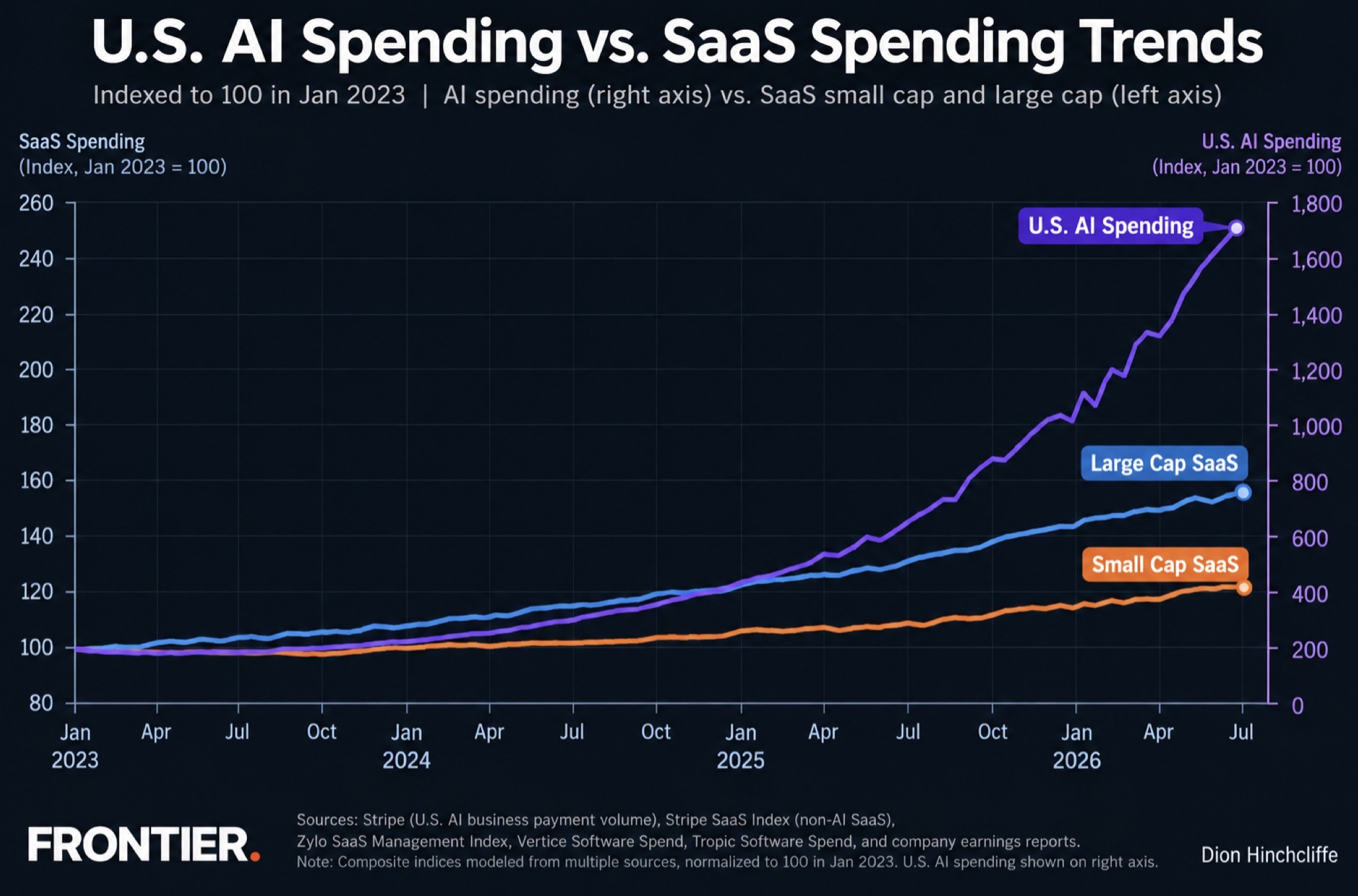
The SaaSpocalypse thesis has a problem: the spending data is moving in the opposite direction.
AI is certainly attacking portions of the software market. It is compressing the value of narrow features, challenging per-seat pricing and creating a new generation of applications that can perform work rather than merely organize it. But displacement is not the same as contraction. The evidence available in September 2026 points to a software economy expanding unevenly, with AI taking a rapidly increasing share of the incremental dollar.
That distinction matters enormously. If CIOs mistake a change in software economics for a collapse in software demand, they will optimize the wrong portfolio.
The spending divergence is the story
Stripe's analysis of the AI economy finds U.S. AI spending on its platform growing 91% year over year. The associated non-AI SaaS series cited in our composite also indicates substantial growth, rather than an outright collapse. The two measurements are not a census of all U.S. software spending: Stripe measures activity on its own payments network, and its AI and SaaS cohorts can change as companies evolve.
The accompanying Frontier chart, U.S. AI Spending vs. SaaS Spending Trends, models the direction of this divergence from January 2023 through July 2026. AI spending accelerates dramatically on its own right-hand axis. Large-cap SaaS rises more steadily, while small-cap SaaS grows more slowly. These are modeled composite indices normalized to 100, not audited national expenditure totals or directly comparable dollar series. They illustrate a hypothesis to test against company filings, not a precise estimate of market share.
The important signal is that rapid AI growth and continued SaaS growth can coexist. The more interesting question is where incremental spending is landing, and whose pricing power survives as buyers discover that intelligence can replace workflows, not merely augment them.
The incumbents are not standing still
Microsoft's fiscal fourth-quarter results provide a revealing example. Microsoft 365 commercial cloud revenue increased 14% on a reported basis while commercial seats grew approximately 6%. Microsoft also disclosed more than 30 million paid Copilot seats. Its annual filing identifies both Copilot and E5 as contributors to revenue per user. AI is part of the monetization story, but it would be analytically careless to attribute the entire difference between revenue and seat growth to Copilot.
ServiceNow's second-quarter results show another route: subscription revenue grew 24.5% year over year, while its AI offerings crossed $1 billion in annual contract value. That does not prove every AI deployment is profitable for customers. It does show that an established workflow platform can sell intelligence as an additional layer of enterprise value rather than simply defend a shrinking seat base.
Salesforce and Workday likewise frame agentic and embedded AI as material commercial opportunities. Their vendor-reported AI growth metrics warrant scrutiny because annual recurring revenue, annual contract value, net-new contract value and realized customer savings are different things. The direction of travel is meaningful; the headline percentages are not interchangeable.
Together, these cases suggest that large platforms are increasingly monetizing three things at once: installed distribution, access to proprietary workflow context and the ability to embed AI in transactions customers already trust.
Why the SaaSpocalypse argument misses the mechanism
The popular collapse narrative assumes a nearly fixed software budget. Every dollar spent on an agent must therefore come from a SaaS subscription. That may eventually describe some categories, but it is not a sufficient explanation for the present market.
Enterprises routinely fund overlapping technology generations during transitions. They retain systems of record while building new systems of engagement, automation and intelligence around them. The initial cost of an AI agent can be additive: models, orchestration, observability, security, integration and human oversight. Only later, once the new workflow is reliable and procurement catches up, can a buyer remove the application, license or labor cost it displaces.
That timing gap creates a period of simultaneous expansion and cannibalization. It also explains why the aggregate numbers can look healthy while individual software companies experience severe pressure.
The vulnerable product is not necessarily the smallest one. It is the product whose value can be reduced to a feature, an interface or a repetitive workflow that a larger platform can absorb. A specialized vendor with unique data, regulatory depth or a hard-to-replace transaction network may retain more pricing power than a much larger vendor selling undifferentiated seats.
The next margin battle is beneath the subscription
Today's visible contest is about who can sell an AI add-on. Tomorrow's contest is about who captures the economics of the completed task.
Per-seat pricing assumes that software value roughly tracks the number of people using it. Agentic systems weaken that relationship. One agent may serve hundreds of employees, execute thousands of tasks and trigger several paid systems. The economically relevant unit becomes an accepted outcome, subject to cost, reliability and accountability constraints.
That shifts the battleground toward inference cost, model routing, context access, orchestration, transaction rights and outcome verification. It also creates a dangerous procurement illusion: a lower subscription bill can be offset by higher consumption charges, integration overhead, model retries and human exception handling.
The second-order effect is architectural. Systems of record may remain durable even as their user interfaces lose strategic importance. The orchestration layer that decides what work happens, which systems are called and how results are validated may become a new locus of leverage. Large suites are racing to own that layer; independent agents and specialist vendors are trying to keep it contestable.
CIOs should therefore avoid treating this as a binary choice between traditional SaaS and AI-native software. They are purchasing a changing division of labor among systems of record, systems of intelligence and systems of action.
What would falsify this thesis?
A spending expansion is not guaranteed to last. Watch for non-AI SaaS renewal compression, sustained net revenue retention deterioration, falling seat counts that overwhelm AI attach revenue, and AI workloads that fail to produce economic returns after full operating costs. Also watch whether AI-native vendors capture the workflow or merely become a new expense line attached to incumbent platforms.
Stripe's payment cohorts are directional, not comprehensive. The chart's composite series are modeled, not independently audited. Company disclosures differ in definitions and reporting periods. These limitations matter precisely because the thesis is about the structure of a transition, not a victory lap for AI vendors.
The Frontier thesis: growth transfers before it disappears
The SaaSpocalypse is unlikely to begin as a universal software spending recession. Its more plausible first act is a transfer of incremental growth: from seats toward intelligence, from interfaces toward execution and from generic features toward proprietary context and trusted outcomes.
AI is lifting much of the software economy for now, but not equally. The first casualties may emerge while the aggregate market is still growing. That is why the right question is not whether AI will replace SaaS. It is which vendors, architectures and commercial models will capture the next dollar of enterprise value.
For CIOs, three decisions follow. First, measure fully loaded cost per accepted business outcome alongside license and token spending; a cheaper seat is irrelevant if exception handling becomes more expensive. Second, separate systems-of-record commitments from agent and orchestration commitments, and demand portable data, observable actions and exit paths before allowing a suite vendor to own both. Third, put renewal pressure on applications whose distinctive value is only a workflow interface, while protecting investments in unique data, regulated processes and hard-to-replicate integrations.
The software economy is not simply shrinking. Its center of gravity is moving.